Grassman
3 UNPREDICTABLE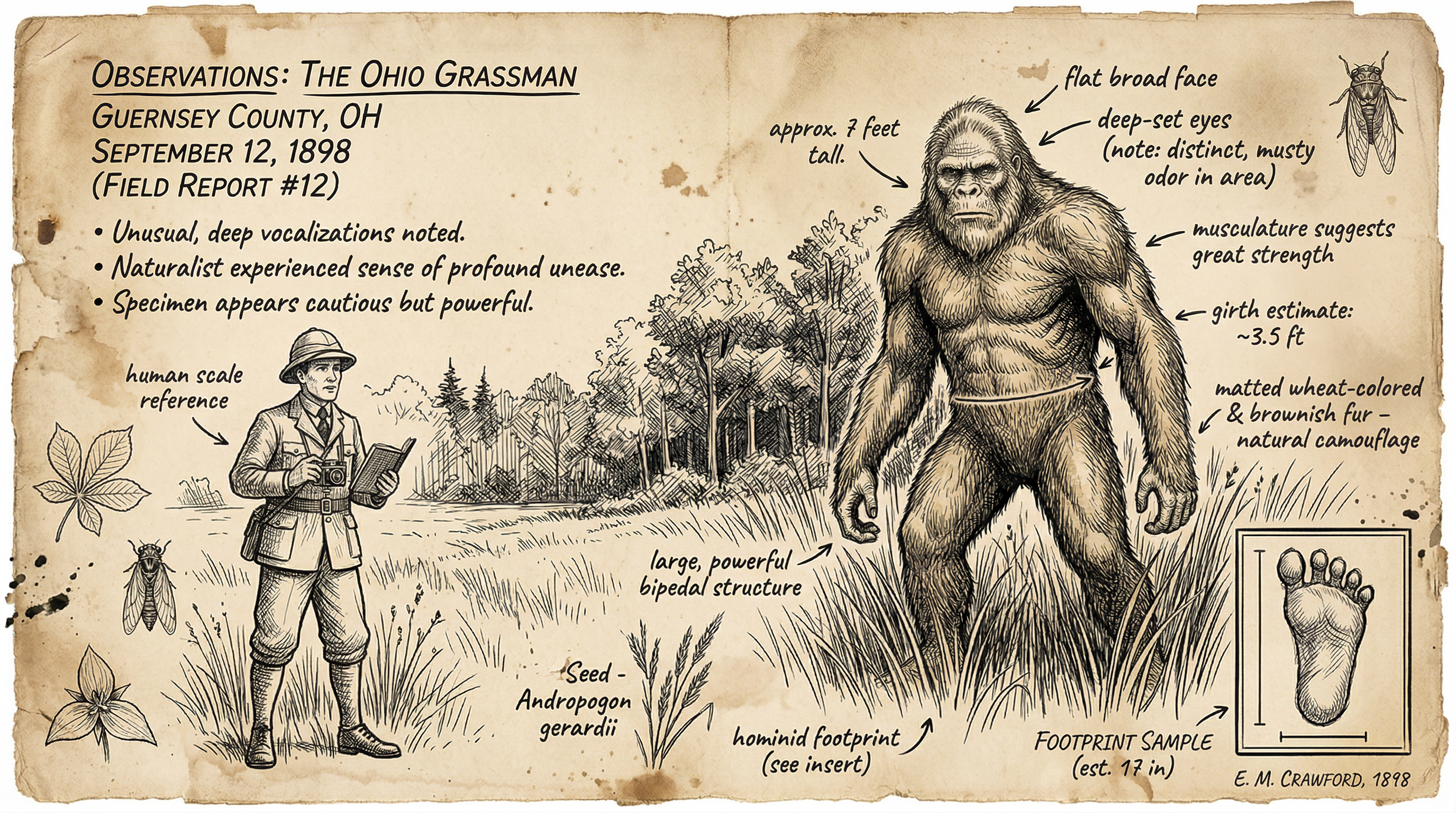
Overview
The Grassman—also known as the Ohio Grassman, Kenmore Grassman, or Orange Eyes—is a tall, muscular bipedal hominid documented across Ohio's grasslands, woodlands, and rural areas over a span of at least 150 years. The entity stands between 7 and 9 feet tall, covered in dark, matted fur, and is distinguished from other North American sasquatch reports by its reported construction of elaborate woven nests from grasses and brush, its tendency to appear in family groups rather than as a solitary creature, and its reputation for aggressive predatory behavior that extends beyond simple territorial defense.
The evidence profile for the Grassman is complicated by the intersection of indigenous oral tradition, settler-era accounts, and modern cryptozoological reports. The legend predates contemporary Bigfoot discourse by centuries, with Native American tribes—including the Shawnee, Delaware, Wyandotte, Miami, Chippewa, and Mingo—describing creatures they called the "Wild Ones of the Woods" as forest entities that warranted food offerings to maintain peace. European settlement introduced a different interpretive framework: "wild men" terrorizing the frontier. Modern sightings cluster around specific locations, most notably the Minerva area and Salt Fork State Park, suggesting either a localized population or a persistent folkloric anchor point that shapes witness expectations and reporting patterns.
Sighting History
1869, Gallipolis
The first documented newspaper account of a creature matching the Grassman description appeared in the Gallipolis Bulletin. Residents reported a nude, heavily hirsute figure described as a "wild man" terrorizing forests in the Gallipolis area. The account established the pattern of Ohio cryptid reports: a bipedal, hair-covered entity behaving in ways that suggested both intelligence and aggression. This early sighting established the geographic and temporal baseline for what would become a persistent regional phenomenon.
August 1978, Minerva Gravel Pit
The most detailed and widely documented encounter occurred near Minerva, Ohio, when the grandchildren of Evelyn and Howe Clayton, along with their friends, fled screaming from a gravel pit after spotting a large, dark-furred creature sitting among discarded trash. The entity was estimated to weigh approximately 300 pounds and was covered in matted, dark hair. When the Claytons themselves investigated, they confirmed their grandchildren's account. The family would experience multiple subsequent encounters with the creature over the following weeks.
Days before the gravel pit incident, the Claytons' German Shepherd was found dead with a broken neck, a death the family attributed to the creature. In the weeks following the initial sighting, the couple observed the creature again on a hill near a strip mine at night. Most remarkably, in broad daylight on the same hill, they witnessed two separate hairy bipeds, suggesting either a mated pair or a family unit. The Minerva case became the foundation for intensive cryptozoological investigation in Ohio and remains the most complex documented Grassman encounter.
1990s, Ohio Woodland Region
Audio recordings captured what became known as the "Ohio Howl"—a distinctive siren-like vocalization with characteristics of both a scream and a roar, recorded in Ohio's woodlands by field researcher Matt Moneymaker. The sound was reportedly heard by multiple witnesses in the area and became recognized as a signature vocalization associated with the Grassman. The audio evidence, while not definitively conclusive, provided a recorded component to the entity's behavioral profile that distinguished it from other reported sasquatch vocalizations.
2002, Bentonville
An unnamed resident of Bentonville, Ohio, discovered a large footprint in mud near their property and made a cast of the impression. The cast was subsequently examined by a primate specialist on the television program MonsterQuest, who concluded that the print bore characteristics consistent with an unknown primate species. This analysis, though not conclusive proof of the Grassman's existence, provided technical validation of at least one physical trace attributed to the entity and suggested that the footprint could not be easily dismissed as a known animal or human fabrication.
Post-2000s, Salt Fork State Park Area
Nathan Gray reported an encounter near Salt Fork State Park with a massive, nine-foot-tall figure that moved through the trees with extraordinary speed and fluidity, describing the creature's locomotion as moving "like lightning." Gray's account reignited contemporary interest in the Grassman legend and contributed to Salt Fork State Park becoming a focal point for cryptid researchers and enthusiasts. The sighting demonstrated the continued active reporting of Grassman encounters in the modern era and established Salt Fork as a primary investigation zone.
Evidence & Analysis
Contributed by Nolan Greer
The Grassman case breaks down into three categories: physical traces, behavioral reports, and audio documentation. None of it is clean.
Physical evidence: Footprint casts exist. The 2002 Bentonville cast got examined by a specialist who said "unknown primate." That's not a confirmation. That's a specialist saying "I can't identify this as a known animal." Difference matters. The Minerva incidents left footprints in mud and a dead dog with a broken neck. Anecdotal. No photographs of the prints. No hair samples. No biological material that survived to laboratory analysis. Grassy nests—allegedly massive structures built from woven grass and branches—have been reported but never recovered, documented, or verified. If something is building shelter structures to house multiple adults, there should be forensic evidence. There isn't.
Behavioral reports cluster around aggression and territoriality. The Minerva family reported a creature that watched them through windows, that killed their dog, that appeared in groups on hillsides. That's intelligence and coordination. That's also the kind of behavior that gets exaggerated in retelling. The indigenous accounts describe something different: entities that could be negotiated with through food offerings, suggesting intelligence of a different kind. The modern accounts emphasize predatory behavior. Both narratives can't be fully accurate without additional context we don't have.
Audio evidence exists in the form of the Ohio Howl—the siren-like vocalization recorded in the 1990s. Distinctive. Consistent across witness accounts. But vocalization alone doesn't establish identity. Black bears produce vocalizations that sound wrong to human ears. Elk bugles carry across distances and distort in ways that fool experienced outdoors people. Without spectral analysis, without source verification, without controlled recording conditions, the Ohio Howl is interesting data, not proof.
What you don't have: a single photograph from the modern era. No DNA. No skeletal material. No hair that's been tested and confirmed as unknown species. The Bentonville footprint cast is the closest thing to physical evidence, and that's still "unknown primate," which is not the same as "Grassman."
Geographic clustering around Minerva and Salt Fork is notable. Persistent reports from specific locations suggest either a localized population or a folklore anchor that shapes witness expectations. Both are worth investigating. Neither is proof.
Evidence quality: LOW-MODERATE. Consistent witness testimony across 150 years, one specialist-examined footprint, audio recordings, behavioral patterns that suggest intelligence. Zero physical specimens, zero photographs, zero DNA confirmation. The case is built on anecdote and audio. That's not nothing. It's also not enough.
Cultural Context
Contributed by Dr. Mara Vasquez
The Grassman legend occupies a unique position in North American cryptid tradition because it bridges indigenous oral history and European settler narrative in ways that are historically traceable and culturally significant.
The indigenous foundation is substantial. The Shawnee, Delaware, Wyandotte, Miami, Chippewa, and Mingo peoples all maintained oral traditions describing bipedal, hair-covered forest entities. What distinguishes these accounts from later European interpretations is their framing of the creature not as threat but as presence—entities that occupied the same ecological and spiritual space as human communities. The practice of leaving food offerings suggests a protocol of coexistence, a recognition that certain territories belonged to these beings and that peaceful negotiation was preferable to confrontation. This is not the same as fearing an animal. This is the maintenance of boundaries between human and non-human intelligence.
When European settlers arrived in the 1700s and 1800s, they reframed these creatures within their own cultural logic. The accounts shift from "entities we maintain peace with" to "wild men terrorizing the frontier." The 1869 Gallipolis report exemplifies this: a hairy, nude figure is presented as a threat to civilization, something to be feared and driven out rather than negotiated with. This interpretive shift reflects broader colonial anxieties about the wild spaces being "tamed" and the beings inhabiting them being either eliminated or incorporated into settler frameworks.
The modern Grassman legend synthesizes both traditions while remaining distinct from its Pacific Northwest Bigfoot cousin. The Bigfoot of Washington and Oregon is typically presented as a solitary, elusive creature—the "undiscovered ape" narrative that emerged from 20th-century cryptozoology. The Grassman appears in family groups. The Grassman builds structures. The Grassman maintains territories. These details suggest a social organization more complex than a simple relict primate population, which is either a sign of greater intelligence or a sign that the legend has absorbed elements of indigenous tradition that describe something other than an undiscovered animal.
Salt Fork State Park has become the contemporary center of Grassman culture. The location serves as pilgrimage site, research zone, and gathering point for cryptid enthusiasts. The park's role in the modern legend is not accidental—it is a space where the landscape itself becomes part of the narrative, where the creature is embedded in geography and therefore in community identity. Grassman festivals, conferences, and merchandise keep the legend alive not as historical artifact but as living cultural practice. For Ohio communities, the Grassman represents something that the farmland and suburbs have not entirely erased: the possibility that wildness persists, that intelligence exists outside human frameworks, that the boundaries between known and unknown have not been fully mapped.
This is significant. Most North American cryptids are either regional variants of continental creatures or localized folkloric oddities. The Grassman is a creature of place—rooted in specific Ohio geography, connected to specific indigenous traditions, integrated into specific community identity. Understanding it requires understanding not just the sightings but the cultural work the legend performs: it marks Ohio's wildness, it honors indigenous presence, it maintains a space for mystery in an increasingly documented world.
Field Notes
Notes by RC
I've spent time in the Minerva area. The gravel pits are still there. They're the kind of place where you can imagine something large moving through brush without being seen—the terrain is broken, there's good cover, water access. The landscape supports the reports. Whether the landscape supports the creature is different.
Salt Fork is stranger. I've been there twice, once during a Grassman research gathering and once alone. The park has that quality that attracts these kinds of legends—it's wild enough to feel genuinely separate from the surrounding farmland, but accessible enough that people actually spend time there. That combination matters. You get repeated human presence in a space that feels genuinely other. That's how legends build.
The Minerva family's account is the most credible. Specific dates, multiple witnesses, repeated encounters, a dead dog. That's not folklore—that's people reporting what happened to them. Whether what happened to them was a Grassman or something else is the question that doesn't get answered.
The Ohio Howl is real in the sense that someone recorded a vocalization that doesn't match standard wildlife. What that means is open. I've heard recordings. It's distinctive. It's also a single data point, and single data points can mean anything.
Threat Rating 3 stands. Too many consistent reports across too long a timespan to dismiss entirely. Too little physical evidence to elevate. The behavioral pattern—aggression, territoriality, intelligence—suggests something that warrants respect and caution. But respect and caution based on witness testimony, not proof.