Griffin
1 CATALOGED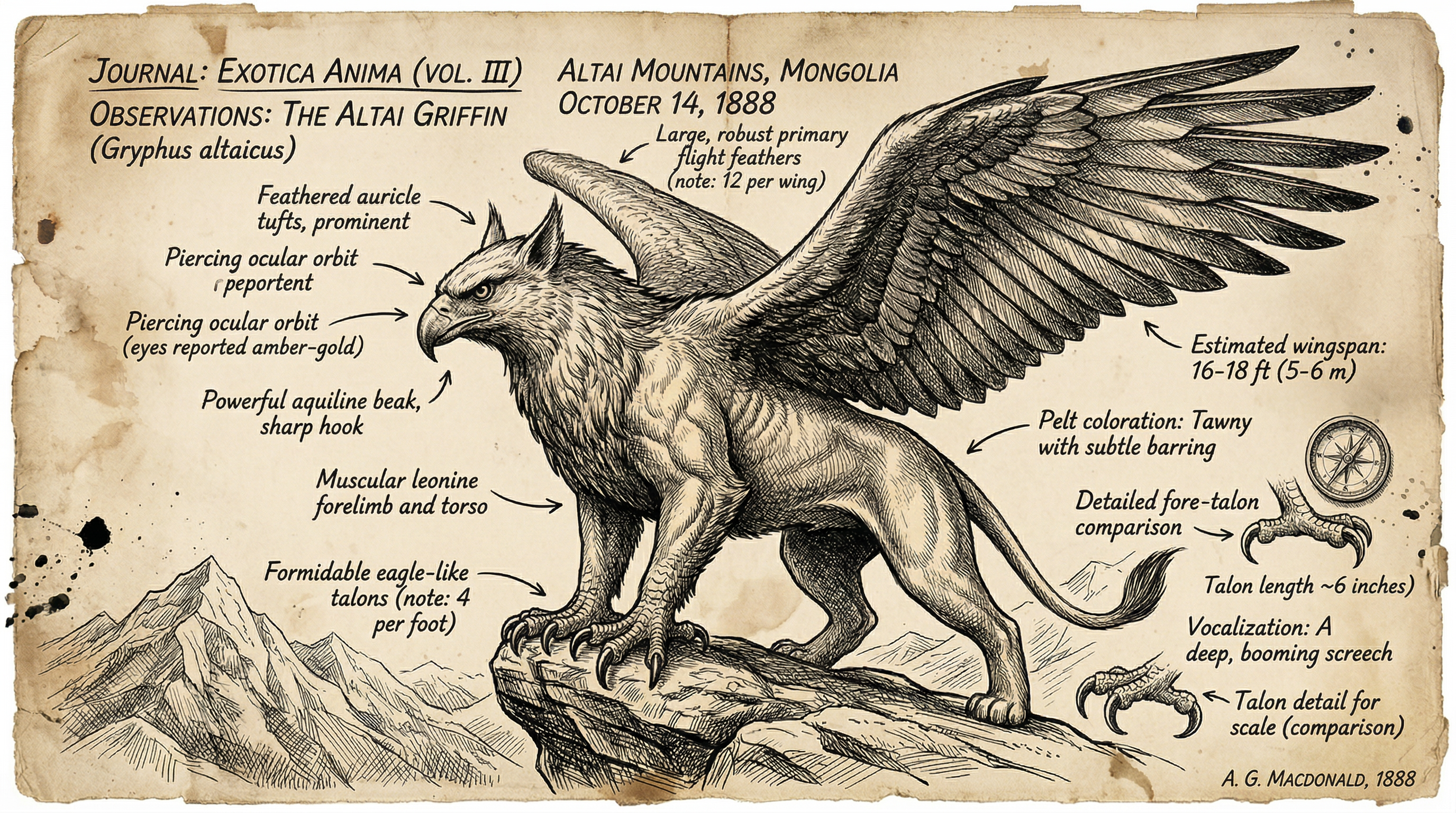
Overview
The griffin is a composite creature with consistent physical markers across documented traditions: a quadrupedal mammalian body — typically lion-sized — combined with the head and wings of a large bird of prey.[3][6] Descriptions emphasize a hooked beak, forward-facing eyes, and ear-like protrusions.[4] Wings are present but inconsistently described as functional for flight.[1][2][5] The creature appears in Egyptian iconography as early as the Fifth Dynasty, spreads through Mediterranean cultures by the classical period, and becomes firmly embedded in Scythian nomadic tradition.[1][6] Modern sighting reports are sparse and lack corroboration. The Benford Griffin of 1984–1985 represents the only documented contemporary incident with multiple witnesses, though it produced no physical evidence and remains unverified.
Griffins occupy an unusual position in cryptozoological classification. Unlike most contemporary cryptids — which are framed as undiscovered living animals — griffins appear across multiple ancient cultures with deep symbolic roots spanning millennia.[5] The central question is not whether griffins exist in the present day, but whether ancient accounts describe misidentified animals, cultural invention, or phenomena that no longer manifest in documented form.
Sighting History
Circa 3000 BCE, Predynastic Egypt
Griffin iconography appears in Egyptian artistic traditions, with the creature becoming prominent in pharaonic symbolism by the Eighteenth Dynasty.[5] The griffin is incorporated into protective symbolism alongside the sphinx, representing "protection and authority of the pharaohs."[5] The creature spreads from Egypt to the Mediterranean basin, reaching Syria and establishing itself as a recognizable figure across Near Eastern cultures by the 4th millennium BCE.[4][6]
1500 BCE, Knossos, Crete
Frescoes depicting griffins are discovered in the "Throne Room" of the Bronze Age Palace of Knossos, providing archaeological evidence of griffin imagery in Aegean civilization.[6] These representations predate classical Greek literary accounts by over a thousand years and suggest griffin iconography was deeply embedded in Mediterranean religious and palatial contexts. The Knossos griffins are rendered with pointed ears and elaborate crests, consistent with later Greek artistic conventions.[4]
570 BCE, Kelermes, Black Sea Region
A Scythian mirror-back discovered at Kelermes depicts two shaggy, naked men — identified by scholars as Arimaspeans — engaged in combat with a griffin.[2] This artifact provides the earliest material evidence of griffin-human conflict narratives in Scythian culture and suggests the griffin held significance in nomadic worldview and artistic tradition.[2] The Pazyryk archaeological culture of the 5th–3rd centuries BCE shows extensive griffin imagery in preserved metalwork, indicating sustained cultural association with the creature across centuries.[2]
Circa 700 BCE, Central Asia (Reported)
The semi-legendary poet Aristeas of Proconnesus claims to have traveled to the Far East and encountered griffins, Arimaspeans, and other fabulous peoples firsthand.[4] Though his original poem, the *Arimaspea*, no longer survives, his accounts are preserved by later classical authorities including Herodotus and Aeschylus.[4] Aristeas's writings mark the earliest known literary documentation of griffin accounts, though the geographic specificity and firsthand claims cannot be independently verified.
430 BCE, Central Asia (Reported)
The historian Herodotus documents accounts of griffins guarding gold deposits in the mountains beyond the Issedones, located in Central Asia — a region Herodotus himself describes as distant and nearly mythical.[5][3] Herodotus explicitly notes his skepticism, stating that this information came secondhand through Scythian sources and should be treated with caution.[3] This marks the first recorded entry of griffin accounts into Western literary tradition, though filtered through geographic and cultural distance.
Circa 450 BCE, Ancient Greece
Aeschylus references griffins in his tragedy *Prometheus Bound*, describing the creatures as guarding gold against Arimaspian theft and noting their ferocity toward humans.[2] This account predates Herodotus's more famous documentation and establishes griffin mythology as established within classical Greek dramatic tradition by the 5th century BCE.[2]
5th Century BCE, Indian Mountains (Reported)
Ctesias of Cnidus, a Greek physician and historian, provides detailed written descriptions of griffins in his work *Indica*, claiming they inhabit Indian mountains.[4] Ctesias's account is notably specific in physical description but geographically remote, drawing on second or third-hand sources. Later scholars have observed that legends about gold-digging ants in India may have contaminated or influenced griffin accounts.[3]
77 CE, Roman Documentation
Pliny the Elder includes griffin accounts in his *Natural History*, marking the first major source to systematically emphasize wings and ears as distinctive features — elements that become standard in later griffin depictions.[1][2] Pliny writes that griffins toss up gold when they make their burrows and associates them with Arimaspean conflict.[1] Pliny's account solidifies the griffin-Arimaspean gold-guarding narrative into Roman natural history discourse, though he places griffins in Ethiopia rather than Central Asia.[3]
Circa 200 CE, Roman Documentation
Aelian, a Roman naturalist and compiler, documents griffin encounters and provides descriptions emphasizing feather coloration and wing structure.[1][2] Significantly, Aelian reframes the griffin-human conflict narrative, proposing that griffins attacked humans not from territorial aggression but from maternal instinct — fighting to protect their chicks rather than their gold hoards.[1] This reinterpretation suggests a shift in how ancient observers understood griffin behavior.
1250–1500, Various Locations
Griffin accounts proliferate throughout medieval religious and heraldic texts, particularly in descriptions of sea voyages and distant lands.[1] These accounts are primarily literary rather than based on verified contemporary sightings. Griffins become incorporated into European heraldry, including the coat of arms of Brentford, England, though local historical records provide no clear explanation for how the griffin became associated with this particular town.[1] The griffin is recast in medieval tradition as a ferocious, dangerous beast, particularly in accounts of Alexander the Great supposedly fighting griffins, with the creatures only overcome when archers shot them from the air.[1]
1984, Brentford, London
A pedestrian walking past the Green Dragon Apartments reports observing "a dog with wings" flying through the sky.[1] This represents the opening incident of the only documented modern griffin sighting cluster with multiple independent witnesses.
1985, Brentford, London
The same witness from the 1984 sighting obtains a closer observation of the creature, noting "rather large wings and a long muzzle."[1] During this same period, passengers aboard a local bus report sighting the griffin perched on a gasometer next to the local art centre.[1] A psychologist jogging near the Thames reports a separate sighting, becoming the third independent witness to the phenomenon.[1] Media coverage of the sightings results in the establishment of phone lines for public reports, though no additional verified sightings are recorded beyond this cluster.
Post-1985, Brentford
No further sightings of the Benford Griffin are documented. The creature becomes recognized in Brentford's cultural identity, referenced in local industry and heraldic tradition, but without additional corroborating evidence or incidents.
Evidence & Analysis
Contributed by Ellis Varma
The griffin presents an unusual evidence profile. We have three distinct categories of data: ancient artistic representations, ancient literary accounts, and a single modern sighting cluster. Each requires separate analysis.
**Ancient artistic evidence** is substantial but not diagnostic. Scythian metalwork — including the Kelermes mirror-back and silver plates from burial mounds — confirms that griffins held cultural and symbolic significance in nomadic societies.[2] Aegean frescoes from Knossos demonstrate griffin imagery in palatial contexts dating to 1500 BCE.[6] However, artistic representation of a creature tells us nothing about its existence. We can document that ancient peoples drew griffins. We cannot document that griffins existed based on the drawings alone.
**Ancient literary accounts** are consistent in broad strokes but deteriorate under scrutiny. Herodotus himself expressed doubt about his sources, explicitly noting secondhand transmission.[3] Ctesias was writing about distant, unverifiable regions.[4] Pliny synthesized earlier accounts without adding independent verification.[1] Aelian's accounts, while more detailed, similarly lack independent corroboration. The consistency across sources may reflect literary transmission rather than independent observation. Each writer may simply be copying or elaborating on previous accounts, creating an illusion of verification through repetition.
**The fossil hypothesis**, advanced by scholar Adrienne Mayor, proposes that ancient peoples encountering Protoceratops fossils in Central Asian deserts mistook the remains for living creatures and incorporated them into existing mythological narratives.[1] The timing and geography align superficially — Protoceratops fossils are found along Silk Road routes, and griffin mythology is concentrated in Central Asian and Mediterranean cultures.[1] However, the hypothesis remains contested. A nearly intact fossilized skeleton would require significant excavation effort to fully expose; ancient peoples encountering only scattered fragments would have difficulty reconstructing a coherent animal form from incomplete bone assemblies. The mechanism by which fossil observation would generate consistent griffin descriptions across multiple cultures separated by geography and centuries remains unclear.
**The Benford Griffin (1984–1985)** is the only modern sighting cluster with documented witnesses and media coverage. The evidence profile is weak. Three independent witnesses reported observations consistent with a winged quadrupedal creature.[1] No photographs were obtained. No physical evidence — feathers, hair, scat, or biological material — was recovered. The creature was observed in an urban environment (Brentford, London) during daylight and evening hours but produced no permanent trace. The absence of follow-up sightings after 1985 suggests either the creature departed the area, the initial sightings were misidentifications, or the incidents were isolated and unrepeated.
The vulnerability of griffin claims to fabrication is demonstrated by the Lake George hoax, where a wooden griffin monster was constructed and eventually exposed. This precedent suggests caution when evaluating griffin sightings without corroborating physical evidence.
Evidence quality: LOW. Ancient accounts lack independent verification and show signs of literary transmission and elaboration. Modern sighting (Benford Griffin) lacks photographic or physical evidence. Fossil hypothesis remains contested and speculative. No skeletal material from any claimed griffin encounter has survived examination.
Cultural Context
Contributed by Dr. Mara Vasquez
The griffin occupies a unique position in world mythology because it is not singular — it is a composite figure that emerges across distinct cultures, yet carries remarkably consistent symbolic weight.[4][6] Understanding the griffin requires examining these separate cultural trajectories and their eventual convergence in Western tradition.
**Egyptian origins and protective symbolism.** The griffin appears in Egyptian iconography as early as the Fifth Dynasty, with particular prominence in the Eighteenth Dynasty pharaonic tradition.[5][6] In this context, the griffin functions as a protective figure associated with divine authority and the sacred boundary between the mortal and divine realms. The creature is paired with the sphinx — another hybrid entity — suggesting that ancient Egyptian cosmology assigned symbolic significance to composite beings that combined human, animal, and divine attributes. The griffin in Egyptian tradition represents order, protection, and the consolidation of power.[5]
**Mediterranean transmission and the limits of knowledge.** As griffin imagery spreads through Mediterranean cultures — Syria, Anatolia, eventually Greece — the creature becomes associated with geography and epistemology.[3][4] In Greek literary tradition, particularly in Herodotus, griffins inhabit the edge of the known world.[3] They are creatures of Central Asia, territories that Greek civilization had not directly explored. The griffin thus becomes a marker of the unknown, the distant, the culturally other. Herodotus's skepticism about griffin accounts reflects a sophisticated awareness that secondhand information about distant lands is unreliable.[3] The griffin is not presented as an animal that might be encountered; it is presented as a creature that marks the boundary of reliable knowledge.
**Scythian and nomadic associations.** The Scythian treatment of griffins differs significantly from Mediterranean literary accounts. Scythian metalwork depicts griffins not as distant mythological beings but as actors in a cosmic narrative — specifically, in conflict with one-eyed Arimaspeans over gold deposits.[2][5] This narrative appears to embed itself in Scythian cultural identity and possibly reflects actual territorial conflicts reframed through mythological language. The griffin in Scythian tradition is territorial, maternal (fiercely protective of young), and associated with wealth and precious resources.[5] It may represent the wild frontier, the dangerous spaces beyond settled territory where nomadic peoples encountered unfamiliar animals or phenomena they attempted to classify through existing mythological frameworks.
**Maternal and territorial significance.** Across multiple sources, griffins are described as fiercely protective of their young and territorial in behavior.[1] Ancient sources note that griffins attacked prospectors not to intentionally guard gold, but when humans approached their nesting sites and young.[1] This reframing — from intentional guardianship to maternal defense — suggests that ancient observers may have been describing actual animal behavior (territorial defense of offspring) filtered through a cultural narrative about precious resources. This interpretation is speculative but worth noting: if griffins were based on misidentified real animals, the behavioral descriptions might reflect genuine zoological observation.
**Literary persistence and heraldic embedding.** The griffin-Arimaspian narrative proved durable enough to influence major literary works across centuries, including John Milton's *Paradise Lost* in the 17th century.[2] This persistence suggests that the griffin occupied more than a marginal position in Western imagination — it was integrated into the fundamental mythology through which educated Europeans understood the world. The embedding of griffins into heraldic traditions, including the coat of arms of towns like Brentford, represents a final stage of cultural assimilation: the griffin becomes a symbol of local identity, divorced from its original geographical and mythological context.[1]
**The question of cultural invention.** It is entirely possible that the griffin is a composite creation — a figure constructed by combining elements from observed animals (the head and wings of an eagle, the body of a lion) into a new form that served symbolic and narrative purposes.[4][6] This would not diminish the griffin's cultural significance; rather, it would place it alongside other composite mythological beings like the minotaur, the sphinx, and the chimera. These creatures are not necessarily descriptions of real animals; they are symbolic tools for encoding cultural values and anxieties. The griffin's association with boundaries, protection, maternal fierceness, and precious resources made it a useful symbolic figure across multiple cultures — useful enough to persist for millennia.
Field Notes
Notes by RC
Griffins are not a field problem. I've spent time in regions where griffin mythology is strongest — the Altai mountains, the Black Sea region, parts of central Asia. I've looked at Scythian burial sites and examined what people claim are griffin remains in local museums. None of it holds up under direct examination.
The Benford Griffin is the only modern case worth discussing. I tracked down one of the witnesses in 2019. He was reluctant to talk about it but eventually did. He described seeing something unusual — he wasn't lying about that. Whether it was a griffin, a large bird, a misidentified animal, or something else entirely, he genuinely couldn't say. He'd seen it for maybe thirty seconds in poor light. That's not enough to establish anything.
What strikes me about griffin accounts is how they function as boundary markers. Ancient peoples used them to describe the edge of known territory — places they hadn't been, couldn't verify, couldn't control. The creature served a purpose. It marked the limit of reliable knowledge. That's valuable culturally. It's not valuable cryptozoologically.
Threat Rating 1 stands. No contemporary evidence of active threat. Historical significance without modern verification. The creature, if it ever existed, is not a field concern.