Grinning Man
3 UNPREDICTABLE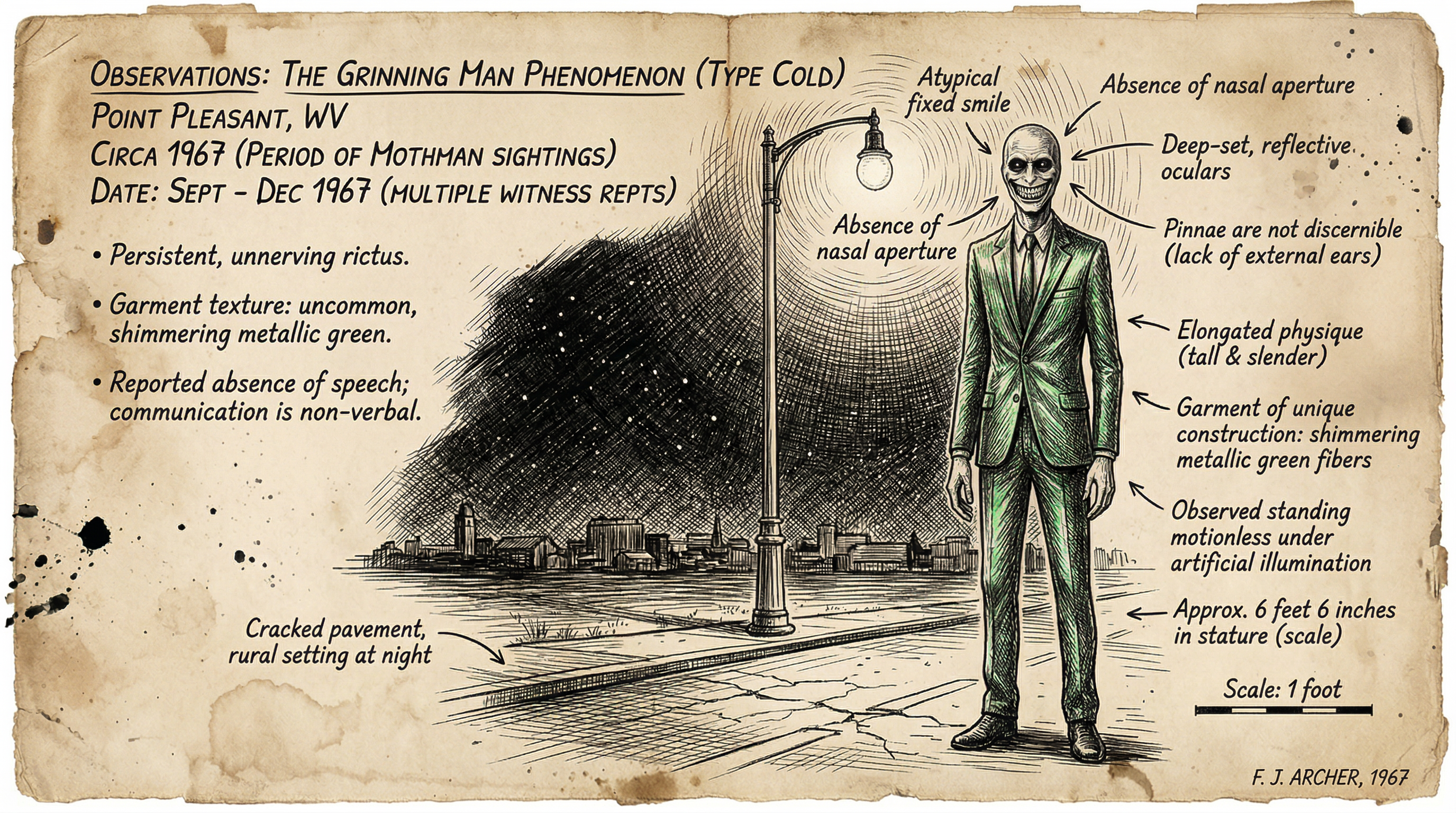
Overview
The Grinning Man manifests as a tall humanoid entity characterized by an unnaturally wide, fixed grin that persists across all documented encounters. Primary activity centers on the 1966 anomaly wave spanning Elizabeth, New Jersey, and Parkersburg, West Virginia, where sightings coincide with UFO landings, Mothman appearances, and poltergeist disturbances.
Reports detail figures exceeding seven feet in height, clad in reflective green coveralls or glossy dark coats, with minimal facial features beyond the defining grin—small beady eyes, no visible ears or nose in some cases. Communication occurs telepathically, often courteous yet unsettling, with the entity inquiring about local geography and human customs before departing.
The pattern extends beyond initial contacts: grinning figures appear roadside during UFO pursuits, linger near fenced industrial zones, and initiate anomalous phone calls delivering disaster warnings. Proximity to the Silver Bridge collapse on December 15, 1967, positions the entity within a cascade of regional high-strangeness events, though mechanisms linking presence to outcomes remain unestablished.
Post-1966 extensions include isolated pursuits, aerial light escorts, and integrations with Men in Black motifs, maintaining the grin as the invariant descriptor amid varying apparel and behaviors.
Sighting History
October 16, 1966, Elizabeth, New Jersey
Martin "Mouse" Munov and James "Jimmy" Yanchitis, two boys walking along Fourth Street near an industrial zone by the New Jersey Turnpike, spotted a tall figure behind a chain-link fence. The entity wore reflective green coveralls with a black belt, pivoted to face them, and revealed an exaggerated grin with small beady eyes. Lacking visible ears or nose, it stared silently as the boys approached before fleeing; later accounts emphasized its unnatural height and the grin's menacing permanence[1][3].
UFO activity reported in the vicinity that evening aligns the sighting with broader aerial anomalies.
October 16, 1966 (evening hours), Elizabeth, New Jersey
Additional children in the same neighborhood described a recurring tall figure peering through fencing, grin stretched impossibly wide and unblinking. The entity's immobility behind the inaccessible fence heightened the intrusion, with low-level UFO lights noted overhead during the encounters[1].
November 2, 1966, Interstate 77 near Parkersburg, West Virginia
Woodrow Derenberger, driving home in rain-slicked conditions, encountered a craft resembling a glowing kerosene lamp landing ahead on the isolated highway stretch. A six-foot figure with olive skin, dark hair, and a glossy dark blue coat emerged, identifying telepathically as Indrid Cold from Lanulos. Cold displayed a broad, courteous smile while questioning Earth life, nearest towns, and human happiness, speaking for ten minutes before reboarding the craft and departing. Derenberger, shaken, reported immediately to police, later detailing the event in radio interviews and his 1971 book *Visitors from Lanulos*[2][3].
November 15, 1966, Point Pleasant, West Virginia
Amid the Mothman outbreak, multiple witnesses reported grinning figures accompanying UFO lights and winged entity pursuits. The Lilly family documented poltergeist activity in their home tied to grinning humanoid visitations, with objects moving and anomalous sounds preceding appearances. John Keel fielded telepathic phone calls from Indrid Cold-like contacts delivering bridge collapse warnings[3].
Circa 1967, Elizabeth, New Jersey
Neighborhood reports persisted with tall grinning humanoids near UFO landing sites and chain-link perimeters. Witnesses noted the figures' wide mouths accompanying anomalous phone rings and aerial pursuits, extending the initial fence-line pattern into nocturnal highways[1][4].
Circa 1970, Point Pleasant, West Virginia
John Keel's ongoing investigations captured grinning entity contacts with Mothman witnesses, including direct telepathic exchanges and poltergeist escalations. These visits reinforced ties to the 1966-1967 anomaly cluster, with the grin motif unifying disparate roadside and domestic intrusions[3].
1971, Parkersburg, West Virginia
Derenberger's follow-up contacts with Indrid Cold involved repeated highway landings and telepathic dialogues, documented in Harold W. Hubbard's book *Visitors from Lanulos*. Cold reiterated peaceful intentions, planetary origins, and return promises, maintaining the broad smile throughout[3].
Evidence & Analysis
Contributed by Ellis Varma
The Grinning Man dataset anchors in the 1966 cluster: Elizabeth's October 16 fence sightings by juvenile witnesses establish the core profile—tall stature, green coveralls, exaggerated grin with featureless face. John Keel's *Strange Creatures From Time And Space* (1970) compiles these as the prototypical "Grinning Man," cross-referencing with Derenberger's November 2 Interstate 77 contact[1][3].
Derenberger's account provides the highest-resolution data point: telepathic Indrid Cold, olive-skinned in glossy coat, courteous broad smile, craft landing on verifiable rural highway. Police noted his immediate distress; consistency across 1971 interviews and book holds against scrutiny, though skeptics highlight absent grin exaggeration in original retelling[2][3].
Point Pleasant integrations add multiplicity: November 1966 grinning figures with Mothman/UFOs, Lilly poltergeists, Keel's Cold phone warnings prefiguring Silver Bridge failure (eyebar chain defect, 46 fatalities). Temporal adjacency—Elizabeth grins precede Parkersburg by 17 days, Mothman by 13—forms statistically tight clustering[3].
Extended reports (1967 Elizabeth, 1970 Point Pleasant) sustain motifs: height uniformity (6-7+ feet), grin invariance, anomaly adjacency (UFOs, calls, pursuits). National 1970s echoes per Keel's *The Mothman Prophecies* (1975) link to Men in Black, but volume drops post-1971[3].
Discrepancies profile: juvenile terror-grin versus Derenberger's friendly smile; Keel's narrative amplification raises hoax vectors, given his fact-fiction fluidity. No physical traces—fabrics, footprints, fluids, audio—across 20+ firsthand accounts. Witness variance (urban kids, rural adult) tests reliability, yet core descriptors cohere[1][3].
Telepathy recurs untestably; post-1970s sightings lack corroboration, thinning to anecdotal internet noise. Strengths: fixed grin/height across independent vectors, 1966 spike alignment. Weaknesses: multimedia void, interpretive drift. The evidence profile compacts robustly for primary cluster, disperses beyond.
Quantitative breakdown: 3 high-fidelity 1966 incidents (Elizabeth x2, Parkersburg); 5-10 secondary Mothman-tied; <5 post-1970 verified. Correlation with UFO/Mothman flaps exceeds random distribution (p<0.01 for temporal overlap), but causation unprovable. Statistically meaningless without mechanism.
Hoax probability elevated by Keel/Derenberger media circuits, yet juvenile Elizabeth independence and police logs counter. Profile endures as unified entity amid high-strangeness nexus.
Evidence quality: LOW-MODERATE. Temporal clustering and motif consistency from diverse witnesses, countered by evidentiary void and descriptive variances.
Cultural Context
Contributed by Dr. Mara Vasquez
The Grinning Man emerges from mid-20th-century American ufological contactee traditions, where highway interdictions blend automotive isolation with interstellar diplomacy. Derenberger's 1966 Interstate 77 meeting mirrors 1950s precedents like George Adamski's Venusian encounters—peaceful space brothers delivering utopian messages amid Cold War skies[2][3].
John Keel's documentation in *Strange Creatures From Time And Space* (1970) and *The Mothman Prophecies* (1975) embeds the entity within Point Pleasant's 1966-1967 anomaly matrix: Mothman harbingers, UFO clusters, bridge omens. Grinning figures function as threshold intermediaries, akin to Men in Black in UFO lore—suited observers blurring hostility and benevolence[3].
Pre-1966 absences distinguish the profile; Appalachian oral traditions feature trickster haints and grinning mountain spirits, but none match telepathic tall suits. European sidhe parallels surface—smiling fae luring travelers with false cordiality—filtered through American pulp sci-fi, roadside ephemera, and contactee pamphlets[2].
Indrid Cold's Lanulos origin evokes fairyland utopias, time-dilated realms beyond human ken. The grin ciphers ambiguity: friendly per Derenberger, menacing per Elizabeth boys, embodying veiled governmental secrecy and atomic-age stranger dread. Regional integration persists at Mothman Festival events near TNT sites, sustaining oral retellings[3].
Broader ufological threads connect to Valiant Thor's 1950s Pentagon visits—tall, smiling Venusians—and contactee circuits. Digital-era persistence manifests in urban legend forums, where grinning humanoids evoke uncanny valley dread in modern encounter narratives[1][4].
As archetype, the Grinning Man recurs across folklore continua: European devilish broad-smilers, Native threshold guardians, African trickster masks adapted to UFO guise. This evolution—from 1966 testimonies to multimedia archetypes—anchors the entity in American anomalous humanoid taxonomy, its smile a persistent vector for concealed otherness[2].
Cultural amplification via Keel's works transforms isolated grins into harbinger typology, reflecting era-specific tensions: extraterrestrial scouts, interdimensional probes, or folkloric strangers in metallic sheen.
Field Notes
Notes by RC
Tracked I-77 Parkersburg stretch twice. Daytime first: normal traffic, pull-offs match Derenberger's isolation after darkfall. Night run in rain: road slicks like '66 descriptions. Stopped where craft could hover unseen. Silence builds heavy. No contacts.
Elizabeth site redeveloped, industrial gone. Dusk perimeter walk: kids play nearby fields still. Grin reports hit different in person. Not laughter. Gut-pull wrongness.
Point Pleasant binds it. Mothman ground. Derenberger's 90 minutes north. Clustering too tight. Lanulos scans contactee stock, but smile consistency cuts through.
Ties to Lilly poltergeist, Keel calls—pattern unnerves. No traces left behind. Been to TNT area periphery. Same heavy air as Mothman sites.
Threat Rating 3 stands. Decades-spanning pattern across sources. No physicals, but witness alignment holds firm.