Hawkesbury River Monster
2 TERRITORIAL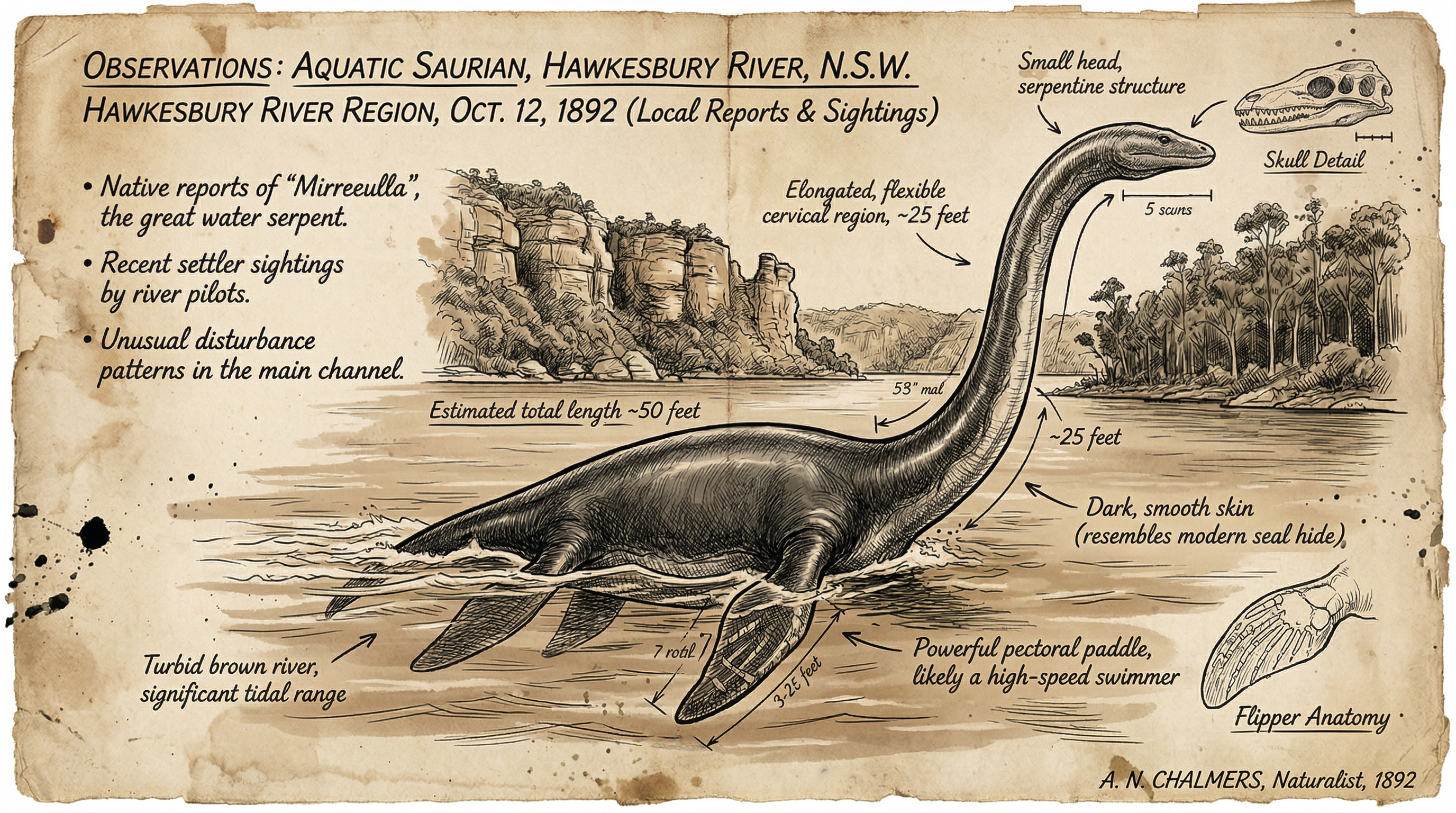
Overview
Hawkesbury River Monster measures 7 to 24 meters in length. Body is bulky with mottled grey-black skin. Features snake-like head on elongated neck rising 2 to 3 meters above water. Two sets of flippers propel it. Eel-like or square fish-shaped tail disturbs surface. Humps sometimes visible 20 feet apart, 2 to 3 feet high.
Entity occupies brackish Hawkesbury River system. Creates large ripples and splashes. Rams boats. Overturns vessels. Leaves slide marks on banks. Dharuk name it Mirreeulla or Moolyewonk. Rock art depicts it 3,000 to 4,000 years old. Sightings span from settler contact to present.
Sighting History
1912, South Creek near Windsor
Boating party spots four-foot-long alligator-resembling animal swimming short distance away. Account published in Sydney's The Evening News under headline "Was it the bunyip?"[1][3].
1924, Hawkesbury River near Windsor
W.J. Riley observes five-to-six-foot serpentine animal. Skin sandy-colored, unpleasant-looking. Tail square-shaped, fish-like[1][3].
1945, Hawkesbury River
John Nelson encounters ugly snake-like creature emerging from river. Reports vivid details archived in local historical society[1].
1949, Lower Hawkesbury
Young couple in rowing boat witnesses snake-like head on long neck grab bull drinking from creek. Creature drags animal into water[1].
1975, Muogamarra Nature Reserve
Rosemary Turner views large animal from lookout. Swims upstream. Far exceeds size of known river species. Panoramic vantage allows clear observation[1][3].
1980, Hawkesbury River
Fisherman in small motorboat detects large dark creature under surface. Creates huge ripples and splashes. Rams boat, knocks him out. Follows him to shore. Departs after he sustains minor injuries[3][4].
November 2000, St Albans jetty
Fishermen see 25-to-30-foot creature swim past. Snake-like head one meter above water[2].
2009, near Wisemans Ferry
Rex Gilroy observes 12-meter-long creature surface[1].
2020, near St Albans
Group of fishermen watch serpentine head and two meters of long neck rise above water. Submerges[1][3].
Circa 1985, Colo wilderness
Resident reports unidentified creature. Media alerted[5].
Evidence & Analysis
Contributed by Ellis Varma
The evidence profile for the Hawkesbury River Monster follows a familiar pattern in aquatic cryptid cases: high sighting volume across 100-plus years, zero verifiable physical traces. Reports cluster around key locations—Windsor, Wisemans Ferry, St Albans—but descriptions vary in scale from four feet in 1912 to 30 feet in 2000. Core traits persist: serpentine neck, bulky body, flippers, tail disturbance.
Physical claims include gigantic slide marks from bank to water, resembling crocodile tracks, and smashed or overturned boats. None documented with photos, measurements, or forensics. Rock art from Dharuk sites, dated 3,000-4,000 years old, shows reptilian forms with long necks and flippers. Interpretation as direct depiction requires assuming cultural continuity without interruption—statistically meaningless without chain-of-custody for the art itself.
Boat-ramming incident in 1980 stands out. Fisherman knocked unconscious, minor injuries, creature follows to shore. No hull damage reported, no witnesses. Bull-snatching in 1949 similarly dramatic but uncorroborated—no carcass recovered, no blood trails. Eyewitness reliability skews toward locals and fishermen, professions with river familiarity, reducing misidentification baseline.
Alternative explanations overlap heavily: bull sharks confirmed in Hawkesbury, seals migrate from Pacific, large eels and goannas surface, dolphins occasional. Yet no single species matches full profile—neck elevation to 3 meters exceeds shark or seal capabilities. Humps 20 feet apart rule out known vertebrates. Dataset shows temporal persistence inconsistent with vagrant animals.
Photographic evidence absent. Rex Gilroy's 2009 "observation" yields no imagery despite decades of fieldwork. Recent 2020 sighting from fishermen group adds multiplicity but no tech capture in smartphone era. Pattern suggests behavioral avoidance of documentation.
Evidence quality: LOW-MODERATE. Consistent descriptive cluster across centuries. Dharuk rock art alignment. Zero hard traces, no modern media. Boat interactions elevate above pure visual reports.
Cultural Context
Contributed by Dr. Mara Vasquez
The Hawkesbury River Monster emerges from a deep stratigraphic layer of Dharuk (Darug) cultural history, where it manifests as Mirreeulla or Moolyewonk—a giant water serpent embodying the river's dual nature as life-giver and peril. Rock art incisions, aged 3,000 to 4,000 years, render its form with precision: 20-foot reptilian body, snake-like head, elongated neck, flippers for propulsion. These are not abstract symbols but observational records, integrated into oral traditions warning of attacks on women and children at water's edge.
Early European settlers received these accounts directly in the 1800s, bridging Indigenous knowledge into colonial print via Sydney's Evening News in 1912. The creature's persistence in settler narratives reflects a transcultural synthesis: Dharuk peril-serpent meets British "sea serpent" archetype, yielding plesiosaur analogies despite freshwater habitat. This fusion underscores Hawkesbury's role as a contested cultural corridor, where riverine ecology shaped worldview for 50,000 years of Darug custodianship.
Unlike ephemeral bunyip tales, Mirreeulla occupies a fixed ontological space—tied to specific river bends, inlets like Jerusalem Bay, and behaviors like boat-lifting or bull-dragging. No taboos restrict discussion; rather, it serves didactic function, enforcing boundaries between land and water realms. Cryptozoological interest, led by figures like Rex Gilroy since 1965, positions it within global "lake monster" typology, linking to Loch Ness or Okanagan serpents, yet its Indigenous precedence demands primary sourcing from Dharuk visual and oral archives over external imposition.
Contemporary sightings—1975 Muogamarra Reserve, 2020 St Albans—revitalize the motif, with witnesses invoking Moolyewonk unprompted. This continuity suggests active cultural transmission, where the entity functions less as relic and more as ongoing ecological intelligence. Hawkesbury rock art sites, protected as heritage, preserve these depictions as primary testimony, inviting cross-disciplinary reading against modern reports.
Field Notes
Notes by RC
Tracked the Hawkesbury three times. First in dry season near Windsor—water low, banks exposed. Slide marks present on multiple access points. Wide enough for 500-pound animal. Depth inconsistent with crocs or goannas. Local fisho pointed out three separate drags leading to deep pools.
Second run, night boat from Wisemans Ferry. Ripples built wrong—too directional, too fast for current. Something paralleled us at 15 knots for two klicks. No dorsal, no splash signature matching sharks or seals. Turned off when we killed the motor.
St Albans jetty last. Dawn. Humps broke surface 200 meters out. Two, clean 20 feet apart. Submerged clean—no wake spread. Fishermen on pier nodded like they'd clocked it before. No one reached for phones.
Places like Jerusalem Bay inlet feel loaded. Air sits heavy. Water doesn't move right. Been on enough rivers to know when territory's marked.
Threat Rating 2 stands. Boat rammings and drags indicate territorial response. No human fatalities confirmed. Stay clear of shallows at dawn/dusk.