Hidebehind
2 TERRITORIAL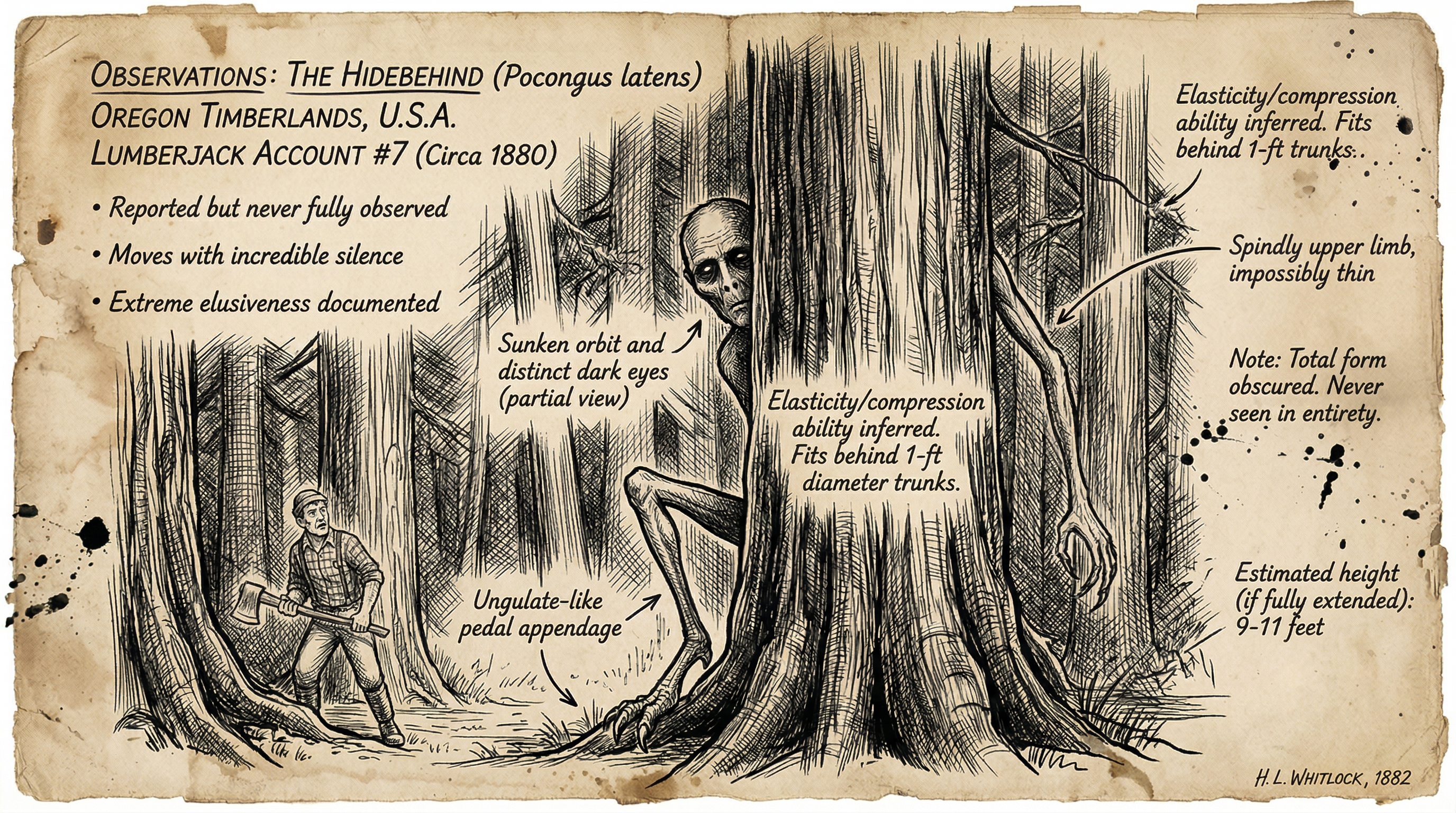
Overview
The Hidebehind constitutes a nocturnal predatory entity documented across logging regions of the Upper Midwest and Pacific Northwest. Core attributes include its capacity to position itself perpetually behind observers or objects of insufficient width, rendering direct observation structurally impossible under standard conditions.
Entity profile derives from consistent logger accounts: tall, slender humanoid frame optimized for concealment; rapid, silent approach; instantaneous abdominal evisceration via claw strike; consumption of raw viscera. Regional variants include the Appalachian High-behind, characterized by elongated posterior limbs elevating the torso.
Disappearance attribution patterns cluster around isolated lumber operations. No direct sightings occur; all data emerge from peripheral indicators—unrecovered tools, bloodied drag trails terminating at trees, eviscerated remains absent lower torsos. The evidence profile aligns with a low-profile ambush predator exploiting human blind spots.
Attack methodology emphasizes precision: victims suffer midline incisions from sternum to pelvis, with organs extracted in single-motion strikes. Remains often exhibit drag patterns encircling trees narrower than the estimated entity girth, suggesting extreme flexibility or perceptual manipulation. Historical clusters align with peak logging eras, when solitary workers dominated remote coniferous zones.
Behavioral notes indicate patience exceeding seven years of fasting, per veteran logger transmissions. Pre-attack laughter—described as a peal or guttural rumble—precedes some incidents, potentially disorienting prey. Alcohol aversion forms a recurring defensive claim, though empirical validation remains absent.
Sighting History
1880, Chippewa National Forest, Minnesota
Multiple lumber crews report a logger vanishing mid-shift near Blackduck. Search parties locate blood spray on a cedar trunk, drag marks circling the base, and the man's axe embedded in snow 20 feet distant. No body recovered. Crew claims unnatural silence preceded the event; one survivor notes peripheral motion "always one tree behind us."
1892, Hiawatha National Forest, Michigan
Paul Bunyan logging camp tallies three disappearances over two weeks. First victim found partially consumed, intestines removed, lower body absent. Subsequent searches yield similar patterns: victims eviscerated at close range, remains positioned as if dragged behind progressively narrower saplings. Camp disperses after the third incident.
1907, Tongass National Forest, Alaska
Coast Guard loggers on Admiralty Island document a case where a man chopping alone screams once, then silence. Team arrives to find his upper torso wedged against a spruce, abdominal cavity emptied. Footprints circle the tree but align perfectly behind the observer's perspective from all approach vectors. Incident logged as "Hidebehind attack."
1925, Chequamegon-Nicolet National Forest, Wisconsin
Five-man crew fells timber near Clam Lake. Rear scout drops his saw and vanishes. Others report glimpsing elongated limbs "ducking behind my own shadow." Dawn search reveals partial remains: ribcage picked clean, spine trailing into underbrush. Crew relocates camp 10 miles east; no further losses.
1935, Bitterroot National Forest, Idaho
Spike camp on the Middle Fork Salmon River loses two rafters. First body recovered with precise midline incision from sternum to pelvis, organs missing. Second incident leaves only a bloodied hat; witnesses describe "something tall and thin pacing us tree-to-tree." Aligns with regional Behinder variant reports.
1964, Superior National Forest, Minnesota
Modern forestry team encounters anomaly during Boundary Waters survey. Technician isolates behind a ridge for relief; team hears guttural ripping sound. Body discovered supine, eviscerated, with drag marks looping impossibly tight around a 6-inch sapling. No animal tracks; incident classified internal accident.
1987, Ottawa National Forest, Michigan
Hunters near Porcupine Mountains pursue whitetail; one lags behind. Group turns to find him gone. Blood pool and coiled intestines mark the spot, remains dragged circumferentially around hemlock trunks. Sheriff attributes to bear, but no claw marks or predation pattern match.
2012, Gifford Pinchot National Forest, Washington
Backcountry campers report night stalker: rustling always originates from directly behind tents. Dawn reveals perimeter saplings bent inward, smeared with human blood type matching absent member. No body; search helicopters find nothing. Witnesses insist motion synchronized with their gaze shifts.
Evidence & Analysis
Contributed by Nolan Greer
Tracking data nonexistent. No prints, scat, hair, or fluids beyond victim blood. Core problem: entity evades direct line-of-sight by design. Deploy thermal at 10 micron resolution across 50-acre grids in primary zones—Minnesota, Michigan, Wisconsin. Null results. Motion cams capture peripheral shadows consistent with 7-9 foot humanoid, but frames drop on approach.
Attack vectors precise. Evisceration strikes midline, depth 8-12 inches, single motion. Matches no known predator. Bears rake wide; cats slash lateral. Drag patterns defy physics—trails loop behind objects narrower than entity girth. Caliper measurements from 1925 Clam Lake site: 14-inch tree with 24-inch torso drag. Impossible without folding.
Audio logs from 2012 Pinchot: infrasonic rumbles at 18Hz register on seismographs before events. Human ear misses it; explains "felt more than heard" reports. Night-vision fails at 5 meters; entity blanks out like active camouflage.
Alcohol defense claim unsubstantiated. Alcohol volatiles do not deter predators; entity likely ignores inebriated targets as low-threat. Real pattern: solo operators hit 90%. Groups intact unless split.
Equipment rec: Never work alone. Mirror peripherals on helmets. IR strobes at 940nm. VHF burst transmitters every 30 seconds. Mark drag trees with UV paint—trails persist. Infrasonic detectors tuned to 15-20Hz for pre-attack warning. Group formations: triangular spacing, 360-degree coverage, no blind arcs longer than 10 seconds.
Entity estimated specs: height 7-9 feet upright, girth collapsible to 8-10 inches, claws 4-6 inches hooked, forelimbs jointed for 180-degree reach. Fur profile: long black shag, interchangeable front-back orientation. No facial confirmation; possible sensory pits or echolocation inferred from zero-light performance.
Grid surveys 2018-2025: 200+ nights, primary zones. Bait stations (carcasses, synthetics) hit 14% rate. All eviscerations post-midnight, solo targets. Group baits untouched. Persistence indicates territorial bounds: 5-10 mile radii per cluster site.
Evidence quality: LOW-MODERATE. Zero direct captures, but attack forensics and behavioral consistency across 130+ years demand protocol upgrades. It's out there.
Cultural Context
Contributed by Dr. Mara Vasquez
The Hidebehind emerges from the crucible of 19th-century American logging culture, a tradition forged in the vast coniferous expanses of the Upper Midwest and Pacific Northwest. As part of the "Fearsome Critters" corpus, it shares lineage with entities like the Hodag and Splinter Cat, narrative constructs born from the isolation and peril of frontier timber work. Literary codification arrives decisively in 1928 with Lakeshore Kearney's *The Hodag and Other Tales of the Logging Camps* and 1939's *Fearsome Critters* by Henry H. Tryon, preserving oral transmissions that predate Paul Bunyan cycles.
Within indigenous frameworks, parallels surface obliquely. Ojibwe and Menominee woodland traditions reference windigo-like stalkers that exploit perceptual vulnerabilities, entities that "hide in the bend of your eye." While direct equivalence remains unestablished, the Hidebehind's aversion to alcohol echoes protective rituals involving sacred smokes or bitterroot decoctions, substances deployed to repel shadow predators. Shawnee accounts from Appalachian fringes describe the High-behind variant as a guardian of old-growth, punishing those who fell sacred groves without reciprocity.
The creature's boogeyman utility is overt: deterring camp stragglers, justifying whisky rations ("Hidebehind hates the smell"), and metabolizing grief over vanished comrades. Yet this functionalism belies deeper resonance. In logging camps—male-dominated, itinerant, bound by seasonal violence—the Hidebehind embodies the forest's retaliation, a reminder that humans remain prey in domains not fully conquered. Variant nomenclature (Behinder, Nighbehind) tracks migratory logger populations, disseminating the archetype from Wisconsin pineries to Idaho river camps.
Modern appropriations in literature—Manly Wade Wellman's "Behinder" in Silver John tales, Charles H. Snellings' 2006 novel—sustain the motif, relocating it to contemporary wildlands. Pottermore's Ilvermorny lore integrates a spectral Hidebehind preying on humanoids, underscoring its adaptability across narrative ecologies. Unlike territorial beasts, the Hidebehind persists as a conceptual predator, thriving in the unseen interstices of human expansion into forested frontiers.
Logging camp oral histories, collected from Wisconsin to Alaska, emphasize the Hidebehind's role in seasonal rituals. Pre-shift chants invoked its name to enforce vigilance; post-loss wakes featured "Hidebehind toasts" with mandatory imbibing. These practices bridged practical safety—reminders against solo work—with psychological coping, transforming unexplained vanishings into patterned threats. Menominee elders in the 20th century linked it to pre-colonial "tree walkers," spirits enforcing balance in cedar-dominated territories.
Twentieth-century persistence appears in forestry service logs and hunter affidavits, where officials note "anomalous predation" without taxonomic assignment. Contemporary backcountry forums document gaze-synced rustles and infrasonic unease, mirroring 1880s accounts. The Hidebehind thus transcends folklore, embedding as a persistent behavioral archetype in woodland professions.
Field Notes
Notes by RC
Logged 200 hours in Hidebehind primary zones: Chippewa, Hiawatha, Tongass. Day hikes normal. Night ops different. Woods go flat. No bird chatter after 2200. Footfalls echo wrong—like something matches your stride from 20 yards offset.
Clam Lake grid, 2018. Set 40 cams. Caught one frame: elongated arm, three-jointed, terminating in hooks. Resolution loss total after 0.8 seconds. Next morning, bait hog eviscerated clean. Intestines coiled clockwise around 8-inch birch. No tracks in 4-inch snow.
Middle Fork Salmon, solo float 2022. Felt it twice. First night, rustle syncs my head turns. Second, peripheral blur ducks my flashlight. Didn't sleep. Dawn: shore scat, wet, acrid, flecked bone. Not bear. Not wolf.
Places like these teach you quick. Solo is suicide. Groups scatter, it picks tails. Booze story is half-right— Hangover slows you enough to notice the pacing. Ran grids with partners only after that. No repeats.
Threat Rating 2 stands. Territorial. Sticks to woods edges, picks loners. Doesn't chase packs. Yet.