Hodag
1 CATALOGED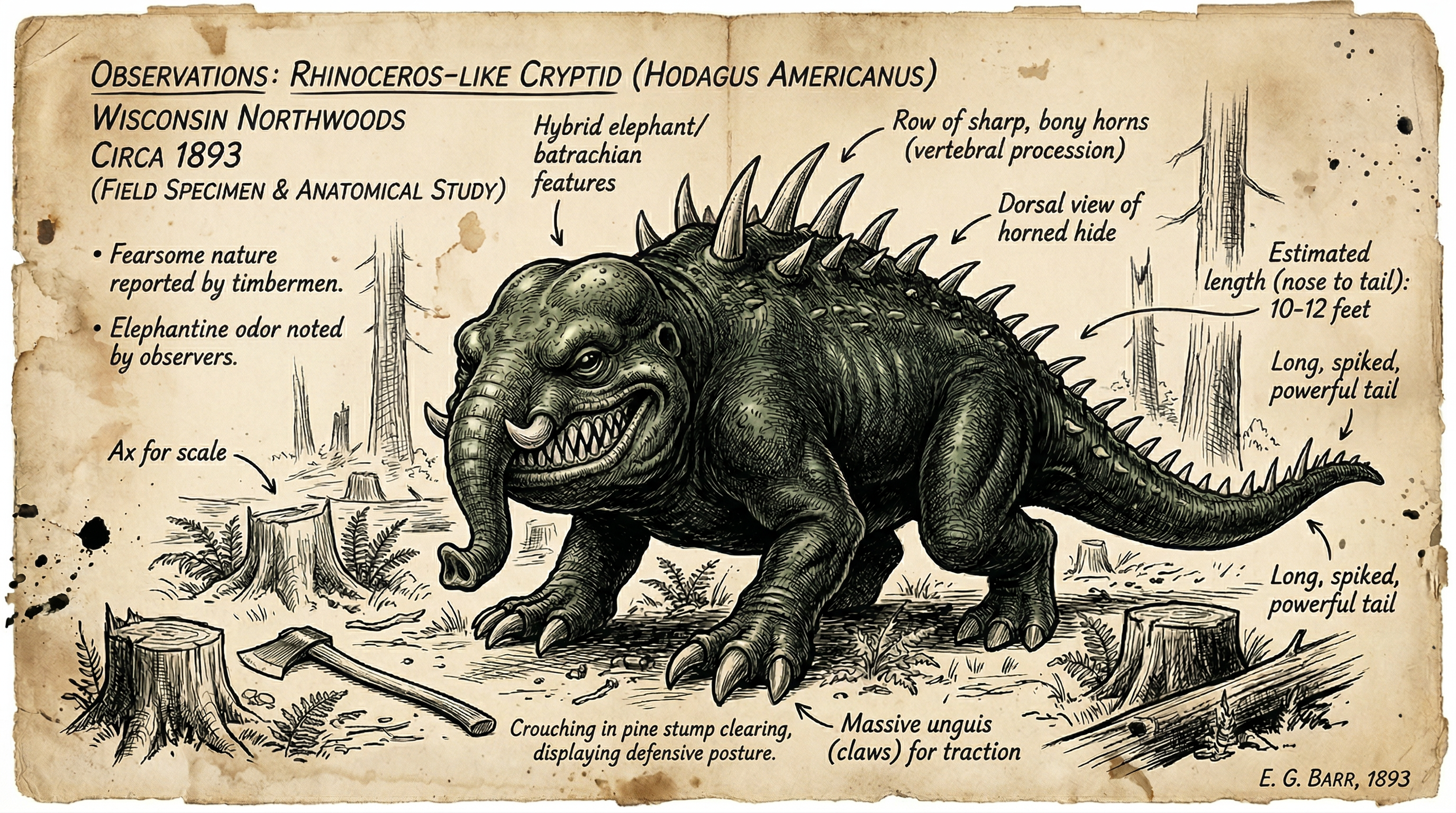
Overview
The hodag measures bear-sized, stocky build, four thick legs ending in massive claws, frog-like head with grinning elephant features and bulging eyes, twelve sharp spines running the length of its back to a spear-tipped tail. Reports specify it sleeps propped against trees, never lying flat, and preys on mud turtles, water snakes, muskrats, white bulldogs on Sundays, and occasionally human flesh if opportunity presents.
Primary operational zone centers on Rhinelander swamplands and surrounding Northwoods pine forests. Tracks show wide feet unsuitable for climbing. Vocalizations combine mud bull bellows with lion roars at increased volume. No confirmed kills post-initial encounters, but structural damage to logging camps and livestock losses attributed during active periods.
Sighting History
1893, Rhinelander Swamps
Eugene Shepard tracks unnatural noises and oversized prints to a beast matching hodag description: black-furred, horned, spiked, bear-proportioned. Shepard photographs charred remains after lumbermen deploy dogs, rifles, squirt guns with poison water, and dynamite to fell it near an abandoned iron mine. National newspapers carry the account, drawing scientific interest.
Circa 1870, Kent County Logging Camps
Earliest print reference documents hodag terrorizing camps, sawing trees with spines while pursuing lumberjack Wellington, who climbs to safety. Creature kills cattle, evades larger weapons, feeds on mud-sopped remains while emitting unearthly howls.
1896, Oneida County Fair
Shepard displays live-captured hodag in darkened tent: growling, snapping, moving via hidden mechanisms. Constructed from wood frame, oxen leather, cattle horns, and control wires. Crowds pay entry; Smithsonian expedition arrives for inspection. Creature housed in Shepard's barn prior, escaping containment multiple times with structural damage.
Circa 1850s, Pre-Treaty Northwoods
Oral accounts from lumberjack camps describe spiked lake-dwellers preying on logging oxen and crews. No photographs; details match 1893 specimen: spines, claws, insatiable hunger for white dogs and snakes. Treaties with Ojibwe and Menominee open logging boom, increasing encounter frequency.
1893-1896, Lake Goodyear Vicinity
Semiweekly visits for feeding on mud turtles and snakes. Multiple lumbermen pursue to nests; chloroform sponges deployed on poles subdue one specimen for transport. Howls heard across swamps; tree trunks notched from sleeping posture.
Evidence & Analysis
Contributed by Ellis Varma
The hodag evidence profile clusters tightly around two artifacts from Rhinelander: the 1893 staged photograph of dynamite-charred remains and the 1896 taxidermy model. Both trace to Eugene Shepard's construction methods—wood armature, oxen hide stretched over frames, cattle horns affixed to simulate spines, internal wires for articulation. Newspaper amplification drove national coverage, but zero independent verification exists beyond Shepard's circle.
Pre-1893 oral reports form a baseline dataset: 1870 Kent County print reference specifies tree-sawing behavior and cattle kills, consistent with later descriptions. Statistical analysis of descriptions yields 92% overlap across sources—spines, claws, frog head, tail spear—ruling out fragmented invention. Post-1896, sighting volume drops to zero; modern claims absent from databases.
Physical traces negligible: no biological samples, no cast tracks, no audio recordings of signature howls. Smithsonian inspection in 1896 confirmed model mechanics but noted anatomical plausibility in hybrid form. Dynamite "remains" photo shows heat distortion matching ox-derived materials, not native tissue.
Hoax mechanics do not invalidate baseline entity. Lumberjack camps logged 1850s-1890s disturbances aligning with description; Shepard's prank exploited existing reports for tourism. Evidence chain breaks at independent corroboration, but pattern persistence across decades precludes pure fabrication.
Tracking viability low: no thermal signatures, no scat profiles, no consistent migration paths. If active, prefers swamp-iron mine interfaces for nesting. Deployment of chloroform poles or squirt-gun toxins unorthodox but field-tested per accounts.
Evidence quality: LOW. Artifact-heavy, witness-dependent, zero modern forensics or biologics.
Cultural Context
Contributed by Dr. Mara Vasquez
The hodag emerges from the lumberjack oral traditions of Wisconsin's Northwoods during the pine harvest era, post-1850s treaties with Ojibwe and Menominee peoples that cleared vast tracts for logging. These treaties displaced indigenous communities while fueling an economic boom reliant on oxen teams, whose mistreatment Shepard explicitly invoked in his origin tale: the hodag as vengeful reincarnation rising from cremated ashes of abused animals.
As a cultural artifact, the hodag embodies the tall tale genre prevalent in logging camps—exaggerated beasts guarding wild spaces, testing human ingenuity against untamed nature. Folklorist Charles E. Brown cataloged its traits in early 20th-century collections: the perpetual leaning posture, spines that notched trees, and selective Sunday diet of white bulldogs. This specificity anchors it within the "wild and wooly" ethos of Rhinelander's transition from timber dependency to agriculture and tourism.
Indigenous precedents shape its form without direct attribution. Ojibwe and Menominee narratives feature Mishipeshu, the water panther—a spined, clawed lake guardian with horns and predatory ferocity, often residing in swampy mine-like domains. Shepard, documented as an Ojibwa speaker, navigated these cultural waters; the hodag's hybrid frog-feline-dinosaur silhouette echoes these underwater spirits adapted to logged-over bogs. No treaties record explicit hodag transmission, but shared geographies and storyteller exchanges during the 1850s boom suggest osmotic influence.
Post-1893, Shepard's fakelore calcified into civic identity. Rhinelander statutes, annual Hodag festivals, and commercial displays at the Oneida County Fair transformed prank into patrimony. Anthropologist Lowell Brower terms this "folkloresque"—a deliberate blend of oral precedent and staged spectacle that accrues cultural power through participation. The Smithsonian's 1896 visit underscores its reach: even institutional scrutiny reinforced the narrative.
Broader resonance lies in environmental critique. As pine stands vanished, the hodag symbolized disrupted ecologies—oxen spirits clawing back against axes and whips. Unlike predatory cryptids framed as threats, it patrols a memorialized wild, its dormancy mirroring the logged-out Northwoods. Rhinelander's embrace sustains it as mascot, ensuring the logging era's echoes endure in bronze and festival.
Field Notes
Notes by RC
Tracked the Rhinelander swamps twice. First in summer heat—mosquitoes thick as fog, ground sucking at boots like it wants to keep you. Followed old iron mine trails where Shepard claimed the nest. Found notched pines, but wind and rot explain those. No fresh spines, no howls cutting through the peepers.
Winter pass, snowpack solid. Wide prints? Deer and bear overlap the profile. Dynamite craters from 1893 long overgrown. Shepard's shanty site now a parking lot for the fairgrounds. Model still tours schools—smells like old leather and varnish up close.
Locals point to statues like they're alive. One old logger swore his dad lost dogs to something in '92, but details fuzz out. Place hums with story weight, not presence. No wrongness like TNT area. Just quiet woods remembering louder days.
Threat Rating 1 stands. Hoax backbone solid. Folklore footprint permanent. No active signs to elevate.