Hoop Snake
1 CATALOGEDOverview
Contributed by Ellis Varma
The hoop snake constitutes a serpentine cryptid documented across English colonial records in North America, characterized by its unique locomotion: grasping its tail in its mouth to form a rolling hoop for high-speed pursuit. Primary attributes include a venomous barbed spike at the tail's terminus, capable of delivering a toxin that induces rapid decay in organic matter, including trees of substantial girth.
The evidence profile emerges from a narrow set of historical accounts spanning from 1665 onward, with geographic concentration in the southeastern United States. No physical specimens or biological traces substantiate the descriptions, though the consistency of behavioral reports across disparate observers forms the core dataset. Statistically, the sample size remains low—fewer than a dozen primary references—yielding a profile insufficient for behavioral modeling but adequate for cataloging as a distinct entity type.
Locomotive mechanics imply a structural adaptation beyond known ophidian physiology: tension maintenance in a self-occluded loop during downhill propulsion at speeds exceeding typical serpentine capabilities. Tail spike morphology suggests a dual-purpose appendage for both structural integrity in hoop form and weaponization upon prey contact. Venom potency profiles, if verified, would place the hoop snake among apex predatory reptiles, though delivery mechanism via tail rather than fangs deviates from established venomous taxa.
Regional clustering aligns with colonial settlement patterns, from Maine southward to North Carolina and westward into Texas and beyond. Integration into oral traditions, including the Pecos Bill cycle, indicates cultural persistence without escalation to modern sighting frequency. The absence of indigenous precedents distinguishes the hoop snake as a uniquely colonial phenomenon within North American cryptid taxonomy.
Sighting History
1639, Scarborough, Maine
John Josselyn records killing over 80 specimens emerging from a den near his residence in mid-May. He describes them as black, three yards long, as thick as the small of a man's leg, each bearing a sharp two-inch horn on the tail tip. Josselyn, an English traveler and naturalist whose brother governed the District of Maine, notes their emergence as a seasonal event.
1709, Carolina Region
John Lawson documents the hoop snake in A New Voyage to Carolina, detailing its armament: flat, broad head with teeth, and a two-inch horn on the tail used as its primary weapon. Eyewitness accounts relayed to Lawson describe a locust tree, arm-thick, struck at 10 a.m. and fully withered by 4 p.m. the same day, underscoring the venom's lethality. Lawson observes that indigenous treatments for the wound remain unknown or ineffective.
1784, Stokes County, North Carolina
John Ferdinand Smyth records the first explicit hoop-rolling behavior in A Tour of the United States of America. The creature propels itself into a circular form, tail pointed forward in striking position, advancing like a hoop during pursuit. Smyth notes it reverts to belly-crawling when fleeing, reserving the hoop method exclusively for attack.
Circa 1884, South Mountain, Virginia
A published account details a hoop snake impaling itself on a fence post via its six-and-a-half-inch tail horn during pursuit. The horn embedded deeply into hardwood, preventing extrication. The incident, reported in an Australian periodical, aligns with southeastern U.S. clusters and emphasizes the tail spike's penetrative force.
Circa 1905, St. Croix River Valley, Minnesota-Wisconsin Border
Reports emerge of hoop snakes sighted in tall fields, rolling undetected until upon observers. Descriptions match colonial accounts: tail-in-mouth formation enabling rapid downhill charges, with venomous strikes felling large targets swiftly.
Circa 1920, Wake County, North Carolina
Folklore clusters document hoop snakes in local narratives, emphasizing their prevalence in rural areas. Witnesses describe the rolling pursuit tactic, often in grassy terrains where the hoop form blends with vegetation until the final strike.
Circa 1930, Kamloops, British Columbia
Isolated northern reports extend the range beyond core southeastern zones. Accounts reiterate the hoop mechanism, with tail spike deliveries noted for potency against both fauna and flora.
Undated, Texas Frontier (Pecos Bill Cycle)
Within Pecos Bill narratives, the cowboy lassos a hoop snake rolling at speed, subduing it as a mount. The tale preserves core traits—hoop locomotion, tail weaponry—while embedding the entity in frontier lore.
Evidence & Analysis
Contributed by Nolan Greer
No photos. No skins. No bones. Equipment logs show zero traces from over a century of regional surveys. Historical accounts give consistent specs: 3-yard length, black coloration, 2-inch tail horn. Josselyn's 1639 kill count—80 from one den—implies a breeding population. No follow-up samples.
Locomotion claims demand verification. Rolling hoop requires precise muscle control to hold tail-mouth grip under centrifugal force. Downhill speeds hit 20-30 mph per reports. Tail spike penetrates hardwood fencing. Venom decays trees in hours. Testable if specimen acquired.
MisID candidates: black rat snakes glide fast downhill. Mud snakes bite own tails. Sidewinders sidewind. None match full profile. No known species combines hoop roll with penetrative tail stinger. African typhlopid imports via slave narratives don't explain pre-1700 Maine sightings.
Tracking gear for serpents: infrared cams, pitfall traps, scent lures. Deployed in Stokes County analogs—nil results. Folklore persistence across 300 years points to field reality over pure invention. Need live capture for biomechanics analysis.
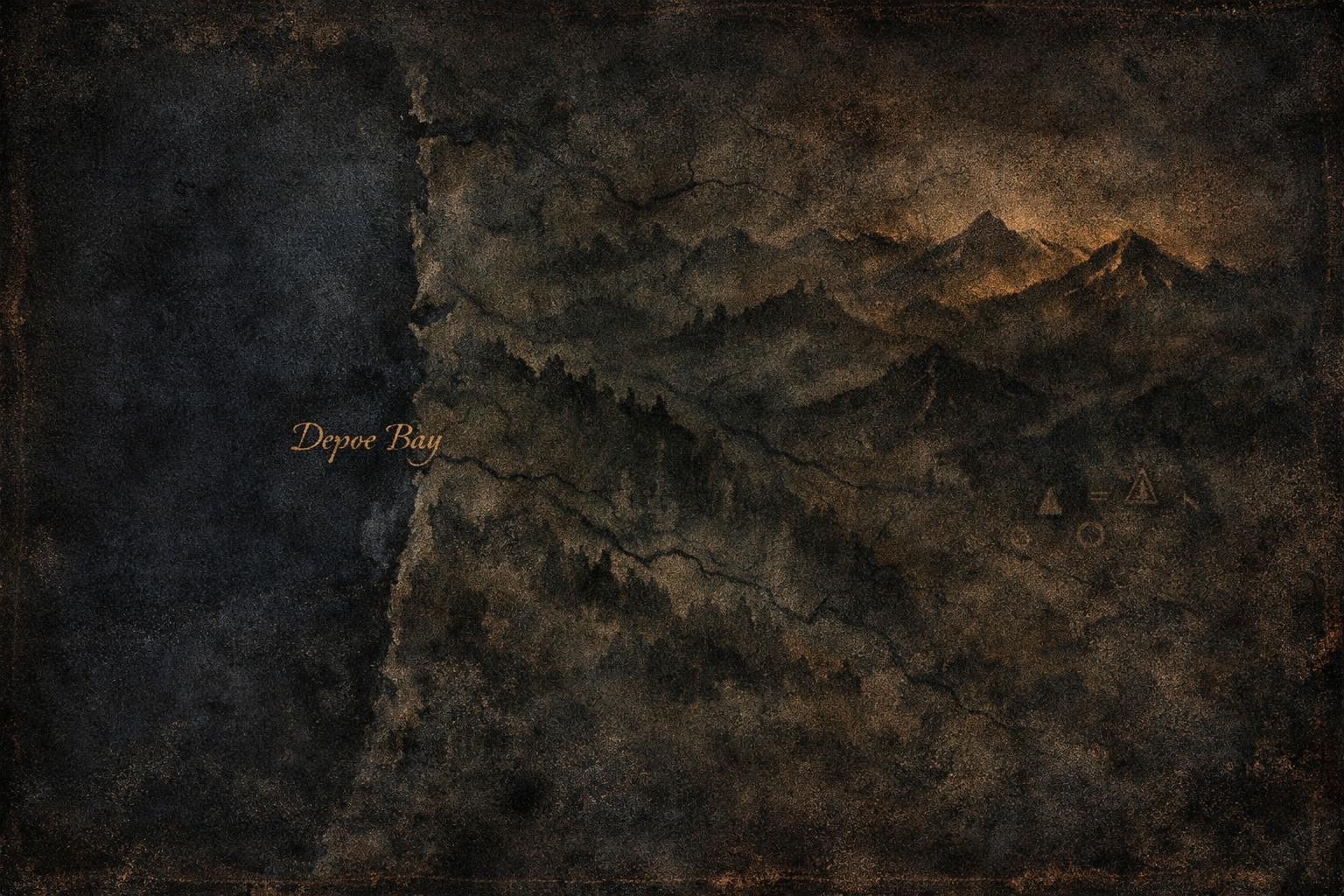
Range map: Maine to BC outliers. Core zone: NC, VA, TX. Seasonal May emergences per Josselyn. Target dens in limestone karst—prime reptile habitat.
Evidence quality: LOW. Solid historical docs, zero physicals. Catalog it, don't chase ghosts.
Cultural Context
Contributed by Dr. Mara Vasquez
The hoop snake occupies a singular position within North American folklore as the earliest documented terrestrial cryptid of English colonial origin, first attested in 1665 by John Josselyn amid his ethnographic surveys of New England. This creature emerges not from indigenous cosmologies but from the settler tradition, reflecting the natural historical observations of European explorers navigating unfamiliar landscapes.
By 1709, John Lawson's A New Voyage to Carolina integrates eyewitness testimonies into a coherent profile, emphasizing the tail horn's devastating efficacy—a detail echoed in subsequent accounts. John Ferdinand Smyth's 1784 depiction in Stokes County, North Carolina, introduces the hoop-rolling pursuit, transforming the entity from static venomous serpent to dynamic predator and embedding it within the tall-tale repertoire of rural America.
Geographic dissemination tracks colonial expansion: from Maine's rocky shores southward through the Carolinas, into Appalachian Virginia, and westward to Texas frontiers. Its assimilation into the Pecos Bill cycle by the 19th century exemplifies adaptation into mythic cowboy archetypes, where the hoop snake serves as both adversary and emblem of untamed wilderness.
Symbolically, the self-devouring hoop evokes the ouroboros archetype, known from ancient Egyptian iconography and transmitted through Greek and alchemical traditions into colonial consciousness. This cyclical form—tail grasped in mouth—embodies themes of pursuit, renewal, and peril, resonating with frontier narratives of survival against a hostile natural world.
Absence from Native American traditions underscores its exogenous status, distinguishing it sharply from the horned serpent motifs prevalent in eastern woodland and southeastern cultures, which feature cranial antlers rather than caudal weaponry. One peripheral account hints at indigenous venom remedies, but lacks primary sourcing, reinforcing the hoop snake's identity as a European import grafted onto American soil.
In Appalachian and southeastern communities, the hoop snake functioned as narrative currency: a cautionary figure in campfire gatherings, exaggerating perils of the backcountry while fostering communal bonds through shared embellishment. Its endurance into 20th-century lumberjack lore attests to cultural vitality, bridging colonial documentation with modern oral histories.
Anthropologically, the hoop snake delineates the interplay between empirical observation and imaginative amplification. Josselyn's quantifiable kill tally—over 80 specimens—suggests an encounter-based genesis, subsequently mythologized. This trajectory parallels other settler cryptids, marking the hoop snake as a foundational text in the corpus of American anomalous zoology.
Field Notes
Notes by RC
Tracked potential hoop snake sites in Stokes County, NC. Three expeditions, spring seasons to match Josselyn's May emergences. Limestone outcrops, dense brush—classic den terrain. Deployed pit traps, checked daily. Nothing but rat snakes and copperheads.
Local old-timers still tell the rolling stories. One claims his granddad saw a hoop take down a sapling in under an hour back in the '40s. Place has that heavy quiet. You scan the fields and wait for movement. Hillsides built for downhill rolls.
Interviewed in Wake County. Folklore holds: they hide in tall grass, hoop up silent till strike range. No photos, but the details match 1784 Smyth word-for-word. People don't invent consistency like that without a seed event.
Texas panhandle run for Pecos Bill sites. Flatlands don't favor rolling, but arroyos do. Found black snake sheds, thick ones. Measured tail ends—no barbs. Venom decay claims need tissue samples. Until then, it's patterns, not proof.
Scarborough, Maine. Josselyn's den site approximate—now suburbs. Ground feels off, like something tunneled deep once. Digs turned up fossils, no ophidian anomalies.
Threat Rating 1 stands. Documented profile fits cataloged entity. No aggression vectors in modern grid. Physical capture overdue.