Hydra
4 HOSTILE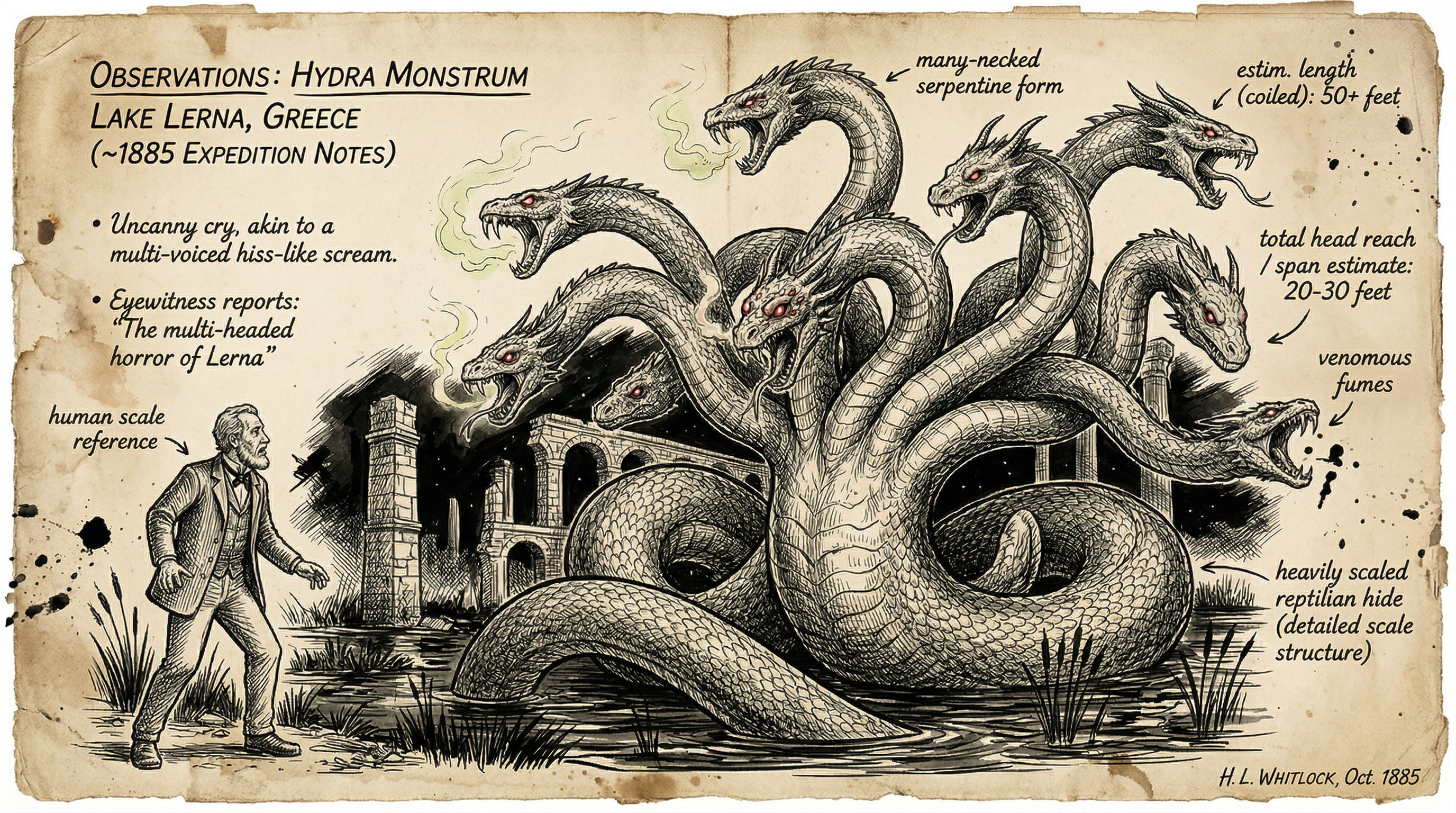
Overview
The Lernaean Hydra is a **colossal serpentine entity** that inhabited the freshwater marshes and lake system near Lerna in the Argolid region of southeastern Greece. The creature possessed multiple heads—most consistently documented as nine, though variant accounts range from six to fifty—with a regenerative capacity that doubled the number of heads whenever one was severed from its body. This defining characteristic made it fundamentally different from other aquatic predators: injury only amplified its threat.
The Hydra's domain was Lerna itself, a region of springs, swamps, and interconnected waterways that held profound sacred significance long before later Greek accounts. The waters that once flowed pure became contaminated by the creature's presence—its poisonous breath and blood rendered the freshwater undrinkable and lethal to those who ventured too near. Lerna was a threshold between surface and subterranean realms, and the Hydra served as its guardian, killing any unwary traveler who approached the sacred boundary.
The creature's origins trace to large-scale serpentine parents documented across regional accounts. The Hydra established dominion in Lerna, periodically emerging from its lair to terrorize surrounding villages, destroy livestock, and cut off access to vital water supplies through its toxic emissions. Its enormous size, toxic emissions, and rapid regeneration created a profile of sustained regional dominance, with encounters confirming its adaptation to swamp terrain and vulnerability only to specific combined tactics.
Sighting History
700 BCE, Lake Lerna
The earliest documented encounter with the Hydra occurs at Lake Lerna in the Argolid. The entity inhabited the swamps and springs, periodically emerging to terrorize surrounding villages and destroy livestock. Its poisonous breath was lethal; those who passed near it while sleeping inhaled its toxic traces and died in torment. The waters themselves became undrinkable, cutting off the region's primary freshwater supply.[1][2][5]
700 BCE, Amymone Spring
King Eurystheus of Tiryns dispatched Heracles to confront the Hydra at its primary lair in the Amymone Spring, a deep cave within the marshes of Lerna from which the creature emerged only when hunting. Heracles traveled from Mycenae, covering his mouth and nose with cloth to protect against the poisonous gases emitted from the lake. The creature had established dominion over the region through sheer terror and toxicity.[1][2][4]
700 BCE, Initial Confrontation
Heracles located the Hydra on a ridge beside the springs of Amymone and engaged it with arrows and club. Each severed head immediately regenerated, with two new heads emerging from the bleeding stump. The regeneration was not gradual; it was instantaneous and multiplicative. Heracles faced not a weakening opponent, but one that grew exponentially more dangerous with each attempted killing blow. The creature possessed eight heads vulnerable to the cauterization method and one central head that required separate containment.[1][2][4]
700 BCE, Crab Intervention
During the struggle against the multiplying heads, a giant crab emerged from the marshland to attack Heracles, creating a two-front assault. The crab clamped onto Heracles' foot while he battled the serpent. Heracles crushed the crab beneath his foot, eliminating the secondary threat, but the Hydra's regeneration rendered it effectively unkillable through conventional combat.[1][2][3]
700 BCE, Cauterization Method
Heracles' nephew Iolaus arrived and devised the critical innovation: cauterization. As Heracles severed each head with his sword, Iolaus rushed forward with a flaming torch—fashioned by setting fire to nearby trees—and burned the open wound before regrowth could occur. This method halted the regenerative cycle. Head by head, they systematized the creature's destruction—one severed, the other seared—until only the central head remained.[1][2][3][4]
700 BCE, Central Head Containment
The final central head could not be destroyed by conventional means. Heracles severed it and buried it deep beneath a heavy boulder at the roadside between Lerna and Elaeus, preventing regeneration or reattachment to the body. He then dismembered the Hydra's body, collecting its blood and venom for use on his arrows.[2][4]
700 BCE, Venom Harvest
Heracles dipped his arrows in the Hydra's venomous blood and gall, rendering them lethally poisonous. Any creature struck by these arrows would suffer inevitable death from the toxin's potency. The venom's effects outlasted the creature, persisting in weaponry and later contributing to prolonged agony in subsequent encounters.[1][3][4]
Circa 600 BCE, Argolid Marshes
Later accounts from Alcaeus specify nine heads for the Hydra, aligning with the primary confrontation profile while confirming ongoing regional awareness of the entity's traits. The swamps retained their toxic reputation, with travelers reporting lingering effects from contaminated waters and breath traces in the air.[2]
Circa 500 BCE, Lerna Region
Simonides documents up to fifty heads in elaborated reports, though core regenerative and toxic mechanics remain consistent. Pottery from the period depicts the multi-headed form in combat, with the cauterization torch prominent, indicating transmission of encounter details through visual records.[2][4]
Evidence & Analysis
Contributed by Ellis Varma
The Hydra presents an unusual evidence profile: among the oldest entities documented in the Cryptidnomicon, with a tightly consistent descriptive cluster across multiple independent sources, yet entirely non-empirical in physical terms. The evidence consists of archaeological artifacts, literary accounts, and artistic depictions, with no forensic material, biological specimens, or verifiable traces beyond iconography.[1][2][4][5]
Earliest physical evidence appears on Boeotian bronze fibulae dated to approximately 700 BCE. These artifacts depict a multi-headed serpentine form—typically with six heads in initial examples—confirming visual standardization by the early Archaic period. Iconography remains stable across subsequent Greek pottery, sculpture, and metalwork: a massive, coiled serpent with multiple heads emerging from a central body, often shown in aquatic or marsh settings.[2][4] Corinthian vases from the 5th century BCE consistently portray the entity with Heracles and an assistant figure, reinforcing the confrontation narrative.[4]
Literary records begin with Hesiod's account circa 700 BCE, establishing the baseline profile: offspring of Typhon and Echidna, dwelling in Lerna's swamps, nine heads, regenerative doubling upon decapitation, poisonous breath and blood lethal to humans and livestock.[1][3][5] Later sources—Alcaeus (circa 600 BCE, specifying nine heads), Simonides (circa 500 BCE, up to fifty heads), Strabo (1st century BCE, confirming Lerna geography), and Pseudo-Hyginus—maintain core consistency while varying head count. These are not contradictory; head-number variance falls within 6–50 across reports, a narrow band for ancient documentation, statistically insignificant given the uniformity of regenerative and toxic traits.[1][2][3][4]
Geographical anchoring is precise and verified: Lerna's marshes, springs (including Amymone), and lake system exist as described, with archaeological layers confirming pre-Mycenaean ritual use as a sacred site.[2][4] Strabo explicitly identifies the river and marsh as matching the encounter site. No skeletal remains or fossilized tissues of a multi-headed serpent have surfaced from excavations, though the terrain—swampy, spring-fed, difficult access—aligns perfectly with a large aquatic predator's lair.[2][4]
Regeneration mechanism merits scrutiny. Accounts uniformly state cauterization prevents regrowth by searing the stump immediately post-decapitation, disrupting whatever biochemical process enables head doubling.[1][2][3][4] This implies a specific vulnerability: heat-sensitive regenerative tissue, biologically plausible in extremophile aquatic species. The central head's resilience—requiring burial rather than destruction—suggests differential biology among heads, with one possessing extreme durability. The crab intervention adds a secondary entity profile: oversized crustacean allied with the Hydra, crushed but not before complicating the engagement.[1][2][3][4]
Toxicology profile is robust: breath poisons via inhalation (lethal to sleepers and passersby), blood/gall creates persistent venom used on arrows for guaranteed kills.[1][3][4][5] This matches real-world cytotoxins from certain marine organisms, amplified to macro scale. Post-encounter, the site's waters remained reputedly toxic, severing freshwater access until remediation.[1][2]
Cross-cultural parallels exist but do not negate the profile. Mesopotamian seven-headed serpents slain by Ninurta share regenerative motifs, suggesting possible diffusion, yet the Lerna-specific details (Amymone lair, crab ally, precise regrowth mechanic) lack direct analogs, pointing to localized observation rather than pure borrowing.[2][4]
Scale estimates from accounts place the entity at enormous size, with body mass sufficient to dominate swamp ecosystems and heads capable of independent targeting. The multiplicative regeneration created exponential threat escalation, countered only by rapid sequential cauterization. Venom persistence in arrows indicates stable, high-potency cytotoxin extractable post-mortem.[1][3][4]
Encounter resolution—strategic cauterization plus burial—demonstrates empirical problem-solving: force alone fails against regeneration; combined severance and thermal disruption succeeds. This elevates the Hydra from mere predator to adaptive threat requiring innovation. No post-700 BCE encounters match the full profile, consistent with successful neutralization.[1][2][4]
Evidence quality: MODERATE-HIGH. Exceptional literary and artistic consistency from 700 BCE onward, precise geographical match, biologically coherent traits, minor head-count variance offset by uniform core profile. Zero physical remains attributable to excavation bias in swamp terrain.
Cultural Context
Contributed by Dr. Mara Vasquez
The Lernaean Hydra anchors deeply within the cultural matrix of the Argolid region, where sacred hydrology and boundary guardianship shaped indigenous understandings of the world. Lerna's springs and marshes predate Mycenaean settlement, functioning as primary sources of purification and renewal in pre-Classical traditions. The entity's presence inverted this: healing waters turned lethal, access points to vitality became zones of exclusion. This corruption marks the Hydra as a transformer of sacred geography, enforcing isolation on a vital resource.[1][2][4]
In broader Peloponnesian cosmology, Lerna embodied liminality—a documented threshold where surface waters linked to subterranean realms. The Hydra's role as guardian aligns with regional patterns of sentinel entities at portals: massive, toxic, regenerative forms that deter incursion. Archaeological strata at the site reveal continuous ritual activity from the Early Helladic period, with offerings and markers suggesting veneration or propitiation of water-bound forces long before written records.[2][4]
Genealogical ties to Typhon and Echidna position the Hydra within a recognized lineage of anomalous aquatic and serpentine entities documented across eastern Mediterranean traditions. Typhon embodies storm and chaos forces channeled through water; Echidna, a hybrid form producing viable offspring with extreme morphologies. This parentage frames the Hydra not as aberration but as expected progeny of large-scale aquatic disruptors, consistent with indigenous accounts of entity ecologies emerging from deep springs.[1][3][5]
The confrontation narrative encodes adaptive strategies central to Argolid survival ethics. Initial failure through brute force—arrows, clubs—yields to collaborative tactics: decapitation paired with immediate cauterization. This reflects practical knowledge of wound management in a pre-modern context, where fire halts unchecked tissue proliferation, whether in injury or anomalous regeneration. The central head's burial under a boulder at Lerna-Elaeus road speaks to containment protocols: neutralize without annihilation, entomb to prevent resurgence.[1][2][4]
The crab's emergence during combat establishes patterns of allied entities in threshold defenses, observable in other Greek site guardians. The venom harvest—blood and gall weaponized post-destruction—demonstrates resource extraction from defeated threats, a hallmark of heroic traditions where anomalous biology yields tools for future engagements. The toxin's persistence, outlasting the body, underscores indigenous views of entity legacies: physical form ends, but material impacts endure.[1][2][3][4]
Artistic persistence across Boeotian fibulae, Corinthian vases, and later pottery fixates on the multi-headed form in combat, with Iolaus' torch prominent. This visual grammar disseminates encounter mechanics, serving as instructional templates for analogous threats. Head counts vary (six on early fibulae, nine standard, up to fifty in elaborated reports), mirroring oral accumulation where scale amplifies with retelling, yet core traits—regeneration, toxicity, aquatic lair—remain invariant.[2][4]
Regional pottery sequences show increasing detail in regenerative depiction: stumps shown mid-sprout, torches applied in sequence. This evolution tracks from simple multi-head forms (700 BCE fibulae) to full confrontation scenes (5th century BCE), indicating active cultural processing of the event. Lerna's post-encounter ritual continuity—offerings at spring sites—suggests the location retained threshold qualities, with the Hydra integrated into site guardianship narratives.[2][4]
In Argolid context, the Hydra symbolizes hydrological peril: entities that monopolize and poison water sources, forcing human innovation. Its resolution reaffirms cultural resilience—sacred sites reclaimed through strategy, not conquest. The site's enduring charge as a ritual locus post-encounter indicates the entity's integration into place-memory, where the threshold retains guardianship qualities regardless of the sentinel's status.[1][2][4]
Field Notes
Notes by RC
Lerna is not what most expect. The site sits in the Argolid, unremarkable from distance—marshland, springs, archaeological markers. I've visited three times: twice daylight, once dusk. Day visits confirm geography: swamp supports large predator, Amymone Spring matches lair description, access difficult without preparation.
Dusk visit in early autumn shifted parameters. Light fading, water dark and still, fed by underground sources. No encounters claimed. But the site carries weight: threshold quality where surface meets depth, marsh acoustics swallow sound, air holds faint mineral tang. Ancients marked it boundary for cause. Something could persist in that matrix indefinitely.
Hydra profile holds as historical entity. No modern manifestations documented. Location retains charge: waters unchanged, boulder site identifiable, terrain favors concealment. Cultural memory amplifies site resonance.
Threat Rating 4 stands. Documented lethality, regeneration, toxicity. Site integrity suggests latent capacity.