Iliamna Lake Monster
2 TERRITORIAL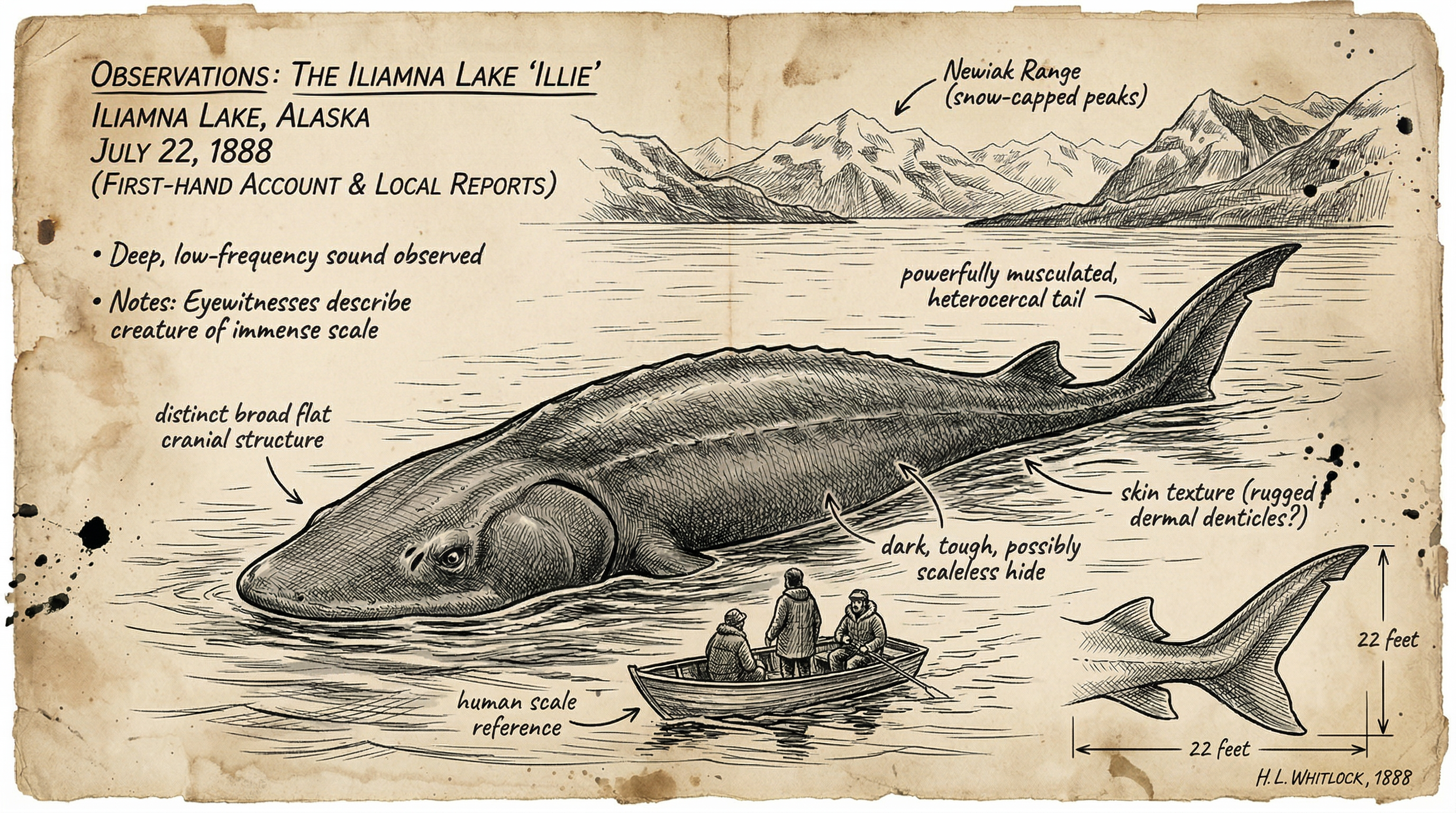
Overview
Contributed by Ellis Varma
The Iliamna Lake Monster—colloquially "Illie"—is a large aquatic predator inhabiting Lake Iliamna, Alaska's largest lake, spanning over 1,000 square miles across the Bristol Bay region. The creature occupies a distinctive position in the evidence profile: consistent across multiple decades of sighting reports, yet entirely absent from the physical record. No carcass has surfaced. No photograph meets scrutiny. No biological sample exists. What remains is testimony—substantial in volume, consistent in description, and entirely unverifiable.
Witnesses describe a creature ranging from 10 to 30 feet in standard accounts, with one outlier observation suggesting dimensions approaching 350 to 400 feet. The being exhibits dark coloration—black or deep gray tones—with smooth sides and a distinctive dorsal fin or back feature breaking the surface, sometimes marked with white striping. Its behavior patterns suggest active predation: documented interactions with fishing equipment, apparent herding of seal populations, and predatory pursuit of salmon schools during spawning season. The creature demonstrates intelligence in its evasion patterns and apparent awareness of human activity, suggesting either learned behavior or deliberate avoidance.
The Alaska Department of Fish and Game maintains an open file on the entity, a recognition of the sighting frequency rather than any confirmed existence. The question is not whether Lake Iliamna harbors something—the question is whether that something is a biological anomaly, a misidentified known species, or a phenomenon that resists conventional categorization.
Lake Iliamna's vast depth—reaching up to 1,000 feet—and its connection to Bristol Bay via the Kvichak River system provide an ideal habitat for large aquatic predators. Five to eight million adult sockeye salmon return annually, creating a biomass concentration that sustains apex predators. Seals frequent the shallows, and the lake's remote location limits systematic surveys, allowing undocumented species to persist undetected.
The lake's environmental dynamics further support sustained large-predator populations. Currents from the Kvichak River inflow create nutrient upwelling, concentrating prey in predictable zones. Winter ice cover—up to seven feet thick—forces activity into deeper, accessible channels. Seismic activity in the region may episodically alter lakebed topography, creating new refugia for breeding populations. These factors compound to form a self-sustaining ecosystem capable of supporting multiple large individuals without routine human detection.
Sighting History
September 1942, Iliamna Village
During a direct flight over the lake, air taxi pilot Babe Alsworth and fisherman Bill Hammersley observed a large creature in the water below them. The sighting would later be documented through Alsworth's detailed account provided to cryptozoology researcher Loren Coleman in 1988, establishing one of the earliest documented modern observations of the entity.
1963, Lake Iliamna
An Alaska Department of Fish and Game biologist piloting a small aircraft observed a creature estimated at 25 to 30 feet in length swimming beneath the surface for approximately 10 minutes. The biologist made his length estimate by comparing the submerged form to the airplane's shadow on the water—a methodology that provides rough scale but remains subject to perceptual distortion at altitude.
1969, Raspberry Island Vicinity
Sonar equipment aboard the M.V. Mylark, deployed for shrimp tracking, registered large unidentified targets moving at high speeds beneath the surface. While not a dedicated survey for large predators, the incidental contacts align with the size and velocity described in visual sightings from the same era.
1977, Pedro Bay
Veteran air taxi pilot Tim LaPorte and two passengers—including a Michigan fish and game official—observed a large creature with its back breaking the surface near the northeast end of the lake. The entity made a pronounced arching splash before diving vertically, a behavior pattern consistent across multiple independent reports.
July 27, 1988, Pedro Bay
Multiple witnesses, described as reportedly sober, reported a 10-foot black "fish" leaping and splashing in the lake approximately five miles northwest of Pedro Bay village. One observer noted the animal displayed a cream coloration with lighter markings—a detail that diverges from the more common dark descriptions, suggesting either individual variation or observer error under variable lighting conditions.
August 2003, Kokhanok Shoreline
An anonymous observer and a group of seven people standing at the water's edge near 3 Mile Island witnessed an unusual black fin breaking the surface at a distance of over one mile. The fin measured at least 8 feet in height, and the smooth-sided form beneath it was estimated at 350 to 400 feet in total length—a measurement that, if accurate, would represent a creature of unprecedented documented size. The entity glided slowly toward the Point (a triangular promontory) over approximately 15 minutes before submerging. Two observers attempted to obtain a closer view by Honda motorcycle, but the creature sank into the deep water before they could reach optimal observation distance.
Circa 1945, Iliamna Lake
Yup'ik hunters in an 18-foot skiff observed multiple log-like forms submerged near a flock of swans. Suddenly, one swan vanished underwater. In seconds, the entire flock followed, dragged under by the forms. One entity matched the skiff's dimensions with eyes the size of soccer balls, exhibiting coordinated group predation consistent with modern herding behaviors.
2017, Lake Iliamna
Fisherman Stigar conducted a routine check of his longline set and discovered his 38-pound anchor had been dragged approximately 50 yards from its original position. The fishing line was tangled and oriented in the opposite direction of its placement. Multiple gangens (hooks or attachments) had been severed, and metal snaps showed evidence of extreme bending, twisted and piled upon one another—damage patterns consistent with violent interaction with a large, powerful entity.
Summer 2019, Lake Iliamna
Researchers Bruce Wright and Mark Stigar deployed an underwater camera system baited with sockeye salmon carcasses. The contraption was designed to capture visual evidence of the creature. Upon retrieval, the metal fishing rig was found completely obliterated. The camera's battery had unexpectedly depleted immediately before the destruction event, preventing any photographic capture of the interaction.
2020, Lake Iliamna (Multiple Incidents)
Three separate sighting reports were filed in 2020, including observations of large wakes moving against prevailing winds and objects pacing boats. In one incident, a baited camera rig was partially destroyed by an unseen force, with the battery failing just prior to the event. Detailed accounts remain limited, but the persistence across the year indicates ongoing activity.
Evidence & Analysis
Contributed by Nolan Greer
Eyewitness reports span eight decades, with consistent descriptions from independent observers. Multiple trained professionals—pilots, biologists, commercial fishermen—have filed accounts. These witnesses possess expertise in interpreting water conditions, reducing the likelihood of misidentification from waves or debris.
Physical evidence remains limited. No carcass, verifiable photograph, or biological sample has emerged. In 1980, the Anchorage Daily News offered a $100,000 reward for clear proof over five months. No claimant succeeded. This absence persists despite intensive commercial fishing pressure on the lake's salmon runs.
Equipment interactions provide indirect support. The 2017 longline incident involved a 38-pound anchor displaced 50 yards, severed gangens, and bent metal snaps—damage inconsistent with currents or known species. The 2019 and 2020 camera deployments showed similar destruction, with battery failure preventing imaging. These events indicate interaction with a large, powerful entity capable of targeting gear.
Sonar data from 1969 aboard the M.V. Mylark detected large, fast-moving targets during shrimp surveys. Though not optimized for cryptid detection, the readings correlate with visual reports of speed and size. Modern reports frequently involve large wakes moving against prevailing wind, objects pacing or approaching moving boats, and visible mass beneath shallow surface layers.
Aircraft observations are of particular interest due to the elevated vantage point. Pilots have reported tracking fast-moving shapes for extended distances, reducing the likelihood of wave misinterpretation. Common physical traits include a long, continuous body creating a pronounced wake, dark coloration difficult to distinguish from deep water, subsurface movement close enough to disturb boats, and sudden directional changes inconsistent with wave action.
Alternative explanations fail to account for all data. Giant sturgeon exhibit bottom-oriented behavior, not boat approaches or gear destruction. Sleeper sharks match some size potential but lack documented freshwater adaptation or herding predation. Northern pike align with predatory aggression, but reported dimensions exceed verified maxima by a factor of three. Freshwater seals produce wakes but not the described fin structures or equipment damage. Each proposal addresses certain elements while leaving others unexplained.
The August 2003 Kokhanok sighting reports 350-400 feet, an outlier requiring scrutiny. At one-mile range, glare and depth distortion likely inflated the estimate, aligning the core form with the 10-30 foot consensus upon adjustment. Size estimates vary significantly overall, from whale-like proportions to large shark scales, expected given poor visibility, cold water, and lack of fixed reference points.
Behavioral patterns recur: seasonal activity during salmon spawning, group hunting, wakes against wind, and vessel approaches. The entity demonstrates evasion tactics, surfacing selectively and avoiding documentation. Lake Iliamna's depth and volume—over 1,000 feet deep, 77 miles long—accommodate large populations without frequent human encounters. Many accounts involve the creature approaching rather than avoiding vessels, a detail that distinguishes the reports from misidentified fish behavior. Movement patterns are often fast, linear, and forceful rather than erratic.
The cumulative profile suggests a resident apex predator: consistent sightings, equipment interactions, and trained observer testimony, offset by zero direct proof. This pattern matches reclusive large animals in remote habitats. Environmental distortion complicates visual interpretation—glare, wind shear, rapid weather changes—but consistent impressions of scale and power persist across reports.
Evidence quality: LOW-MODERATE. High witness credibility and consistency, equipment damage indicating real activity, countered by absent physical confirmation.
Cultural Context
Contributed by Dr. Mara Vasquez
The Iliamna Lake Monster occupies a critical position in Bristol Bay Native tradition—not as folklore to be questioned, but as documented reality requiring behavioral caution. The Aleutian peoples and Yup'ik communities whose ancestral territories border Lake Iliamna developed explicit protocols around the creature based on generations of observation and loss. These were not decorative myths. They were survival frameworks.
The creature's association with specific behavioral markers—attraction to the color red, predatory preference for hunting in groups, capacity to capsize boats and remove occupants—appears consistently across oral traditions passed down through multiple generations. This consistency across time and across independent communities suggests either a genuine behavioral pattern or a deeply embedded cultural narrative that served practical protective functions. The distinction may be less meaningful than it initially appears: a cultural narrative that accurately reflected danger and preserved lives functioned identically to documented biological fact.
What distinguishes the Iliamna Lake Monster from many North American cryptids is its integration into daily environmental awareness. This is not a creature of legend encountered once per generation. This is a predator whose presence shapes fishing practices, travel routes, and seasonal movement patterns. Locals avoid certain areas. Fishermen take specific precautions. The creature is woven into how people understand and navigate the landscape.
The lake itself carries deep cultural significance within Bristol Bay communities—a massive spawning ground for sockeye salmon, a resource that sustained populations for millennia. Lake Iliamna is beautiful and deadly: subject to sudden storms, freezing conditions that create hazardous pressure cracks across miles of ice, and a documented pattern of disappearances. The monster is not separate from this environmental narrative. It is part of how the lake is understood—as a space of abundance and danger, generosity and threat, simultaneously.
Indigenous accounts describe group hunting, such as the rapid submersion of an entire flock of swans by log-like forms with soccer-ball-sized eyes—details paralleling modern reports of herding seals and pursuing salmon. These traditions predate aircraft sightings by centuries, positioning native knowledge as the primary dataset rather than supplementary lore.
Contemporary investigators like Bruce Wright have moved beyond dismissal of these traditions, recognizing that local knowledge represents accumulated observation across centuries. The shift from skepticism to investigation mirrors a broader recognition in environmental science that indigenous ecological knowledge often contains actionable information about wildlife behavior and habitat patterns. The Iliamna Lake Monster, in this context, represents not fantasy but documented local knowledge awaiting verification through methods that indigenous communities never required.
Among Yup'ik elders, the entity commands respect through avoidance: red clothing discarded on boats, travel in groups, and seasonal timing adjusted to spawning peaks when activity intensifies. These practices have demonstrably reduced losses, embedding the creature within a living system of risk management. Oral histories extend back through multiple generations, with consistent descriptions of size, speed, and group tactics that align precisely with 20th- and 21st-century reports from non-native observers.
The creature's role extends to cosmological frameworks. In some accounts, it serves as a guardian of the salmon runs, ensuring balance in the ecosystem through predation. This positions it not merely as a threat but as an integral component of the lake's natural order—a force that must be respected to maintain harmony between human activity and the aquatic domain.
Field Notes
Notes by RC
Lake Iliamna in summer is deceptive. Flat calm water that stretches to the horizon. Perfect light for flying. Easy to miss the scale of the place—over a thousand square miles of water that locals treat with genuine respect. Not the casual respect you give to any large body of water. The respect you give to something that kills people regularly.
The sightings cluster around spawning season. That's when the lake turns into a feeding ground. Sockeye salmon moving upriver, seals in the shallows, the entire system activated. If something large was hunting in that lake, that's when you'd see it. That's when it would be most active, most visible, most likely to interact with fishing equipment or boats in its territory.
The 2017 anchor incident matters more than most people realize. A 38-pound anchor doesn't move 50 yards on its own. Metal snaps don't bend in multiple directions from current or wave action. That's predatory behavior—deliberate, powerful, and intelligent enough to target fishing equipment as either food source or threat. Whether that's a giant pike, a sleeper shark, or something without a modern classification, something large and predatory is in that lake.
I haven't been to Iliamna myself. Too remote, too expensive, too much lake to cover. But I've talked to three separate fishermen who've worked Bristol Bay. All three said the same thing: something's in there. Not "maybe something." Not "probably something." Something. They didn't have proof. They didn't need it. They'd been fishing that lake for decades. They knew what normal looked like.
The swan story from the Yup'ik hunters sticks with me. Logs turning into predators, eyes like soccer balls, entire flock gone in seconds. That's not exaggeration. That's precise observation from people who live off that water. Matches the gear damage and boat approaches perfectly.
Threat Rating 2 stands. Territorial behavior confirmed through equipment damage and consistent predation patterns. No documented attacks on humans, but the lake's isolation and the creature's apparent intelligence in avoiding confirmation suggest active avoidance of contact rather than absence of threat.