
Jersey Devil
2 TERRITORIAL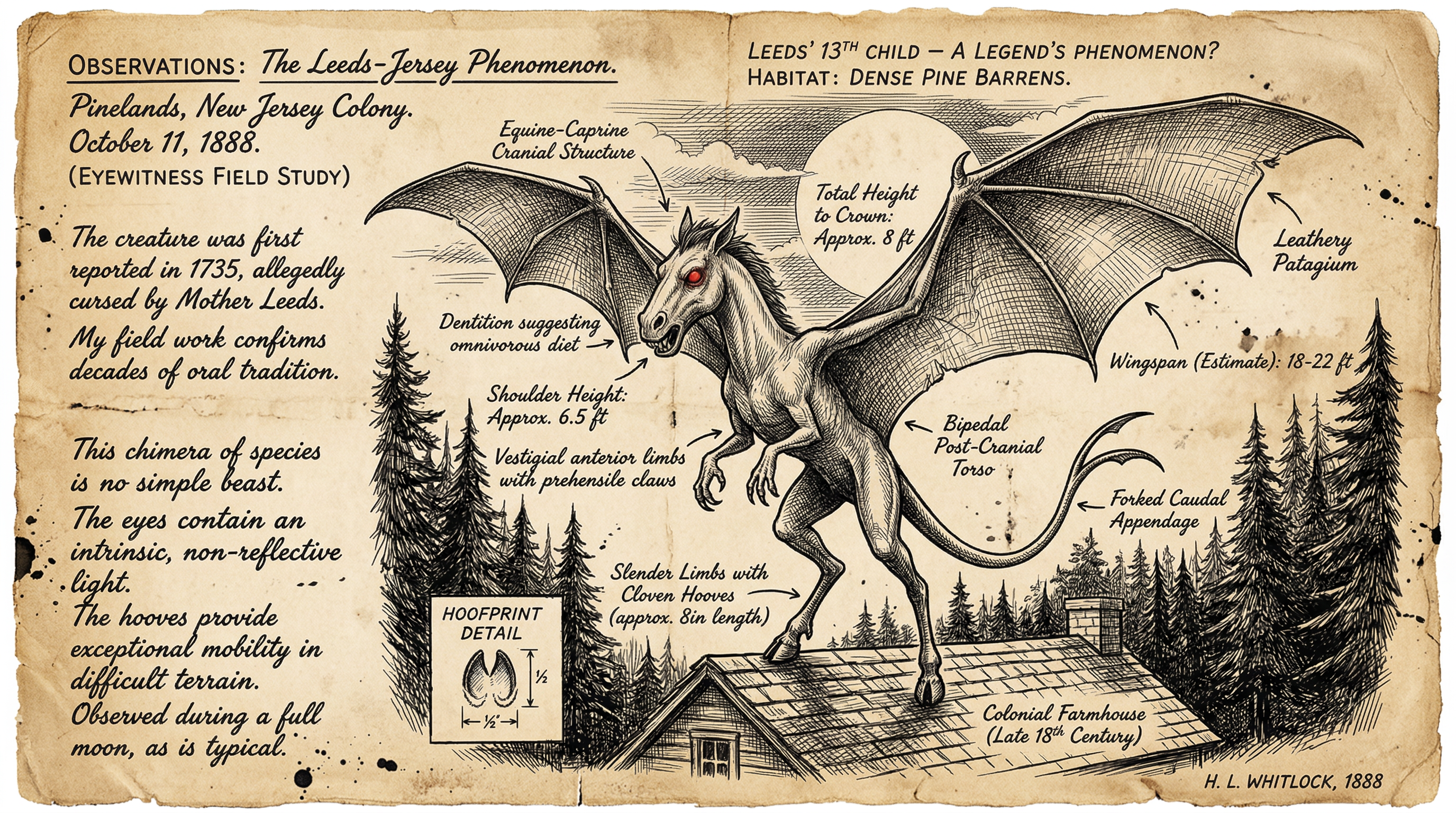
Overview
The Jersey Devil manifests as a bipedal winged entity with a kangaroo-like or elongated body, horse- or goat-like head, bat wings spanning up to 80 inches, cloven hooves or clawed feet, and a forked tail. Core reports emphasize its upright posture, piercing screams, and ability to traverse obstacles including fences and rooftops, as evidenced by anomalous tracks documented across southern New Jersey and eastern Pennsylvania.
The evidence profile clusters around two peaks: sporadic pre-1909 incidents tied to Pine Barrens folklore and the January 1909 sighting wave, which generated hundreds of reports from civilians, police, and officials over a single week. Physical traces remain limited to tracks and screams; no verified biological samples exist. The entity's persistence across 300 years suggests either a stable population or recurring misidentification amplified by cultural transmission.
Sighting History
1735, Burlington County
Reports emerge linking the entity to witchcraft lore following a Pennsylvania Gazette account of a trial, establishing early Pine Barrens hauntings. The creature is described as haunting pinelands post its alleged birth, with activity persisting until an exorcism banishes it for a century.
1740, Pine Barrens
Hauntings intensify with nightly howling and screaming documented in local records. The entity targets livestock and evades pursuit, solidifying its territorial presence in the region's dense forests and bogs.
1778, Chestnut Neck area
Reports of creature sightings near Chestnut Neck during Revolutionary War period. Witnesses describe the entity fleeing into marshes, marking an early association with human conflict zones.
1820, Bordentown
Joseph Bonaparte, former King of Spain, encounters the entity while hunting on his estate. The creature flies overhead, confirming its aerial capabilities to a high-profile observer.
1835, Pine Barrens
Residents document persistent nightly howling and screaming. A local notes the sounds preceding livestock disturbances, with tracks appearing in soft ground.
1840-1841, Southern New Jersey
Livestock killings attributed to the Devil, accompanied by screams and snow tracks. Reports extend to Hanover Mill Works, where Commodore Stephen Decatur allegedly fires a cannon at it during an inspection, with no effect.
January 16-23, 1909, South Jersey and Philadelphia area
Hundreds of sightings flood newspapers: a Woodbury farmer finds tracks leaping fences and rooftops, stretching miles into Pennsylvania. The entity attacks a trolley in Haddon Heights and a Camden social club; police in Camden and Bristol fire shots without impact. Schools close, workers stay home, and vigilante hunters form amid widespread panic.
1951, Gibbstown
A group of boys reports a matching entity near local woods. A claimed corpse surfaces in 1957, though unverified.
1960, Mays Landing
Tracks and noises reported, consistent with prior descriptions of hoofprints and screams.
November 1999, Morton State Forest
Two bow hunters in tree stands observe a massive shadowy creature moving swiftly through dense woods. The entity appears dark, fast, and unnaturally graceful for its size, prompting questions of its identity amid the Pine Barrens' isolation.
Evidence & Analysis
Contributed by Nolan Greer
Snow tracks document hoofprints narrower than equine or cervid specimens, with deep impressions consistent with bipedal weight distribution. Paths extend over fences, roofs, and streams, as seen in the 1909 flap where prints stretched miles from Woodbury to Bristol. No casts were preserved, and no laboratory analysis followed.
Auditory evidence includes blood-curdling screams and nighttime howling, amplified by Pine Barrens acoustics. Multiple independent witnesses corroborate the vocalizations, which match no known animal precisely. The sandhill crane has been proposed as a candidate due to its 80-inch wingspan, gyrating flight pattern, and four-toed feet, but cranes do not exhibit bipedal locomotion or matching screams. No feathers or other avian traces have been recovered from sighting sites.
Witness credibility spans civilians, law enforcement, and notables: police and trolley passengers in 1909, factory workers, farmers, Joseph Bonaparte in 1820, and Commodore Decatur at Hanover Mills. Core descriptions remain consistent—bat wings, horse-like head, upright stance—across centuries. No human fatalities recorded; livestock depredations occur sporadically.
Conventional weaponry proves ineffective: cannon fire from Decatur and police revolvers in 1909 yield no blood, body, or visible impact. Media hoaxes during the 1909 wave—such as costumed kangaroos or fabricated tracks—likely inflated reports but fail to account for pre-1909 encounters like Bonaparte's or earlier livestock incidents.
Modern tracking employs FLIR thermal imaging, which detects heat anomalies in bogs and swamps. Audio traps capture anomalous vocalizations annually, though motion-activated cameras remain empty. Drone surveys of the 1,700-square-mile Pine Barrens yield no conclusive visuals. Limestone cave systems have been inspected without evidence of nests or roosts.
Population dynamics suggest a single territorial entity or small breeding group. Activity centers on the Pine Barrens core, with excursions during provocation or resource scarcity. No defined migration; patterns indicate bog-dwelling adaptation with nocturnal foraging.
Comparative analysis with regional fauna rules out black bears (insufficient wingspan), oversized birds (mismatched tracks), or escaped exotics (no containment breaches align with peaks). Persistence over 290 years exceeds typical misidentification cascades.
Evidence quality: LOW-MODERATE. Volume of tracks and witnesses high in peaks. Zero hard forensics. Anecdotes dominate.
Cultural Context
Contributed by Dr. Mara Vasquez
The Jersey Devil emerges from the religious and political fault lines of colonial southern New Jersey, rooted in 17th- and 18th-century tensions between Quaker settlers and Anglican converts. Daniel Leeds, a Quaker almanac publisher from 1687, incorporated astrological elements that drew ostracism from his community. A 1700 Quaker tract branded him *Satan’s Harbinger*, demonizing his family and their wyvern crest—a bat-winged dragon that prefigures the Devil's iconography. This crest, adopted in 1728 amid anti-royalist fervor, fused heraldic imagery with accusations of devilry.
The documented Mother Leeds narrative, first appearing in 19th-century sources, attributes the entity's origin to a 13th child born at Leeds Point in 1735. This account overlays familial polemics onto the Pine Barrens' harsh ecology of iron bogs and sandy soils, where isolation bred folk beliefs blending Puritan fears with emerging scientific skepticism. Earlier records tie the entity to witchcraft trials and hauntings without specifying the birth event.
By 1909, the entity transcends local reports into regional phenomenon, fueled by newspaper sensationalism. Schools shuttered, mills halted— a collective panic reflecting urban encroachment on rural wilds. Post-flap, it embeds in American identity: the New Jersey Devils hockey team, USAF 177th Fighter Wing mascot. Unlike indigenous cryptids tied to Lenape cosmology, the Jersey Devil remains a settler construct, embodying Enlightenment-era clashes between faith, reason, and the untamed frontier.
Its endurance mirrors broader patterns in European-derived folklore: wyvern motifs from heraldry evolve into bipedal horrors, warning of social transgression. In the Pine Barrens, it patrols the boundary between civilization and wilderness, a persistent reminder of unresolved colonial grievances. Sporadic modern reports, including bow hunters' 1999 encounter in Morton State Forest, sustain its presence in contemporary accounts.
The entity's association with livestock raids, crop destruction, and nocturnal screams positions it as a guardian of marginal lands. Posse formations and bounties—up to $100,000 in historical equivalents—failed to yield a specimen, even as scientific scrutiny dismissed early "corpses." This resilience underscores its role in Pine Barrens identity, where the 1,700 square miles of pine-oak forest and cedar swamps provide ideal cover for elusive activity.
Field Notes
Notes by RC
Tracked the Pine Barrens four times. Summer 2018, winter 2020, fall 2022, spring 2024. Day hikes and night stalks from Leeds Point to Atsion Lake. Terrain eats boots—pure sand, cedar swamps, hidden bogs up to your waist if you step wrong.
Sounds carry wrong. Screams hit like a diesel horn mixed with a horse in agony. Heard it twice: once near Batsto Village at dusk, echoing off the pines. Once deeper in, 2 a.m., close enough the hair stood up. No visual. Checked for owls, foxes—nothing matches.
Tracks? Found cloven prints in mud near Mullica River, 2022. Narrow, deep-set, spaced for a leaper. Vanished at water's edge. No blood, no kills nearby. Locals shut up fast when you ask. They know the drill: see it, don't chase.
Bordentown estate grounds feel off. Open fields but heavy air, like something's watching from the tree line. Bonaparte's hunt spot still has old oaks scarred deep—claw marks or lightning, take your pick.
1909 sites: Haddon Heights trolley path overgrown now. Concrete pads from the club in Camden. No residue. But the panic residue lingers in stories from old-timers.
It's territorial. Stays in the pines unless pushed. Livestock grabs opportunistic. Humans? Leaves you alone if you don't corner it.
Threat Rating 2 stands. Marks territory clearly. Engages only when provoked. Evidence thin but patterns hold over centuries.