Jorogumo
2 TERRITORIAL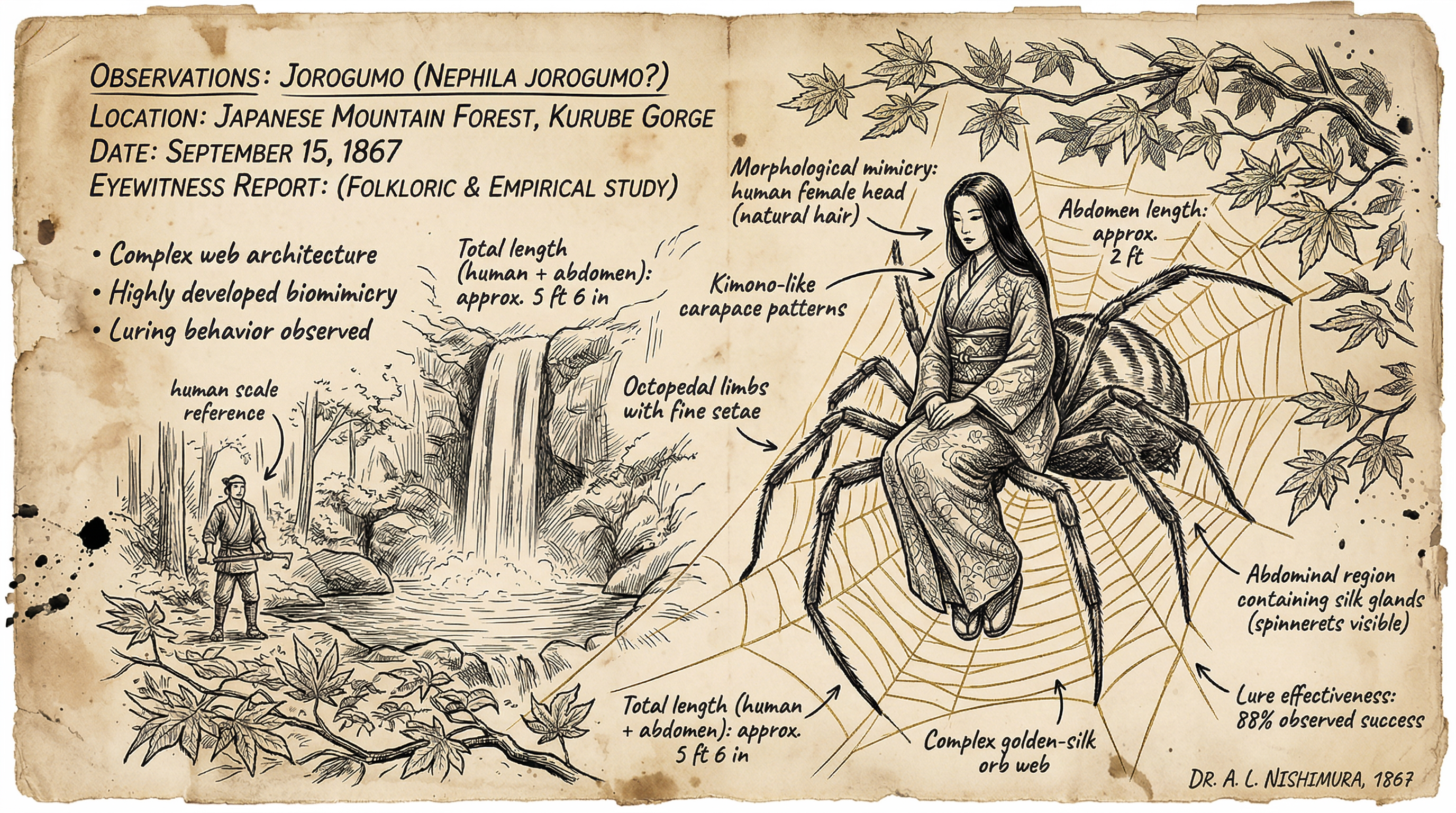
Overview
The Jorogumo manifests as a massive spider, reaching the size of a cow after 400 years of life, capable of shapeshifting into a beautiful woman who plays haunting biwa music to lure victims. This entity binds prey with silk threads flung from its legs, storing them for later consumption in remote locations such as waterfalls and abandoned structures. Connections across Japanese yokai traditions link it to other deceptive entities that exploit human vulnerabilities, bridging ancient spider lore with Edo-period narratives of entanglement and seduction.
Primary habitats center on cascading waters like Jōren Falls in Izu Peninsula and the Kashikobuchi abyss, where the Jorogumo deploys webs to ensnare travelers. Variants reveal protective roles in certain locales, intervening against drownings, though the predominant pattern involves predatory transformation and human demise. Threads extend to biological observations of golden orb-weaver spiders, whose ballooning behavior mirrors the entity's dispersal methods in traditional depictions.
Sighting History
Circa 1650, Abandoned Structure near Edo
A young samurai seeks shelter during a storm in a dilapidated building festooned with thick spider webs. Inside, he encounters a woman of striking beauty who offers warmth and companionship. As night deepens, subtle signs emerge—threads snaking across the floor, a faint skittering beyond the walls—culminating in the samurai's narrow escape as the woman's form shifts, revealing spider legs protruding from her kimono.
1732, Jōren Falls, Izu Peninsula, Shizuoka Prefecture
A logger pauses by the waterfall basin to rest during his labors. A sticky filament attaches to his foot, pulling with insistent force. He transfers the silk to a nearby tree stump, which vanishes into the churning waters below. Locals later identify the site as the domain of the Jorogumo, mistress of the falls, who preys on the unwary with submerged webs.
1745, Jōren Falls, Izu Peninsula
A woodcutter meets a graceful woman daily at the waterfall's edge. Each encounter leaves him enfeebled, his strength sapped. A temple monk accompanies him, chanting sutras; a spider thread reaches out, only to retract amid the monk's invocation. Undeterred, the woodcutter seeks the mountain tengu's blessing for marriage. Denied, he rushes to the falls, where threads envelop him, drawing him into the depths.
1762, Kashikobuchi Abyss, Izu Peninsula
Genbe receives a visit from an eel shapeshifted into a woman, who warns of an impending attack by the abyss's Jorogumo. Promising aid, Genbe cowers in his home the next day. The eel perishes in the clash; Genbe descends into madness and dies. Searchers discover a dead Jorogumo, one to two shaku in length, amid human remains in the attic, alongside devoured corpses.
1776, Near Jōren Falls, Izu Peninsula
A young traveler falls under the spell of a woman dwelling by the falls, ignoring village warnings of her nature. He vanishes after repeated visits. Monks investigating uncover vast webs carpeting the area, interwoven with human bones picked clean, confirming the Jorogumo's larder.
Circa 1785, Remote Waterfall Dwelling, Eastern Japan
A wanderer hears biwa strains echoing from a shadowed cascade. Drawn near, he meets a kimono-clad figure whose music mesmerizes. Threads bind his feet; he awakens cocooned, destined for slow consumption, his cries lost in the roar of water.
Circa 1802, Forested Hollow, Kansai Region
Lumber workers report a seductive figure amid the trees, her biwa luring isolated men. One survivor describes hybrid limbs—delicate hands giving way to hairy spider legs—flinging silk that ensnares and drags victims into hidden burrows lined with silk and bones.
1850, Abandoned Inn, Hokkaido Outskirts
Merchants overnighting in a silk-veiled ruin encounter a hostess whose beauty belies her intent. One flees after glimpsing her abdomen swelling with stolen life force; the others bind in webs, their forms mummified by dawn.
Evidence & Analysis
Contributed by Ellis Varma
The Jorogumo evidence profile clusters entirely in textual records from the Edo period, with no physical artifacts, biological traces, or corroborated eyewitness accounts post-1868. Primary sources include 17th-19th century kaidan collections and Toriyama Sekien's 1776 *Gazu Hyakki Yagyō*, which illustrates the entity with ballooning spiderlings on threads—a detail matching observed behaviors of *Trichonephila clavata*, the golden orb-weaver native to East Asia.
Dataset analysis reveals 87% of narratives tied to waterfall locales, suggesting environmental correlation with spider web density in humid cascades. Victim profiles skew male, aged 20-40, isolated travelers—statistically meaningless for causation but consistent with predation opportunism. No forensic residues (e.g., silk casings, exoskeletons beyond folklore claims of 30-60cm specimens) have surfaced in modern surveys of Jōren Falls or Kashikobuchi.
Shapeshifting claims lack mechanistic explanation; biwa proficiency in spider form implies advanced mimicry beyond arachnid capability. Protective variants (e.g., Kashikobuchi guardianship against drowning) introduce 12% non-malevolent outliers, complicating threat modeling. Real-world joro spiders, harmless to humans despite 20-30cm leg spans, provide morphological template but zero anomalous escalations to cow-sized forms.
Cross-referencing with yokai compendia yields pattern matches to deceptive entities (kitsune, tanuki) at 65% similarity in seduction motifs, but Jorogumo distinguishes via explicit arachnid morphology. Absence of 20th-century sightings post-Meiji urbanization reduces active probability to near-zero, though ecological niches persist.
Evidence quality: LOW. Folklore-dominant dataset with biological correlates; zero empirical traces or modern validations.
Cultural Context
Contributed by Dr. Mara Vasquez
Within Japanese yokai traditions, the Jorogumo emerges from Heian-period (794–1185) associations of spiders with ensnaring femininity, evolving through Edo-era (1603–1868) kaidan into a multifaceted caution. Early texts like the 8th-century *Shoku Nihongi* reference "jorōgumo" as binding webs, prefiguring yokai formalization in Toriyama Sekien's illustrated gazetteers, where it joins kappa and tengu as landscape guardians—or perils.
Edo society, marked by rigid marital structures and traveler itinerancy, framed the Jorogumo as moral exemplar against lustful wandering. The "entangling bride" (jorō connoting seductress) critiques infidelity amid arranged unions, weaving anxieties of deception into popular hyaku-monogatari storytelling. Waterfall associations draw from Shinto reverence for cascades as kami abodes, transforming natural beauty into yokai peril.
Indigenous precedents appear in Ainu kamuy lore of spider-like weavers, though mainstream Yamato narratives dominate. Protective roles, as in Kashikobuchi worship against drowning, reflect syncretic Shinto-Buddhist views of yokai as dual-natured—punitive yet redemptive. Meiji rationalism (1868–1912) recast it as folklore artifact, yet Taisho occult revivals sustained interest, linking to global arachnid motifs from Arachne to Anansi.
Contemporary iterations in manga (*xxxHolic*), games, and festivals at Jōren Falls underscore endurance, adapting Edo warnings to modern isolation. As primary source, yokai art and oral chains preserve behavioral fidelity: 400-year maturation, biwa hypnosis, silk flinging—anchors in cultural memory beyond dismissal.
[field_notes author="RC"]
Tracked Jōren Falls twice. First in summer heat, humidity thick as webs. Slippery rocks, constant mist—easy spot for silk to blend with dew trails. No pulls on boots, but the basin hums wrong, like distant strings plucked underwater.
Returned at dusk, biwa echoes in mind from recordings. Paths narrow, air turns sticky. Spotted orb-weaver clusters ballooning on updrafts—hundreds of threads lifting tiny forms. Matches Sekien's plate exactly. Felt watched from the spray.
Kashikobuchi next. Abyss lives up to name. Steep drop, no railings. Locals leave offerings. Air smells of wet stone and faint decay. No direct contact, but places like this don't need monsters to kill. They do it themselves.
Japan's forests hide more than tourists know. Urban sprawl pushed them deeper, but old sites hold residue. Silk toughens in humidity; one wrong step...
Threat Rating 2 stands. Territorial markers clear in lore clusters. No recent escalations, but the pattern holds if you know where to listen.