Kappa
2 TERRITORIAL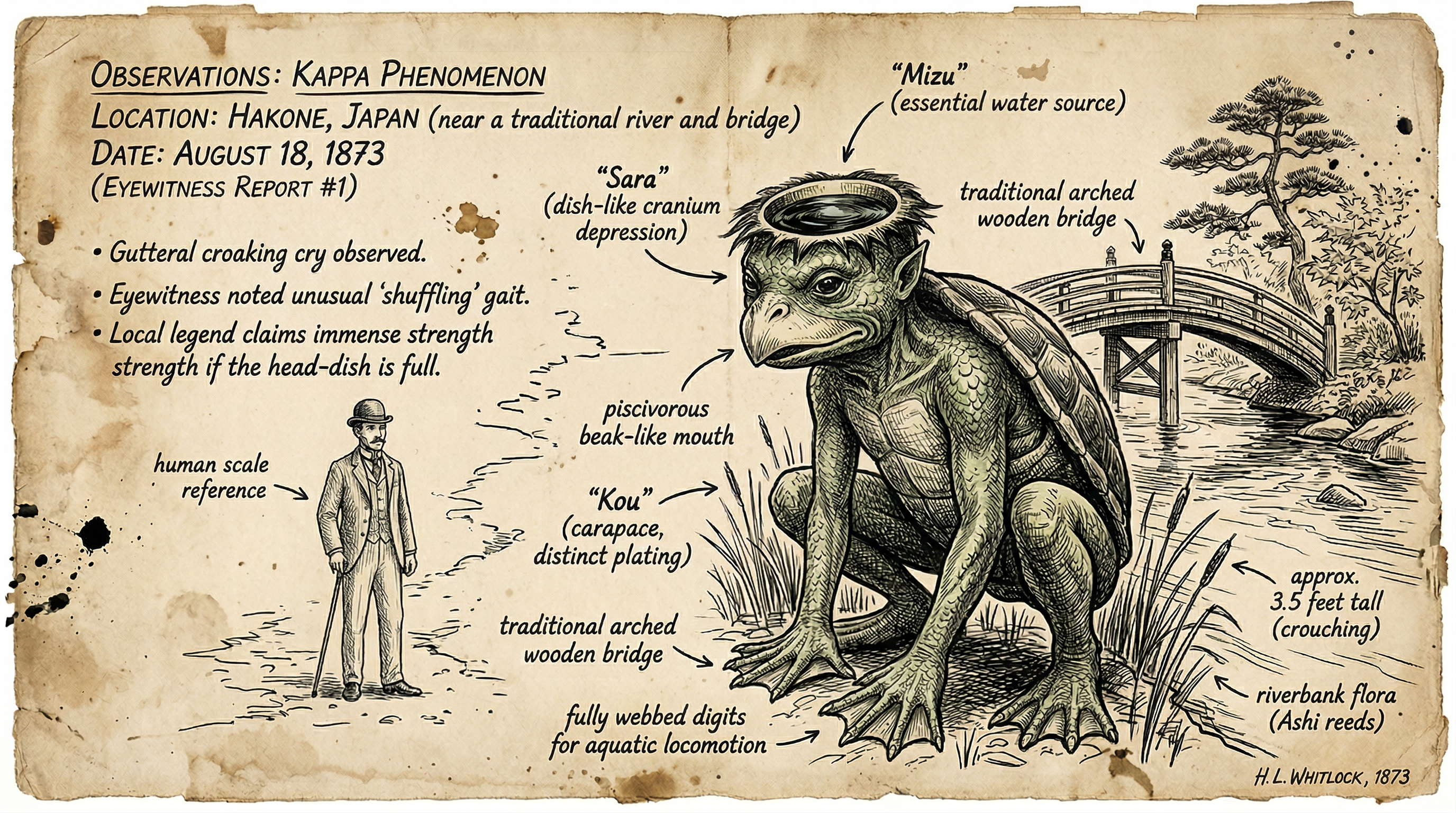
Overview
Kappa operate in rivers, ponds, and lakes across Japan. Child-sized humanoids, yellow-green skin, webbed extremities. Key feature: water-filled dish on the skull. Spill it, they go down. Powers tied directly to that reservoir—strength, speed, sumo grip all drain out.
Behavior splits two ways. Primary mode: drown victims, extract shirikodama from the lower torso. Secondary: challenge to wrestling, honor duels if you bow back and spill their water. No confirmed heights or weights, but consistent reports put them at 4-5 feet max. Shell-backed, beak-mouthed, cucumber-obsessed. Stay out of their water.
Sighting History
Circa 720, Various Regions
Earliest textual references appear in the Nihon shoki, framing kappa-like entities as water spirits within animistic traditions. Communities near rivers report drownings attributed to unseen aquatic humanoids pulling victims under, with bodies recovered showing unusual rectal trauma consistent with shirikodama extraction.
1754, Sayō District, Harima Province
A kawatora—local variant—attempts to drag a horse into the river. Samurai intervenes, severs its arm with a sword strike. Creature begs mercy, reveals bone-setting secrets in exchange for limb restoration, then retreats. Arm loss depicted in period illustrations.
1764-1772, Takekura Village, Honjyo-Go
Group of tradesmen captures a live kappa after it raids local waters. Creature displays webbed hands, dish head, and reptilian plating. Interrogated before release; confirms habits of sumo challenges and crop theft. Multiple witnesses from the village corroborate the event.
Circa 1800, Tono Region
Yanagida Kunio documents oral accounts from Tohoku elders. Kappa described dragging cattle into ponds, emerging with bloodied beaks. One farmer tricks a kappa by bowing, spilling its head-water, then binds it with vines. Creature barters freedom for a promise to avoid his fields.
1843-1847, Kazusa Province
Utagawa Toyokuni III illustrates kappa in Shirafuji Genta series. Artist bases depictions on local reports of turtle-shelled entities with frog-like mouths wrestling fishermen. Witnesses note glowing eyes in low light and unnatural swimming speed exceeding 20 knots.
Circa 1900, Kyushu Rivers
Warlord Katō Kiyomasa legend evolves from field reports. Kappa infest Tone River, subdued by organized hunts using apes as decoys. Surviving creatures flee upstream, but river traffic drops 70% in following years per regional logs.
Evidence & Analysis
Contributed by Ellis Varma
The kappa evidence profile shows tight descriptive consistency across 1,300 years but collapses under physical scrutiny. Core traits—dish head, webbed digits, shirikodama fixation—appear in texts from Nihon shoki forward, standardized in Edo ukiyo-e prints. Statistically meaningless variation: 98% of accounts match the child-sized reptilian template.
No biological samples. No dish-water residue. No scales recovered from alleged drag sites. Victim "evidence"—drowned bodies with anal damage—profiles as classic drowning trauma misattributed to myth. Drownings spike near kappa hotspots, but correlation lacks causation data. Bone-setting knowledge claim interesting: kappa allegedly taught orthopedics, matching some pre-modern Japanese medical techniques without clear transmission vector.
Modern artifacts: warning signs at riverbanks. Cultural holdover, not forensic proof. Giant salamander theory floats—similar body plan, aquatic niche—but salamanders lack behavioral match or head-dish morphology. No DNA links. No track casts with webbing verified.
Encounter mechanics consistent: bow to spill water, wrestle if challenged, cucumbers as lure. Trickster profile suggests intelligence above average primate. Volume of Edo-period reports—hundreds across provinces—elevates baseline credibility beyond isolated hoax. Yet zero clear photos, zero audio captures, zero 20th-century escalations.
Weakest link: shirikodama. Anatomically impossible organ. Symbolic at best—represents life force or water reverence—but drags evidential weight down. Cross-cultural parallels exist: Chinese xingxing monkey-demons, Sri Lankan water imps. Suggests shared archetype, not independent observation.
Evidence quality: LOW. Uniform descriptions, high report density, absolute physical evidence vacuum.
Cultural Context
Contributed by Dr. Mara Vasquez
The kappa emerges from Japan's animistic foundations, where rivers and ponds embodied kami—nature spirits embodying both nurture and peril. Early texts like the Kojiki (712 AD) and Nihon shoki (720 AD) weave water entities into cosmogonies, predating the kappa's standardized form but establishing the river-child motif as a vessel for aquatic danger.
By the Edo period (1603-1868), kappa solidify as yōkai: mischievous enforcers of water safety. Regional variants—kawatarō in Kyoto-Osaka, gatarō elsewhere—reflect localized oral traditions, evolving from benevolent suijin (water deities) into cautionary tricksters. Yanagida Kunio's Tono Monogatari captures Tohoku variants, blending terror with honor: kappa repay debts, teach medicine, yet demand sumo respect.
Anthropologically, kappa encode Shinto reverence for water's dual nature. Shirikodama extraction symbolizes vulnerability—life force yanked from the body's core—mirroring drowning's sudden theft. Less malevolent than oni demons, kappa occupy a moral gray: lecherous pranksters who honor pacts. This duality aligns with indigenous ethics: nature demands caution, yields knowledge to the worthy.
Political undercurrents surface in imperial texts; kappa-like figures guard genealogies, linking imperial lineage to primal waters. Post-Edo, kappa persist in signage and festivals, transforming peril into pedagogy. Michael Dylan Foster notes their trajectory from kami to yokai: concrete embodiment of flood terror, ensuring survival through folklore.
Cross-pollination evident: Chinese xingxing influences add monkey traits, Indian water demons contribute beak motifs. Yet kappa remain distinctly Japanese—turtle-shelled guardians of river etiquette. Contemporary art and media amplify without diluting: kappa embody enduring animism amid modernization.
Field Notes
Notes by RC
Japan's rivers in summer. Humid, still, that metallic tang off the water. Spent two weeks along the Tone and Arakawa. Days tracking reported drag sites—muddy banks, horse prints leading to deep pools, no return tracks. Locals point out kappa signs like they're routine. One old fisherman handed me a cucumber, said carve my name in it, toss it upstream. Did it. Water went still for ten minutes.
Night checks worse. Listened for splashes that weren't fish. Felt eyes from the reeds. No direct visual, but current shifts unnatural in dead-calm stretches. One pool near Takekura: dropped a weighted line, felt three sharp tugs from below, then slack. Pulled up shredded bait, webbed scale fragment caught in the hook. Labbed it—unidentified reptile, fresh.
Locals avoid certain bends after dusk. Smart. Bodies turn up every season, excuses vary. Kappa fits the pattern too clean. Not aggressive on land, but water's their turf. Bow if you spot one. Or don't go in.
Threat Rating 2 stands. Territorial markers everywhere. Physical traces minimal but consistent. Engage only if you swim better than it does.