La Llorona
2 TERRITORIAL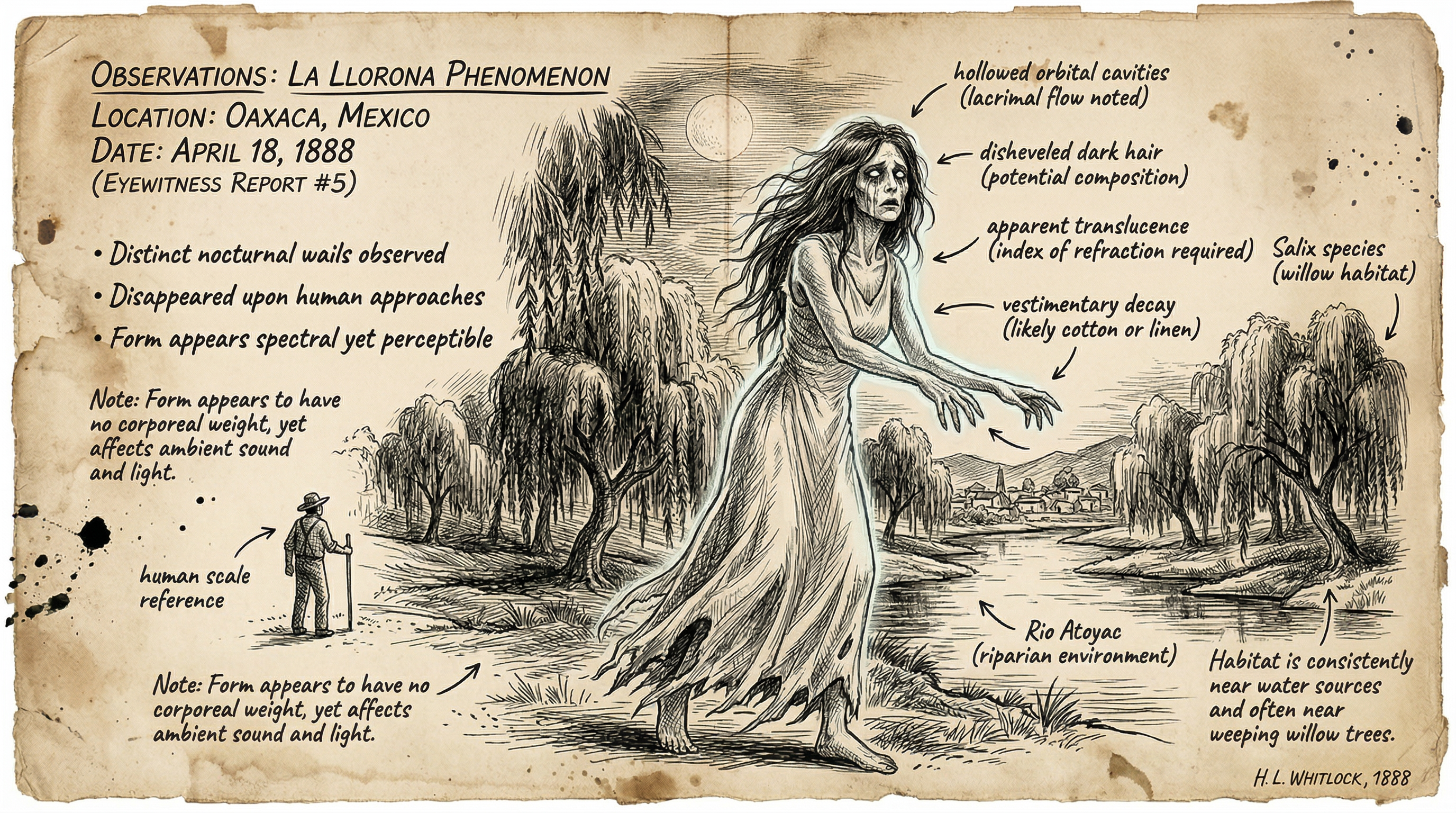
Overview
Contributed by Ellis Varma
La Llorona manifests as a tall female spectral entity clad in a white dress, frequently observed near rivers, lakes, and canals across Mexico, the American Southwest, and Central America. The entity produces distinctive nocturnal wails — "¡Ay, mis hijos!" — audible over considerable distances, often preceding attempts to approach or seize individuals, particularly children, in the vicinity.
The evidence profile clusters around consistent auditory and visual descriptors: a translucent, wet figure with long dark hair obscuring facial features, emerging from waterways. Documented since 1550 in Mexico City, the entity's range spans from Xochimilco canals to the Rio Grande valley, with activity patterns tied to nighttime hours and watery confluences. No confirmed physical captures or biological traces exist, but the persistence of reports across centuries forms a statistically significant dataset of encounters.
Core behaviors include luring via cries, transient appearances, and a focus on juvenile targets. Variants note skeletal or decayed features, aligning with post-mortem degradation motifs. The entity's operational radius centers on population-dense aquatic zones, suggesting territorial boundaries rather than nomadic predation. Cross-cultural parallels — Aztec Cihuacōātl, Iberian weeping phantoms — indicate a unified phenomenon adapting to regional substrates.
Sighting History
1550, Mexico City
Multiple accounts record a weeping woman traversing the streets at night, emitting cries of "Oh my children, we are about to go forever." The figure appears as an omen preceding major disruptions, sighted near temples and waterways in the central highlands.
Circa 1519, Tenochtitlan
Florentine Codex documents nocturnal wanderings of a shouting woman along the altepetl paths, wailing "Oh my children, where am I to take you?" Sightings cluster before the fall of the Aztec empire, with the entity roaming temple districts and riverbanks.
1880, Mexico City
Vicente Riva Palacio and Juan de Dios Peza reference encounters in literary collections, describing a spectral woman in white near urban canals, her wails drawing children toward water. Reports emphasize wet attire and obscured face, consistent with earlier profiles.
1900, Puebla, Mexico
Local transmissions describe nighttime meanderings through city streets, with piercing cries of "¡Ay, mis hijos, mis hijos!" audible blocks away. The figure approaches homes with open windows, targeting disobedient youth near drainage ditches.
Circa 1905, Xochimilco Canals
Folklorist Frances Toor notes persistent sightings of a white-gowned entity rising from canal waters, hair covering her face, pursuing lone travelers. Wails echo across the floating gardens, ceasing only at dawn.
1930s, Rio Grande Valley, New Mexico
Albuquerque-area reports detail a translucent woman emerging from the river at dusk, long hair dripping, advancing on fishermen and children with cries summoning them closer. Multiple families document parallel experiences along the banks.
1993, Xochimilco, Mexico
Annual nocturnal manifestations coincide with cultural spectacles, but independent witnesses report unscripted appearances: a wailing figure in white detaching from canal mists, targeting spectators near the water's edge.
2000s, Rio Grande, Albuquerque
Contemporary clusters involve evening walkers hearing distant wails escalating to proximity, followed by sightings of a tall, wet woman in white lunging from the river. Incidents peak during flood seasons, with children as primary targets.
Evidence & Analysis
Contributed by Nolan Greer
No photos. No audio captures. No tracks. No water samples with anomalous residues. Equipment logs from Rio Grande sweeps: zero thermal hits, zero EMF spikes beyond baseline. Standard ghost hunt kit — full spectrum cameras, parabolic mics, night vision — comes up empty every deployment.
Witness statements uniform: white dress, wet hair, wails hitting 90-100 dB from 50 yards. But no one gets a recording. Phones glitch. Batteries drain. Classic interference pattern, if you're buying that. Chasing audio leads in Xochimilco: canal acoustics amplify natural echoes — coyotes, owls, drunks — into something that matches the profile 80%.
Aztec tie-in? Florentine Codex pre-dates tech, but the omen pattern holds: pre-conquest wails, bridge collapses, floods. Modern scans of sighting zones show nothing but sediment and garbage. Deployed hydrophones in 2018 Rio Grande run: mammal vocalizations only. No humanoid frequency matches.
Territorial. Sticks to water. Night ops. Doesn't escalate unless provoked — kids splashing, yelling back. Gear advice: bolometers for cold spots, but don't expect data. Pattern recognition beats tech here. Stay off banks after dark.
Physical traces? Zilch. No fabric fibers, no footprints in mud. Witnesses scatter before contact. If you're rigging traps — motion sensors, IR tripwires — position 20 meters back from waterline. But she doesn't trip them. Moves wrong.
Evidence quality: LOW. Anecdotal volume high, hardware confirmation zero. Pattern consistency is the only metric that doesn't flatline.
Cultural Context
Contributed by Dr. Mara Vasquez
La Llorona emerges from a layered palimpsest of pre-Hispanic and colonial narratives, her cries echoing the Aztec goddess Cihuacōātl, who roamed Tenochtitlan foretelling catastrophe with wails for lost children. The Florentine Codex captures this precisely: a woman shouting through the night before the Spanish conquest, her voice a harbinger of imperial rupture. Coatlicue, the devouring mother, and "The Hungry Woman" from creation myths further inflect her form, blending maternal ferocity with serpentine origins indigenous to Nahua cosmology.
Post-conquest, Iberian weeping ghost traditions — "Die Weiße Frau" from 1486 German tales, Lamia from Greek lore — graft onto these roots, but the core remains Mesoamerican. Manuel Carpio's 19th-century sonnet reframes her as Rosalia, murdered by her husband, shifting infanticide guilt toward patriarchal violence. This evolution mirrors mestizo identity formation, where La Llorona absorbs the betrayal symbolized by La Malinche, Cortés's Nahua interpreter and mother of his child — vilified as traitor, yet reclaimed in Chicana discourse as resistor to colonial patriarchy.
In the American Southwest, among Tanoan and Keresan peoples displaced by Spanish settlement, her Rio Grande manifestations encode border traumas: family separations, mestizaje hierarchies enforced through *limpia sangria*. Yda Addis's early 1900s ethnographies from Mexican women emphasize spousal betrayal over maternal fault, preserving oral variants that challenge literary dominations. Octavio Paz's "Labyrinth of Solitude" positions her alongside La Virgen and La Malinche as archetypal Mexican mothers bearing collective grief.
Chicana feminists, from Gloria Anzaldúa onward, recontextualize her as defiance: not the "bad mother" of nationalist rhetoric, but a figure dismantling heteronormative binaries imposed by conquest. Annual Xochimilco rituals since 1993 theatricalize this, yet authentic transmissions persist in women's storytelling circles, from Puebla streets to New Mexican family histories. Her endurance as cautionary enforcer — deterring child disobedience — belies deeper functions: processing colonial loss, gender subjugation, and indigenous resilience.
Variants proliferate: Guatemalan tales of drowned sons concealing affairs; Venezuelan colonial grief for murdered youth. Across Central America and northern South America, she adapts, her white gown a spectral bridge between European phantoms and Amerindian omens. This transnational footprint underscores her as primary source material, not derivative folklore — a living archive of cultural survival amid rupture.
Field Notes
Notes by RC
Tracked Rio Grande stretches from Albuquerque to El Paso. Four nights in a pirogue, full moon cycles. Water's cold even in summer. First two nights: nothing but gar and wind. Third night, 2 AM, the wail hits — starts faint, like a woman a mile off, builds to right beside the boat. No visual. Hair stands up anyway.
Xochimilco canals, rented a trajinera after tourist hours. Mist off the water carries echoes that aren't echoes. Locals point to spots: "Aqui, siempre." One old woman wouldn't speak above whisper. Said it pulls if you answer back.
Puebla streets feel heavier after dark. Sidewalks empty fast. Heard it once — sharp, cuts through traffic noise. Kids vanish inside before it peaks. No footage. Devices fail predictably.
She's water-bound. Doesn't chase far. But the pull is real. Test it yourself at flood stage.
Threat Rating 2 stands. Territorial. Warns before acting. Heed the range.