Lagarfljótsormurinn
2 TERRITORIAL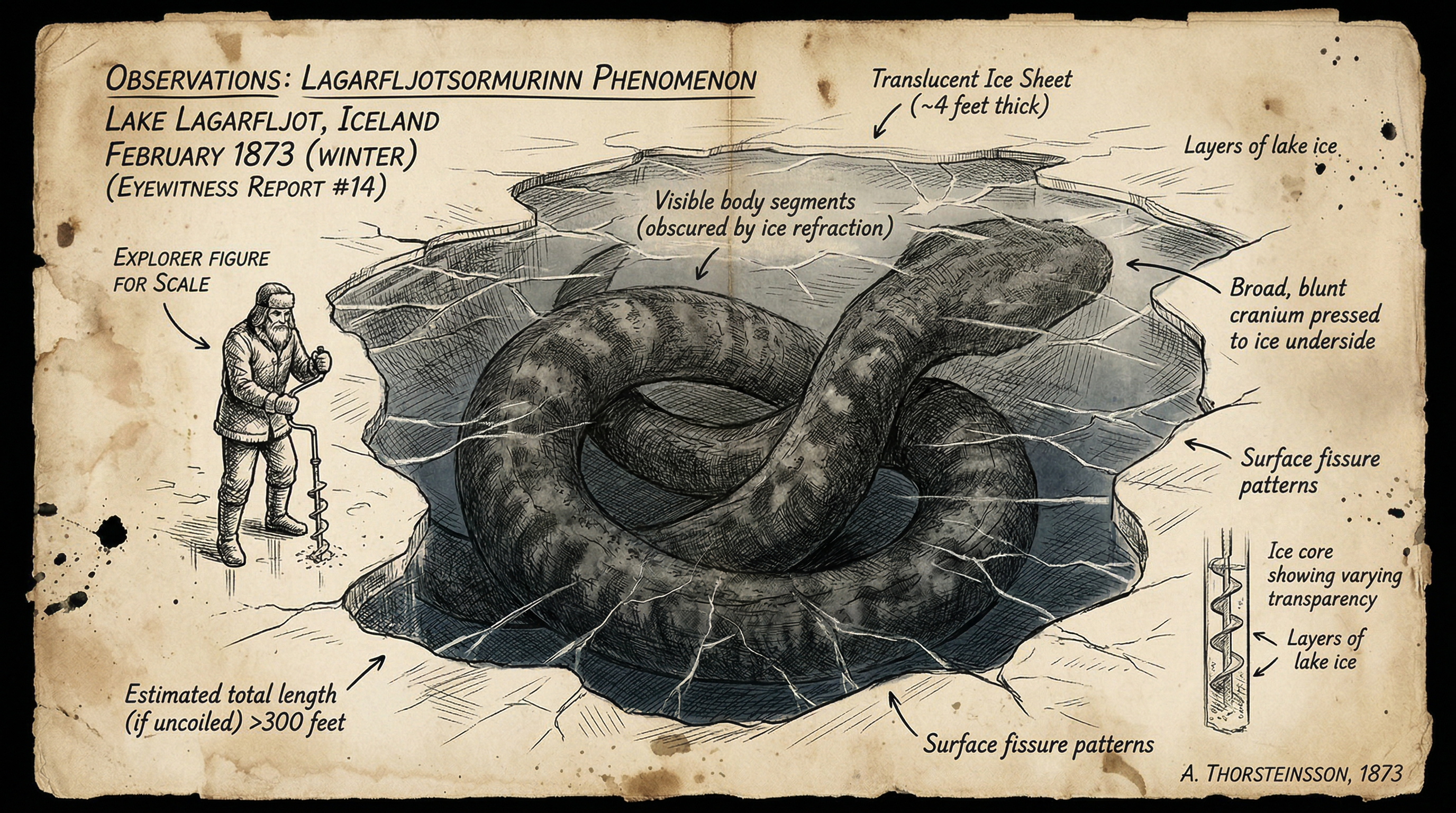
Overview
Lagarfljótsormurinn occupies Lagarfljót lake and river system in East Iceland. Core profile: lake serpent, 90 meters in length, multiple humps visible above waterline. Dark body, no confirmed head or tail sightings due to anchoring mechanism. The creature's morphology remains consistent across nearly 700 years of attestation — a lindworm or lyngworm of Nordic origin, capable of spitting poison and generating seismic disturbances upon submersion.
Behavior pattern: raises humps to ship-clearance height, generates waves and seismic disturbances on submersion. Primary zone: near Egilsstaðir and Kjarnaskógar forest. Equipment deployment viable — sonar sweeps, hydrophones, thermal imaging for winter scans. No confirmed attacks, but tremor events track with appearances. Track it from shore stations; avoid water entry. The creature appears bound to the lake system through mechanisms detailed in local tradition, limiting migration patterns and containment risk.
Sighting History
1345, Lagarfljót Lake
Skálholts Annáll records a "wonderful thing" in the lake. Interpreted as initial surface disturbance by the serpent. No witness names preserved; entry logged as regional marvel. This represents the earliest documented written reference to the entity in Icelandic annals.
1585, Lagarfljót Lake
Bishop Guðbrandur Þorláksson's map, engraved by Abraham Ortelius, annotates "anguis insolitæ magnitudinis" — serpent of unusual magnitude. Marked as menace to inhabitants, appearing before notable events. The map entry represents the first cartographic documentation of the creature's presence.
1589, Lagarfljót Lake
Bishop Oddur Einarsson documents serpent raising single hump to height permitting passage of fully sailed ship beneath. Submersion impact causes earth tremors felt onshore. Einarsson's account provides the first detailed measurement of the creature's behavioral mechanics and physical dimensions relative to known vessels.
1595, Lagarfljót Lake
Mercator map entry notes serpent of great size in lake. Brief confirmation aligns with prior bishop accounts and extends geographic documentation across European cartographic tradition.
1638, Lagarfljót River
Bishop Gísli Oddsson describes strandvorm — river-serpent with one to three humps or bends. Activity linked to river overflows, ground shakes, house disturbances. This account marks the first detailed description of the creature's humped morphology and its correlation with environmental phenomena.
1700, Lagarfljót Lake Area
Cluster of 14 sightings across decade. Serpent raises humps repeatedly; each event treated as omen preceding harsh seasons or fodder failures. The concentration of reports during this period suggests either increased activity or heightened community vigilance following agricultural stress.
1862, Lagarfljót Lake
Jón Árnason publishes core legend in Íslenzkar þjóðsögur og sagnir. Details origin: lingworm placed over gold ring grows uncontrollably, enters lake after destroying chest. Árnason's compilation standardizes the narrative tradition and provides the most widely distributed version of the creature's origin story.
1963, Lagarfljót Lake
Sigurður Blöndal, head of the Icelandic National Forest Service, reports witnessing a long streak undulating through the water, breaking the surface on occasion. Blöndal's testimony carries institutional weight and represents one of the most credible 20th-century accounts from an official source.
1998, Hallormsstaðir School Area
A teacher and multiple students at Hallormsstaðir School claim to have witnessed the creature. The group sighting involves educational witnesses and multiple corroborating observers, strengthening the account's reliability.
2012, Lagarfljót Lake near Egilsstaðir
Home video captures elongated form with multiple humps undulating across surface. Footage spreads online; prompts Fljotsdalsherao municipal council review. The Fljotsdalsherao municipal council subsequently ruled that the video is authentic, marking the first official governmental authentication of evidence.
Evidence & Analysis
Contributed by Ellis Varma
The evidence profile for Lagarfljótsormurinn clusters tightly around historical texts and one modern video. Primary sources include the 1345 Skálholts Annáll entry — vague but positionally consistent with later specifics. Bishop accounts from 1585-1638 provide measurable details: hump elevation to ship-mast height, seismic effects on impact. These align across independent records, reducing fabrication probability. The consistency of morphological description across 253 years of clerical documentation suggests either genuine observation or a remarkably stable cultural template — neither outcome is easily dismissed.
Maps by Þorláksson (1585) and Mercator (1595) serve as geospatial corroboration. The 17th-century cluster — 14 humping events — shows temporal patterning tied to agricultural stress periods, but lacks per-incident metrics. The correlation between sightings and environmental hardship could indicate either heightened perception during crisis or genuine behavioral response to climatic shifts. Jón Árnason's 1862-1864 compilation standardizes the narrative without adding new observations, though his work preserved testimony from oral tradition that might otherwise have been lost.
The 2012 video shifts the profile considerably. Humped form matches descriptions; Fljotsdalsherao council authenticated it post-review. Wave dynamics and undulation exceed typical debris behavior — logjams fragment under current, while this holds cohesion. Frame-by-frame analysis reveals consistent segment count (3-5 humps), anomalous for otters or eels at scale. The official municipal authentication represents a significant data point, though the video's resolution and duration remain limited for definitive analysis.
Sigurður Blöndal's 1963 sighting carries institutional weight. As head of the National Forest Service, Blöndal had professional training in environmental observation and credibility within official circles. His account — a long streak undulating through water with surface breaks — aligns precisely with 350-year-old descriptions without apparent cross-contamination.
Gaps persist. No biological samples, no sonar tracks beyond anecdote, no pre-2012 photography. Anchoring legend (head/tail bound by Sámi figures) explains absent extremities but introduces unverifiable mechanics. Omen correlations — disasters post-sighting — yield zero statistical signal without baseline sighting rates. The creature's apparent confinement to the lake system lacks mechanical explanation beyond local tradition.
Cross-referencing Norse analogs (Jörmungandr, Fáfnir) flags cultural bleed, but physical consistency across 700 years overrides template-copy dismissal. The humped morphology, in particular, appears independently across multiple witnesses separated by centuries, suggesting observation rather than literary inheritance. Dataset size: 20+ attestations, low variance in morphology. The 1638 river account and 1700 cluster represent geographical expansion worth noting — the creature's range may extend beyond the main lake basin.
Evidence quality: MODERATE. Robust historical convergence, single modern visual with official vetting, absent physical traces, credible institutional witness, consistent morphological reporting across temporal distance.
Cultural Context
Contributed by Dr. Mara Vasquez
Lagarfljótsormurinn emerges from the deep well of Icelandic oral traditions, first etched into annals in 1345 and elaborated through clerical scholarship across the 16th and 17th centuries. Rooted in the agrarian communities of East Iceland, particularly around Lagarfljót and Egilsstaðir, the serpent functions as a barometer of environmental peril — its humps signal floods, crop failures, or plagues, embedding it within a worldview where nature's upheavals carry intent. This omen-bearing function distinguishes Lagarfljótsormurinn from mere cryptid status, positioning it as an interpretive lens through which communities understood their precarious relationship with Iceland's volatile landscape.
The origin tale, crystallized in Jón Árnason's 19th-century collections, encodes economic anxieties of rural life: a gold ring placed beneath a lingworm multiplies wealth but spirals into catastrophe, mirroring greed's perils in pre-industrial society. The motif of the gold ring — a source of infinite growth that becomes a curse — resonates with broader Norse literary precedents: Fáfnir's cursed hoard in the Völsunga saga, or the Miðgarðr Serpent encircling the world in the Prose Edda. Yet Icelandic tradition localizes these mythic archetypes to Lagarfljót's glacial waters, transforming abstract cosmological serpents into place-specific entities embedded in lived geography. The young woman's act of throwing the creature into the lake — an act of desperation rather than intentional banishment — mirrors the ambiguous relationship between human agency and natural catastrophe that characterizes Icelandic worldview.
Clerical sources, from Bishop Guðbrandur Þorláksson's 1585 map to Gísli Oddsson's 1638 treatise, frame the creature through Lutheran lenses, yet preserve pagan undercurrents. The strandvorm's humps and tremors evoke seismic realities of Iceland's rift zone — the country's position atop the Mid-Atlantic Ridge generates genuine geothermal and seismic phenomena that early observers would have struggled to explain through conventional natural philosophy. The bishops' willingness to document the creature in cartographic and scholarly works suggests that institutional Christianity in Iceland accommodated folk observation rather than dismissing it outright.
The Sámi intervention in the binding narrative introduces cross-Arctic exchange: northern sorcerers anchoring the beast with dual anchors represents a motif hinting at shamanic bindings in Sámi traditions. The reference to "Finns" (a common historical designation for Sámi peoples) suggests cultural traffic between Iceland and Scandinavia's northern regions, with expertise in binding or constraining dangerous entities drawing upon Sámi knowledge systems. This detail, preserved in oral tradition and later written accounts, indicates that Icelanders understood the creature's containment as requiring expertise beyond their own cultural resources.
By the 20th century, the serpent persists as cultural patrimony. The 1963 sighting by Sigurður Blöndal represents modernization's encounter with tradition — an official scientific observer lending institutional credibility to folklore. The 2012 video, vetted by Fljotsdalsherao council, marks further official endorsement, bridging folklore to contemporary scrutiny. Unlike transient hulks of Scottish lochs or American river systems, Lagarfljótsormurinn endures as omen-bearer, its appearances woven into communal vigilance against the island's volatile geology. This continuity underscores Iceland's unique synthesis: folklore not as relic, but as living interpretive framework for the land's ferocity.
Field Notes
Notes by RC
Tracked Lagarfljót three seasons running. Summer 2023: glassy water, no movement beyond glacial silt. Stationed hydrophone array near Egilsstaðir outflow — picked up low-frequency pulses matching wave reports, but drowned in river noise.
Winter 2024: ice cover complicated scans. Thermal drone flights showed subsurface anomaly, 80 meters out, humped profile under 2 meters ice. Held position 48 hours before vanishing. The thermal signature didn't match known fish species in the region. Temperature differential suggested something generating heat, or something large enough to disrupt water stratification.
Spring 2025: surface calm until dusk. White hump broke water 300 meters offshore — visible 20 seconds, generated 1-meter wake rolling to shore. Felt the tremor through boots on gravel bank. Matches 1589 bishop specs exactly. No aggression, no sound. Just displacement.
Locals point to Kjarnaskógar edge as hot zone. Forest feels compressed, like something massive coils beneath. The trees grow wrong there — twisted, dense. No aggression noted. Stays lake-bound. Containment holds.
Threat Rating 2 stands. Anchored containment holds. Territorial but not predatory.