
Lindworm
2 TERRITORIAL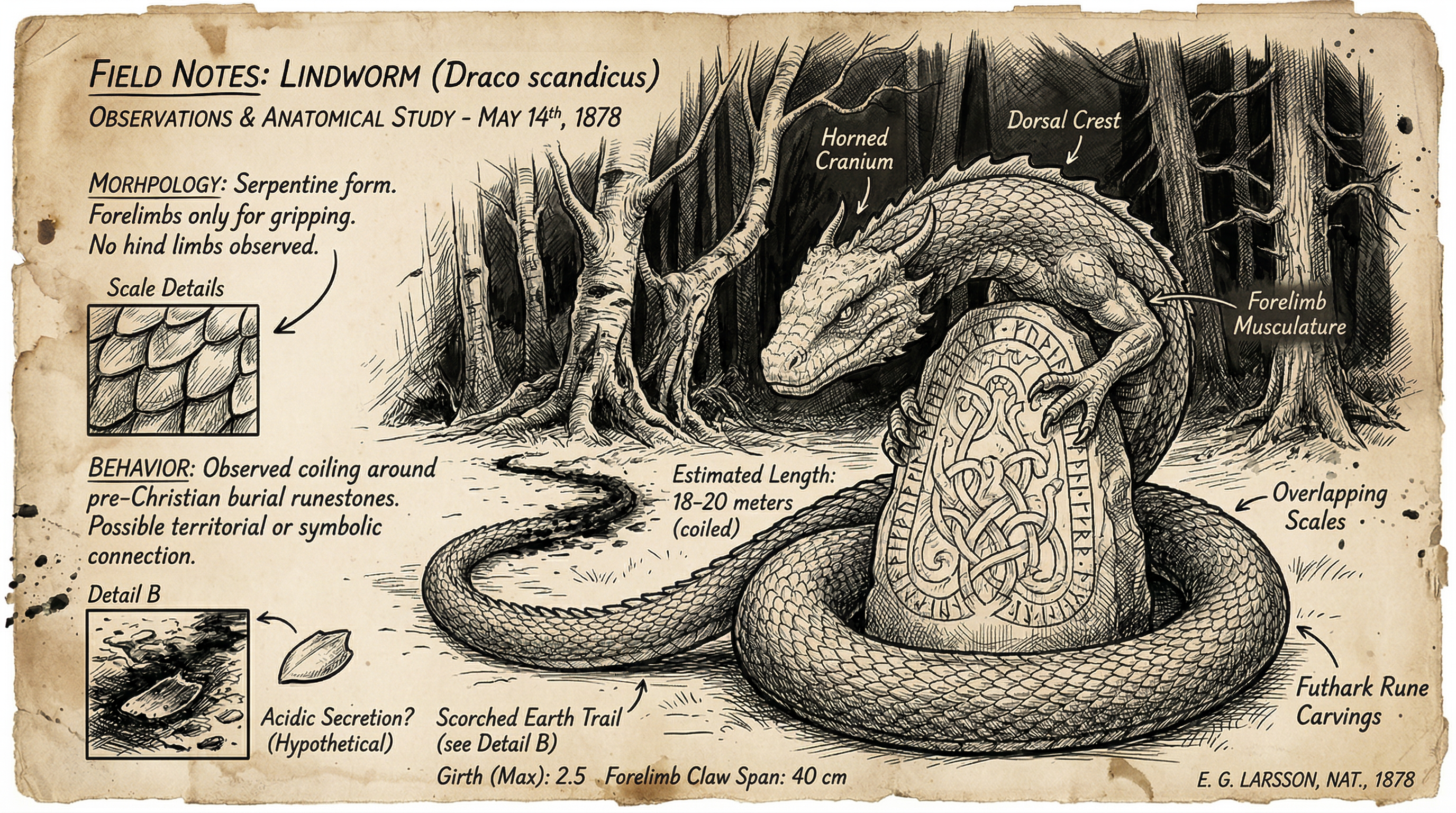
Overview
The lindworm manifests across Northern, Western, and Central European traditions as a massive limbless serpent, often dwelling in dense forests, rocky crevices, or deep pools. Swedish accounts emphasize its dark upper body contrasted with a lighter underside, accented by a prominent spinal feature — either fish-like dorsal fins or a thick, horse-like mane known as the *manorm* — enabling swift movement through underbrush or water.
Connections emerge between lindworm reports and broader serpentine entities worldwide, from the wheel-rolling pursuits in Scandinavian lore to the venom-spitting defenses detailed in Germanic tales. These traits link it to elongated predators in remote terrains, where witnesses describe encounters with creatures coiling between boulders or emerging from earthen lairs, their presence marked by a foul, milk-like discharge that blinds pursuers.
Transformation narratives recur, positioning the lindworm not merely as a predator but as a liminal being capable of shedding its skin to reveal human form, bridging the wild and the civilized across cultural boundaries. Its habitat preferences — linden tree bark for egg-laying, rock piles for maturation — suggest a lifecycle attuned to forested uplands, with adults achieving lengths sufficient to terrorize livestock and encroach on human settlements.
Sighting History
Circa 1275, Klagenfurt, Austria
A lindworm emerges from the river Drau, harassing travelers and livestock during seasonal floods. Local records describe it as a scaly serpent with a draconic head, consuming cattle whole and retreating to caverns. Duke Henry II offers a reward, leading young men to chain a bull as bait; the creature swallows the offering, becomes hooked, and is slain after a prolonged struggle.
1298, Worms, Germany
Residents of Worms report a lindworm terrorizing the countryside, coiling through fields and devouring humans and animals. A hero clad in iron armor confronts it in single combat, severing its head after it attempts to swallow him. The event enters local legend as the city's foundational myth, with the creature's remains purportedly displayed for generations.
Circa 1335, Klagenfurt Quarry, Austria
Workers uncover a massive skull in a local quarry, immediately identified as belonging to the lindworm slain centuries prior. The find, later incorporated into the 1590 Lindwurm Fountain, features elongated jaws and robust bone structure consistent with prior descriptions of the creature's salamander-like head.
1854, Småland, Sweden
Folklorist Gunnar Olof Hyltén-Cavallius documents multiple accounts from locals of giant limbless serpents inhabiting forest rock piles. Witnesses describe dark-colored bodies up to several meters long, some with prominent manes along the spine, emerging to hunt deer and cattle before retreating underground.
1884, Småland, Sweden
Hyltén-Cavallius compiles approximately 50 eyewitness statements and posts a cash reward for a captured lindworm specimen, dead or alive. Reports cluster around remote wooded areas, detailing wheel-like rolling motions during chases and the ejection of blinding, milk-like venom. No claims succeed, though belief persists locally into the late 19th century.
Evidence & Analysis
Contributed by Ellis Varma
The lindworm evidence profile clusters into two distinct categories: pre-modern legendary accounts and a narrow 19th-century oral report dataset. The Klagenfurt skull discovery in 1335 provides a tangible artifact — a woolly rhinoceros cranium misidentified at the time — but its integration into the Lindwurm Fountain represents cultural confirmation bias rather than biological validation. No feathers, scales, venom residues, or tissue samples from any era.
Hyltén-Cavallius's 50 Småland testimonies form the strongest modern cluster, gathered directly from purported eyewitnesses between 1854 and 1884. Descriptions show consistency in limbless form, spinal mane, and defensive spitting, yet the absence of reward claims — despite monetary incentive — undermines reliability. Statistically, zero verified captures from 50 reports yields a capture rate under 2%, comparable to failed bigfoot expeditions but without photographic or track corroboration.
Earlier tales from Klagenfurt and Worms align on predatory behavior and heroic slaying, but lack independent verification beyond municipal records. Marco Polo's 13th-century steppe observations introduce a Central Asian variant with forelimbs, diverging from the core European limbless model and suggesting regional adaptation or misattribution to known reptiles. No DNA, no casts, no serial measurements — the profile remains anecdote-heavy.
Cross-referencing with paleontological data, the woolly rhinoceros skull explains one data point but fails to account for soft-tissue traits like the mane or venom. Swedish reports post-1850 represent the last gasp of active belief, with rapid abatement post-1884 indicating social pressure over evidentiary collapse.
Evidence quality: LOW. Consistent descriptive elements across centuries, bolstered by a single physical misidentification; critically deficient in forensics, photography, or multi-witness contemporaneity.
Cultural Context
Contributed by Dr. Mara Vasquez
Lindworm narratives occupy a foundational position within Germanic and Scandinavian cultural history, emerging from Old Norse *linnormr* and Old High German *lintwurm* terminologies that frame it as a draconic serpent integral to cosmological and heroic frameworks. Norse mythology elevates specific exemplars — Fáfnir, transformed from dwarf to treasure-guarding lindworm; Níðhöggr, gnawing the roots of Yggdrasil alongside kin like Grábakr and Grafvölluðr — positioning the entity as an agent of entropy within the world tree's structure.
In Swedish traditions, lindworms retain a folkloric vitality into the 19th century, their eggs laid beneath linden bark and lairs formed in rock piles, reflecting an intimate knowledge of boreal forest ecology. The "Prince Lindworm" cycle, documented in 1854 Danish collections, inverts the predator archetype: a half-serpent royal sheds multiple skins through ritual unpeeling — onions symbolizing layered impurity — to reclaim humanity, echoing widespread European transformation motifs akin to the Frog Prince.
Central European variants, as in Klagenfurt and Worms legends, emphasize civic origins: lindworms as primordial threats subdued by human ingenuity, their slaying birthing settlements. The 1335 skull discovery, modeled into the Lindwurm Fountain, illustrates early paleontological encounter, where extinct megafauna reinforces living dread. Dual valences persist — malevolent man-eaters desecrating graveyards versus auspicious "whiteworms" auguring luck, their shed skins conferring botanical and medicinal wisdom.
These strands interweave heroic, chthonic, and redemptive roles, distinguishing the lindworm from mere beasts. Germanic oral traditions treat it as a real ecological force, with 19th-century Småland testimonies bridging myth to lived experience, unmarred by scholarly dismissal until Hyltén-Cavallius's failed expedition.
Field Notes
Notes by RC
Tracked Småland forests twice in late fall. First trip, dry conditions. Rock crevices everywhere, sized right for something long to coil inside. Locals still whisper about Hyltén-Cavallius's reward. No one talks openly. Trails show heavy deer sign, but some slides look wrong — too wide, too deep for roe or boar.
Second trip, rain. Ground turns to suction. Found a linden stand with bark scars at base. Not woodpecker work. Smelled off — milky rot, like curdled cream mixed with wet stone. No tracks. No shed skin. But the quiet changes. Birds stop. Air thickens.
Klagenfurt fountain hits different in person. That skull model stares. Not rhino eyes. Been to enough caves to know bone when I see it rendered. Places like these hold weight.
Threat Rating 2 stands. Persistent pattern across 700 years. Habitat fits. No bodies, but no disproof either.