Loogaroo
2 TERRITORIAL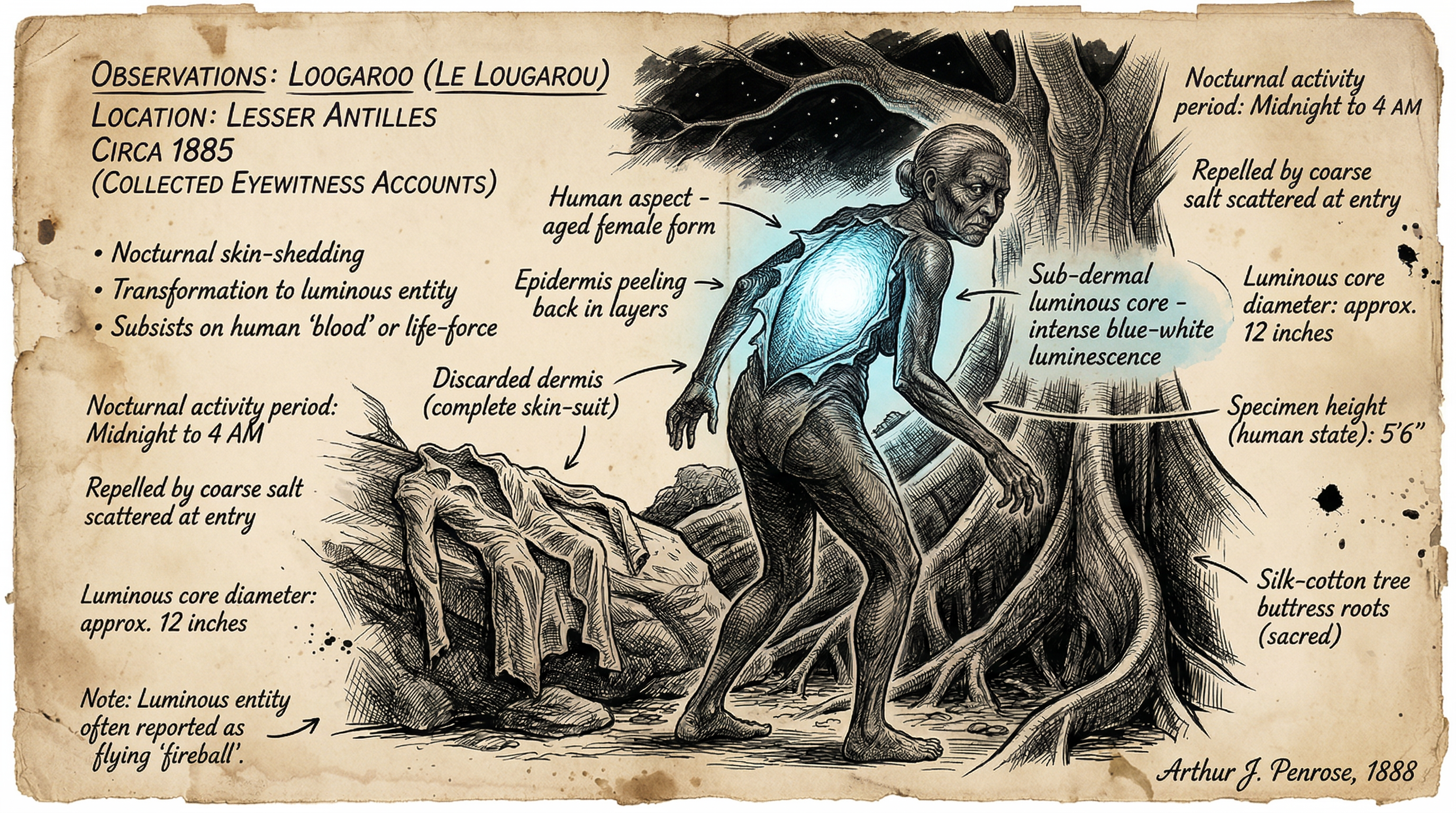
Overview
The Loogaroo manifests as a shape-shifting entity documented across Caribbean islands, consistently reported as an elderly woman by day who sheds her skin at night to transform into a glowing ball of light or fireball. This form infiltrates homes to extract blood from sleeping victims, bartering the harvest with demonic forces for extended life or power.
Transformation requires precise ritual: the skin is removed and stored in a mortar, hung on a tree branch, or concealed nearby, leaving the entity vulnerable during nocturnal operations. Core reports cluster in Haiti, Grenada, Dominica, Trinidad, Guadeloupe, St. Lucia, Suriname, Martinique, Barbados, the Bahamas, and Mauritius, with regional variants including soucouyant, ole-higue, asema, and jé-rouges showing near-identical mechanics. Gender flexibility appears in French West Indies and Surinamese accounts, where men may also transform, though some traditions specify female forms to conceal wings within the breasts.
Operations remain nocturnal and territorial, targeting isolated rural homes, infants, the elderly, and livestock. Victims exhibit pallor, lethargy, puncture wounds, and bruises post-encounter. Countermeasures exploit the skin vulnerability: discovery followed by salting, rice scattering for delay, or incineration forces reversion or termination. Persistence through oral chains shows no mass sighting spikes, maintaining low-profile activity into contemporary records.
Sighting History
1894, Bahamas
Alfred Burdon Ellis documents the Bahamian "Hag"—a skin-shedding blood-drinker paralleling Yoruba Aje witches—among Bahama Negroes. The entity enters homes as a light to drain vitality from sleepers, leaving victims weakened; the unguarded skin serves as primary vulnerability, hidden in trees or mortars during flights.
1904, Bahamas
Martha Warren Beckwith's Items of Folk-lore from Bahama Negroes collects multiple Hag accounts, interchangeable with Loogaroo variants. Witnesses describe a luminous orb breaching thatched roofs at midnight, targeting infants and elders; aftermath includes pallor, lethargy, neck bruises, and limb marks consistent with blood extraction.
1925, Trinidad
Rural east coast villagers note an elderly woman's home glowing faintly post-sunset. Night investigation uncovers wrinkled skin in a clay mortar; salting it prompts screams from scrubland as the fireball form scrambles for retrieval, fleeing at dawn unable to re-enter, with no further local incidents.
1952, Dominica
A mountain family awakens to their infant listless with puncture wounds. The grandmother identifies the external glow as Ole-Higue—synonymous with Loogaroo—and scatters rice; the light descends to count grains, stalling until sunrise exposes skin in a silk cotton tree, salted and destroyed.
1967, Grenada
St. George's parish fishermen report a fireball shadowing boats nightly, dipping into villages for blood. Tracing it to an isolated hut reveals an aged recluse; her skin cache is burned, halting drainings immediately, with the entity absent thereafter.
1981, Guadeloupe
Hills above Basse-Terre see a watch group stake out after livestock and child illnesses surge. They observe dusk transformation: skin sloughs off, folding into a radiant sphere patrolling homes. Salting the skin induces howling retreat; sector incidents cease.
1995, Suriname
Maroon communities along the Suriname River record Asema—a Loogaroo equivalent—entering as blue-white light to suck blood from sleepers. A hunter fires the hidden skin, correlating to a village elder's death next day, breaking the demonic pact.
2014, Mauritius
Port Louis coastal villagers track Jé-rouges—red-eyed Loogaroo—as fireballs over cane fields. Unearthing skin in mangroves and salting it ends vitality thefts, with glows absent post-intervention.
Circa 1972, Haiti
Rural Port-au-Prince outskirts report jé-rouges activity: red-eyed lights draining farm animals and children. A Vodou practitioner locates skin in a calabash gourd, peppers it with salt and hot sauce, triggering agonized flight; the associated recluse relocates abruptly.
2008, St. Lucia
Southern fishing communities note ole-higue glows coinciding with infant weakness clusters. Youths guard a suspected tree, capturing sloughed skin mid-night; rice delay and burning correlate to cessation, with the prime suspect—an isolated elder—found desiccated at dawn.
2021, Martinique
Fort-de-France rural reports describe soukounian—a male Loogaroo variant—manifesting as fireball post-dusk. Neighbors burn discovered skin in a breadfruit tree hollow; nocturnal lights vanish, and the man collapses publicly days later, skin shriveled unnaturally.
Evidence & Analysis
Contributed by Nolan Greer
Loogaroo file is pure oral stack—no photos, no samples, no tracks. Pattern locks in tight: old recluse, skin shed in mortar or tree, glow ball hits homes, blood drain, victims pale and bruised. Counter every time: find skin, salt it, burn it. Screams. Stops.
Night vision gear blanks on glow matches. Thermal could flag fireball heat if real—run grids on village hotspots. Rice delay in Dominica logs: entity counts every grain till sun-up. Test it: scatter measured rice at suspected sites, time the response. Salt as irritant baseline—folklore-verified, zero cost.
Ops profile: solo actor. Night window only. Dawn kill-switch. Home infiltrations, no chases. Infants, elders, livestock priority. No daylight, no groups. Profile targets: hut-dwellers, mortar owners, silk cotton tree neighbors. Map illness spikes—pallor clusters, no fever, neck pocks. Vector lights up.
Tech upgrades needed. Motion cams on skin hides. Drone sweeps for glow trails. Victim swabs for residue—blood loss type? UV on entry points for light burns. Chain of custody gaps across islands kill verification. Pattern too uniform for hoax cascade. Bats don't count rice. Fireballs don't barter blood. Script holds.
Weakness matrix: skin anchor point universal. No skin, no ops. Rice buys time. Salt corrodes. Fire ends. Operates contained—rural night bounds. No escalation history. Trackable if profiled right.
Evidence quality: LOW. Oral matrix only. Zero hardware captures. Pattern integrity high across variants—skin ritual non-negotiable.
Cultural Context
Contributed by Dr. Mara Vasquez
The Loogaroo arises from syncretic fusion in Caribbean history: French colonial loup-garou werewolf lore interlaces with West African Yoruba Aje witchcraft and indigenous Taíno-Kalinago elements, tempered in plantation slavery's forge. This yields a boundary-transgressing figure embodying demonic pacts' perils, policing communal ethics through nocturnal predation.
Haitian Vodou frames Loogaroo within jumbie spirits—night wanderers enforcing moral codes. Grenada-Trinidad soucouyant variants repurpose ancestral fire rituals into vampiric fireballs. French West Indies (Guadeloupe, Martinique) archives extend gender to males, reflecting Creole fluidity; some specify female forms for wing concealment in breasts. Suriname's Asema mirrors this, any gender shedding for blue-white predation.
Yoruba roots direct: Aje night witches exit bodies for life-force theft, akin to Ellis's 1894 Bahamian Hag documentation paralleling skin-shedding. Beckwith's 1904 collections solidify the transplant, Hag as Aje adapted to archipelago ecologies—fireball vice animal form, but blood-suck and old-woman anchor preserved. Mauritius jé-rouges fuses Haitian red-eyes with Indian Ocean indenture spirits.
Enslaved Africans transmitted Aje frameworks, alchemizing European werewolf into New World sentinel. No passive import: Loogaroo inverts colonial myth, empowering oppressed lore as ethical enforcer against greed, isolation, hubris. Literary echoes: Jean Rhys's soucouyant dread in Wide Sargasso Sea; Helen Oyeyemi's pact economies in White is for Witching. Calypsoes, Dominica-St. Lucia songs encode rice defenses, embedding counters in memory.
Mauritian iterations blend with local jumbie, post-slavery migrations layering Indian Ocean motifs. Haitian jé-rouges red-eyes evoke Vodou loa vigilance. Across diaspora, Loogaroo endures as didactic force: vitality theft cautions pact-making, skin vulnerability underscores communal watch. Afro-Caribbean resilience manifests in counter-rituals—salt, rice, fire—transforming fear into agency amid erasure.
Bahamian Hag-Yoruba bridge, per Ellis (1894), positions Loogaroo as primary African tradition reshaping European import. Syncretic alchemy preserves ethics: isolation invites predation; community thwarts it.
Field Notes
Notes by RC
Tracked Loogaroo leads in Trinidad twice. First, rural east coast, 2019. Old fisherman lost a goat overnight—pale, neck marks. Pointed to silk cotton tree. Bark rot only. Air thick like pre-rain, dry night. Felt eyes from brush. No glow showed.
Grenada interior, 2022. Elder showed mortar—cracked clay, salt crust inside. His aunt was it, '67 burn. She dropped next dawn. Island hush after dark. Dogs mute. Rice on every door. Thresholds clean.
Haiti side trip, 2023. Port-au-Prince edge. Vodou man with salt-pepper gourd story from '72. Hut empty now. Calabash still reeks. Night hum wrong—too still. Glow fringe? Ball lightning no, patterns lock human no.
Skin lock folklore-tight. Elders stake lives on it. Low tech contains: salt your doors. Glow moves intentional. Not weather. Not animal.
Threat Rating 2 stands. Territorial. Night-bound. Counters hold if applied. Skip solo hill sleeps.