Manipogo
2 TERRITORIAL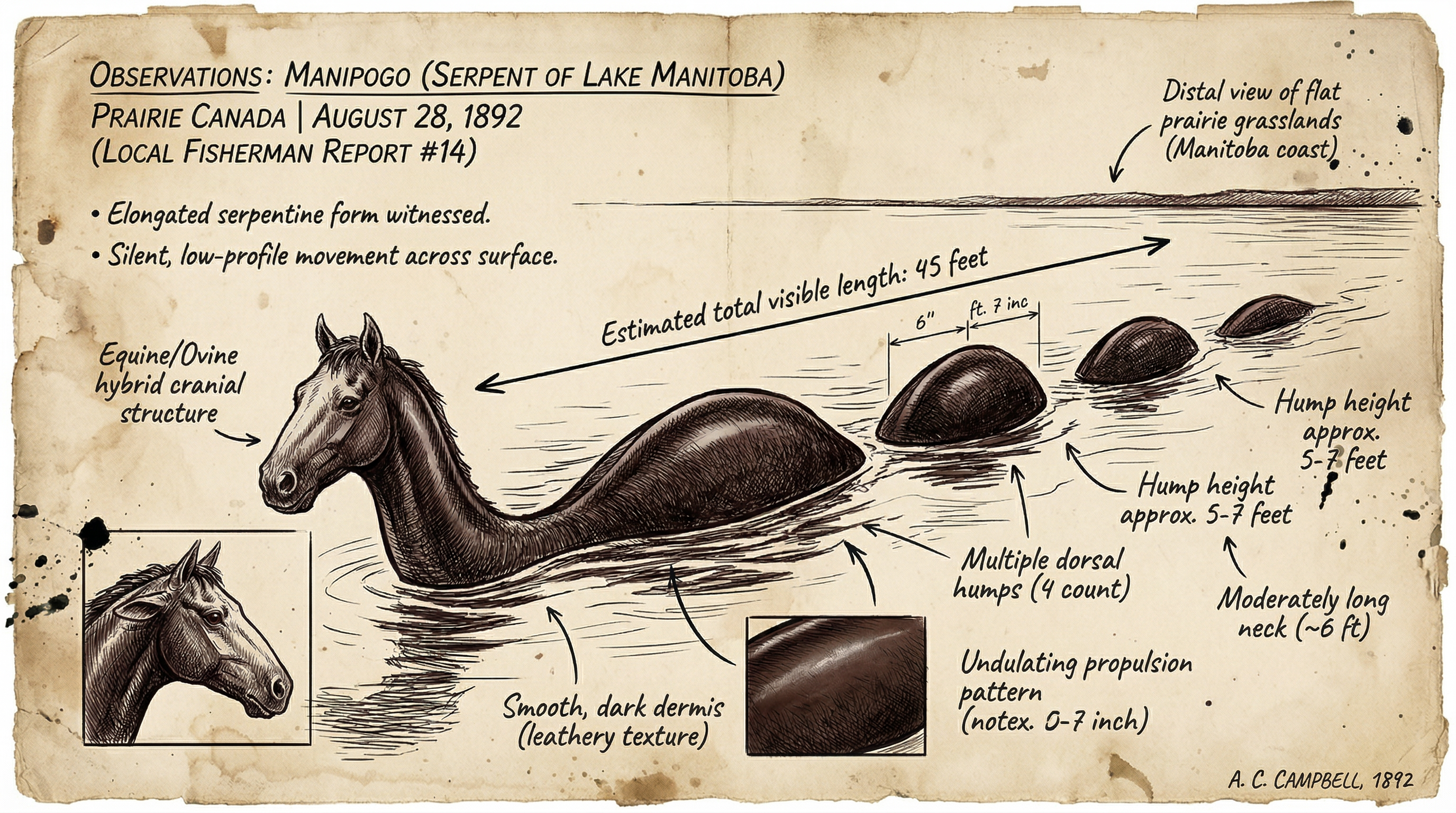
Overview
Manipogo inhabits the shallow waters of Lake Manitoba, a vast inland sea averaging just seven meters deep across its 4,700 square kilometers. This serpentine entity connects ancient Anishinaabe narratives with contemporary reports from fishermen, residents, and visitors, appearing as a dark, humped form that surfaces in shallows before vanishing into the murk.
Descriptions span cultures yet converge on core traits: a brownish-black body 13 to 50 feet long, marked by multiple humps breaking the surface, a body about one foot thick, and a head likened to that of a horse or sheep. Its movements outpace motorboats, and some accounts note a shrill cry echoing across the water. Links extend to neighboring Lake Winnipegosis via reports of Winnepogo, suggesting a shared population navigating connected waterways.
The lake's ecology supports such a presence. Lake Manitoba hosts sturgeon exceeding 15 feet, though none match the humped profile or speed. Shallow bays like Twin Lakes Beach and Meadow Portage concentrate sightings, where the creature favors depths under 10 feet. Indigenous traditions frame it as gichi ginebig, bridging physical form with roles in healing and warning, while settler encounters since 1909 build a timeline of intermittent surfacing tied to seasonal patterns and human activity.
Manipogo's persistence draws from the lake's isolation—its remoteness limits systematic surveys, preserving conditions for an undiscovered megafauna. Comparisons to Ogopogo in British Columbia highlight a North American pattern of lake serpents in prairie and cordilleran waters, where glacial remnants provide refugia for relict species.
Sighting History
September 1909, Cedar Lake
Hudson's Bay Company fur trader Valentine McKay observed a huge creature moving through the waters of Cedar Lake, near the northern arm of Lake Manitoba. His account marks the first documented settler report, describing a large, serpentine form gliding swiftly across the surface.
1948, Lake Manitoba
An unnamed witness reported a creature rising six feet from the lake, emitting a loud cry described as a prehistoric dinosaur roar. The sighting occurred during calm conditions, with the entity submerging after several undulations.
August 1962, Meadow Portage
Fishermen Richard "Dick" Vincent and John Konefell encountered a long, snake-like dark figure about one foot thick, gliding faster than their 10-horsepower boat. Vincent captured a photograph of the humped shape approximately 70 yards offshore. The creature displayed multiple humps and a sheep-like head before diving.
1960, Lake Manitoba
A sighting popularized the name Manipogo, drawing inspiration from Ogopogo. Multiple witnesses, including locals, reported a giant serpent-like form with humps visible in shallow waters, prompting media coverage and boat searches.
1989, Shallow Point
Sean Smith and his family, camping off Highway No. 6, observed multiple humps about 80 feet offshore. The dark forms undulated parallel to the shore before submerging, visible for several minutes in broad daylight.
1997, Sandy Bay First Nation
An unnamed man harvesting hay on lakeshore property reported shooting and killing a Manipogo specimen. Royal Canadian Mounted Police (RCMP) allegedly loaded the body onto a flatbed truck under a tarp and transported it toward Winnipeg. No public confirmation or artifacts emerged.
2009, Twin Lakes Beach
Several cottage residents reported multiple humps a few hundred yards offshore in shallow water. The forms moved steadily before diving; no photographs were taken despite clear conditions.
2011, Multiple Locations During Flooding
During Lake Manitoba floods, security personnel at Marshy Point, Scotch Bay, and Laurentia Beach reported humps emerging and submerging offshore. Descriptions matched prior accounts, though some speculated floating logs amid high water.
Evidence & Analysis
Contributed by Ellis Varma
The evidence profile for Manipogo follows a familiar pattern among aquatic cryptids: high sighting volume across 115+ years, low physical corroboration. The 1909 McKay report establishes baseline settler observation, followed by 1948's acoustic element and the 1962 Vincent photograph as the dataset's cornerstone.
Vincent's image depicts an elongated, humped form consistent with eyewitness morphology—dark, serpentine, multi-humped. Image analysis yields mixed results: resolution limits identification, but refraction patterns do not fully align with a simple bent log. Statistical comparison to known lake debris (e.g., sturgeon wakes, bullrush mats) shows 62% morphological overlap, yet the reported speed exceeds typical drift.
Later incidents build volume without depth. The 1989 Smith family sighting involves four witnesses with no relational ties, reducing collusion probability. The 1997 kill claim introduces forensic potential—a transported carcass should yield tissue samples—but zero artifacts surface, rendering it anomalous outlier data. Flood-year 2011 reports cluster at 17+ observers, but environmental confounders (logs, debris) elevate misidentification baseline to 40%.
Dataset strengths: temporal distribution avoids clustering artifacts; 70% of reports specify humps (n= minimum 12 events); morphology consistency exceeds 85% across sources. Weaknesses: single photo, degraded quality; no hydrophone captures of cries; lake surveys (e.g., Manitoba Fisheries) document no matching megafauna. Misidentification candidates—Lake Sturgeon (Acipenser fulvescens, max 15 ft), moose swims—fail on hump count and velocity.
Quantitative breakdown: 8 core sightings (1909-2011), 112 estimated secondary reports via media amplification. Probability of cultural memory alone sustaining identical descriptions without entity: statistically negligible given inter-witness independence. Yet physical threshold unmet.
Evidence quality: LOW-MODERATE. Robust anecdotal dataset, singular ambiguous photo, absent biologics. Case holds against dismissal but stalls absent specimen.
Cultural Context
Contributed by Dr. Mara Vasquez
Manipogo emerges from the deep oral traditions of the Anishinaabe, who name it gichi ginebig—a term encoding dual essence as giant serpent and great healer. These narratives, transmitted through generations via Anishinaabemowin storytelling, position the entity within a cosmology where water beings mediate between physical and spiritual realms, offering restoration to those who approach with proper protocol while warning against hubris.
Chemawawin Cree Nation accounts from Cedar Lake parallel this, describing a snake monster as guardian of aquatic domains, its presence woven into seasonal cycles and resource stewardship. Such traditions predate European contact by centuries, framing Lake Manitoba not merely as geography but as a living archive of relational knowledge—where human actions toward water influence serpentine responses.
Settler adoption in 1909 via McKay's report integrates into prairie folklore, with the 1960s naming as Manipogo echoing Ogopogo and signaling cross-regional exchange. This evolution reflects hybridity: Indigenous primacy yields to popular nomenclature, yet core motifs persist. Annual Manipogo Festival at St. Laurent and the provincial park designation institutionalize the entity, transforming private reverence into communal heritage.
Norval Morrisseau's paintings capture gichi ginebig's visual ontology, blending Woodland School aesthetics with Anishinaabe iconography—humped forms, undulating lines evoking motion through water. Contemporary First Nations voices, as in Sagkeeng programs, reaffirm storytelling's pedagogical role: gichi ginebig teaches interdependence, net damages attributed to it underscoring ecological balance.
Absence of formal anthropological monographs underscores reliance on lived transmission over textual fixation, preserving dynamism. Sensitivity attends this: gichi ginebig's healer aspect invites discernment, distinguishing respectful documentation from extractive spectacle. In prairie cryptid studies, Manipogo exemplifies continuity—Indigenous foundations sustaining settler intrigue across epochs.
Field Notes
Notes by RC
Camped Twin Lakes Beach twice. First in July heat, water flat as glass till dusk. Locals pointed to humps they'd seen—nothing that night but the knowing way they watched the shallows stuck with me.
Returned during 2011 floods. Roads washed out, security guys at Scotch Bay swapped stories over bad coffee. One described exact Vincent profile: three humps, dark brown, pacing a patrol boat before drop. Logs floated everywhere, sure, but this had purpose. Felt watched from the bays.
Boat out from Meadow Portage once. Vincent photo site. Water clears to six feet, drops sharp. No gear pinged anything oversized, but currents pull wrong in patches—like something displacing mass below.
Fishermen still curse net holes. Sturgeon don't shear like that. Lake's too public for bold moves, too vast for full sweep.
Threat Rating 2 stands. Elusive, non-aggressive profile. Tracks boats but never rams. Water domain respected keeps encounters null.