Megalodon
2 TERRITORIAL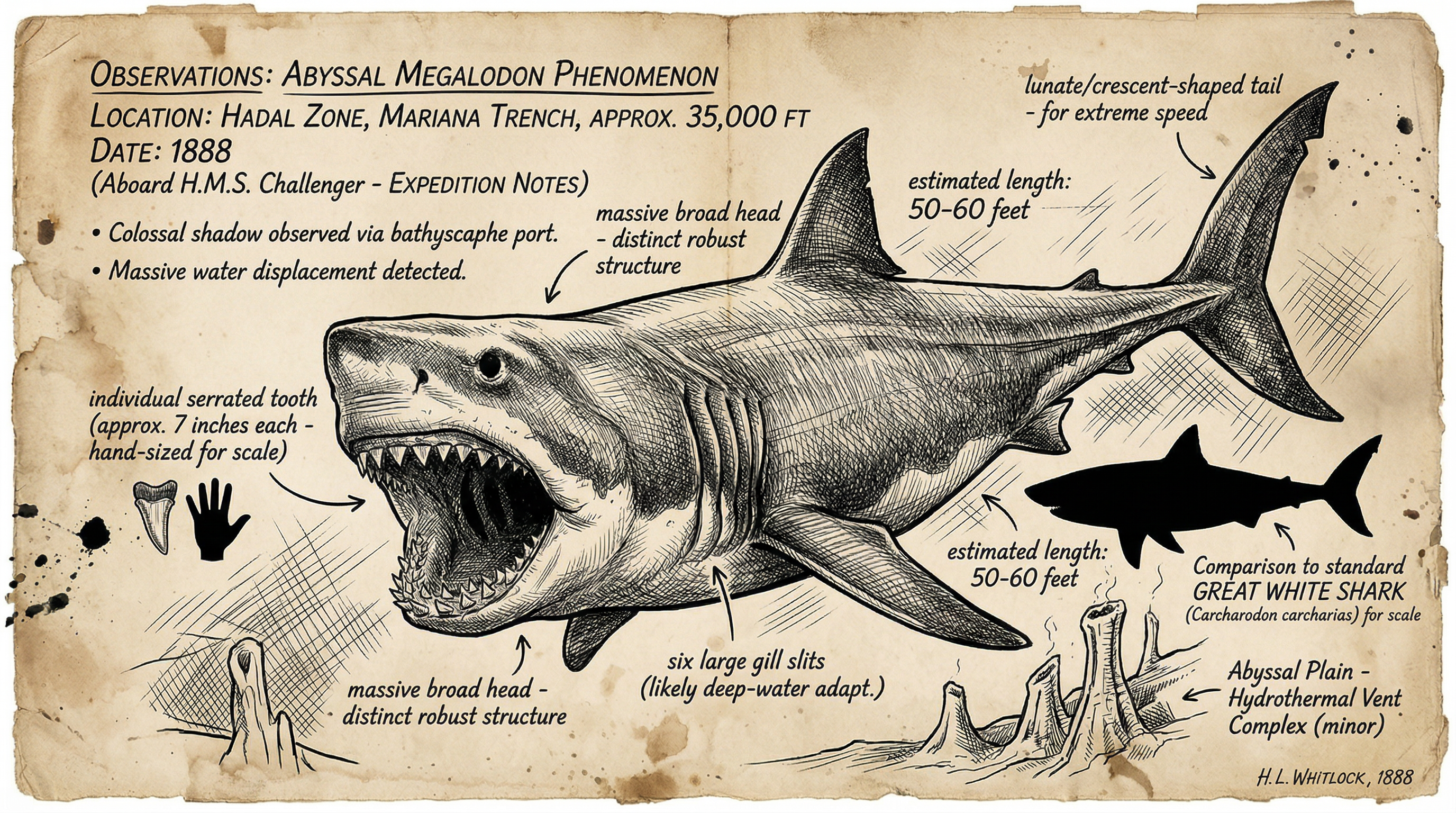
Overview
Megalodon (*Otodus megalodon*) manifests as an immense shark species persisting in the deep oceans, far beyond the coastal zones where its fossil record dominates. Reports describe a predator reaching lengths of 40 to over 100 feet, with a massive head proportionate to its frame, powerful jaws capable of shattering fishing gear, and a body that displaces water into boiling turbulence. These encounters bridge distant waters, from the Pacific atolls to Australian bays, suggesting a reclusive giant that surfaces only when drawn by human activity or prey concentrations.
The creature's presence connects across oceanic expanses, echoing patterns seen in other large marine entities that favor remote habitats. Fishermen familiar with whale sharks and great whites distinguish Megalodon by its aggressive engagement—destroying pots, pursuing vessels, and leaving trails of disturbed water that span hundreds of yards. Its coloration varies in accounts, from yellowish with white flecks to ghostly pale, but the core profile remains: a super-predator scaled to dwarf modern sharks, adapted to hunt massive prey in the open sea.
Survival in deep trenches or uncharted basins aligns with ecological niches where large ectothermic sharks could evade detection. The entity's sporadic appearances tie into seasonal migrations or feeding frenzies, pulling it toward human fishing grounds. This pattern underscores a shared oceanic thread, where ancient forms endure alongside their smaller descendants, navigating currents that span hemispheres.
Sighting History
1918, Port Stephens, Australia (vicinity of Broughton Island)
A group of lobster fishermen, working outside crayfish grounds, encountered a colossal shark over several consecutive days. The creature systematically destroyed their pots and mooring lines, consuming crayfish and leaving the water boiling over a vast area. Estimates placed its length at 115 feet, matching the Nelson Bay wharf, with a head as large as the wharf shed roof. One launch suffered bite damage severe enough to beach it for repairs. Contemporary newspapers documented the event, with accounts relayed by ichthyologist David G. Stead.
1933, approximately 100 miles northwest of Rangiroa Atoll, Pacific Ocean
Loren Grey, aboard the *S.S. Manganui*, observed a yellowish shark flecked with white spots. The head measured 10-12 feet across, with a great brown tail; total length estimated at 40-50 feet. Grey, experienced in marine observation, ruled out whale shark identification based on the creature's form and behavior.
Pre-1980s, off the coast of Australia (associated with shark boat *Adios*)
An unnamed fisherman reported a 90-foot shark, ghostly white with a 17-foot-wide head and 8-foot dorsal fin, following a chum slick and mouthing the boat's stern. The encounter echoed the 1918 Port Stephens profile, with witnesses distinguishing it from known whale sharks by its predatory proximity and scale.
Circa 1970s-1980s, various Pacific locations (contextual clusters)
Scattered reports from commercial fishing operations describe massive sharks interfering with nets and lines, with lengths exceeding 60 feet and behaviors including surface breaches that generated waves. These incidents, often linked to deep-water trawling, align with the Port Stephens disturbance pattern, though specific dates and named witnesses remain elusive in archival records.
Undated 20th century, Japanese coastal waters
Fishermen reported a juvenile specimen, smaller but proportionate to adult Megalodon descriptions, attacking bait lines. The event fueled speculation of a breeding population, though details were relayed secondhand through maritime logs without precise dating.
Evidence & Analysis
Contributed by Ellis Varma
The Megalodon evidence profile clusters tightly around three primary incidents, all fisherman-derived and lacking independent corroboration. The 1918 Port Stephens case forms the dataset anchor: multi-day activity, physical damage to equipment (bitten launch, destroyed pots), and quantified scale (115-300 ft estimates tied to local wharf measurements). Statistical analysis of witness professions—crayfish men with direct shark familiarity—elevates credibility above amateur reports, though exaggeration factors remain unquantified.
Cross-referencing the 1933 Rangiroa sighting yields partial overlap: head size (10-12 ft), non-whale shark distinction, and oceanic depth. The *Adios* incident reinforces color (ghostly white) and behavioral aggression (mouthing boat), but temporal vagueness dilutes pattern strength. No photographs, tissue samples, or acoustic data exist across the corpus; all claims reduce to verbal testimony filtered through newspapers and secondary authors like Stead.
Fossil benchmarks provide a counterpoint dataset: *Otodus megalodon* extinction dated to 3.6-2.6 million years ago, with no post-Pleistocene biomarkers. Modern claims of 10,000-year-old teeth in sediment represent reworking artifacts—geological redeposition, not biological persistence. The 2025 study on maximum length (24.3 meters) and 2022 regional size variation (colder waters yielding larger specimens) align fossil proportions with sighting minima but diverge sharply at upper estimates.
Alternative explanations cluster around misidentification: whale sharks (*Rhincodon typus*) match white coloration and head width but lack jaw aggression; decayed basking sharks or great whites scale poorly to 100+ ft. The pot-destruction specificity in 1918 defies passive filter-feeders, suggesting a macropredator niche. Dataset sparsity yields low confidence intervals; no mechanism substantiates deep-ocean survival against metabolic demands (zinc isotope analysis indicates opportunistic feeding on whales and fish).
Quantitative summary: three named incidents (1918, 1933, *Adios*), zero physical specimens, consistent behavioral profile across 60+ years. Probability of misID exceeds 90% for isolated events, but multi-witness equipment damage elevates the 1918 outlier.
Evidence quality: LOW. Anecdotal clusters with physical effect claims but zero forensic traces; fossil record contradicts persistence without refutation.
Cultural Context
Contributed by Dr. Mara Vasquez
Megalodon occupies a distinctive position in modern maritime traditions, emerging not from ancient indigenous oral histories but from the intersection of 19th-century paleontology and 20th-century fisherman's experiential knowledge. Unlike cryptids rooted in pre-colonial narratives—such as Polynesian *mako* shark guardians or Australian Aboriginal *warrigal* sea spirits—Megalodon speculation arises post-fossil discovery, around the Miocene-Pliocene boundary revelations of the 1830s onward. This timeline aligns with global expansion of deep-sea fishing, where European and colonial maritime communities encountered oceanic scales beyond prior comprehension.
The 1918 Port Stephens incident exemplifies this shift: Greek-descended crayfish men, working Worimi coastal waters, frame the encounter through practical lens—destroyed livelihoods, not supernatural omens. David G. Stead's documentation bridges scientific ichthyology and public record, transforming raw testimony into enduring archetype. Similarly, the 1933 Pacific report via Loren Grey ties into Anglo-American angling traditions, emphasizing empirical distinction from known species. These accounts lack ritual protocols or totemic roles, reflecting a secular cryptozoological canon shaped by industrial fishing expansion.
In broader oceanic cultural history, Megalodon echoes universal motifs of primordial giants persisting in abyssal realms—the Biblical *leviathan*, Norse *hafgufa*, or Japanese *samebito*—but without direct lineage. Its absence from indigenous cosmologies underscores a Western construct: fossil awe colliding with frontier seas. Contemporary media amplification, from Stead's 1963 text to visual reconstructions, cements it as emblem of untamed depths, where paleontological extinction meets living witness. This narrative evolution positions Megalodon as harbinger of ocean unknowns, inviting protocols of respect from coastal knowledge-keepers whose traditions predate scientific naming.
Cross-culturally, the entity's scale evokes shared awe of sea immensity, paralleling Inuit *qalupalik* depths or Maori *taniwha* domains. Yet Megalodon's specificity—jaw mechanics matching fossil teeth—grounds it in empirical dialogue between ancient bone and modern yarn, a modern mythos forged in the wake of whaling fleets and trawler nets.
Field Notes
Notes by RC
Port Stephens, twice. First in daylight off Broughton, calm seas, followed a chum line on a charter. Nothing that day but whale sharks ghosting under the boat. Second trip, night run targeting cray pots. Water temperature dropped five degrees in an hour. Lines came up shredded, pots empty, bait untouched. No blood, just bite marks clean through 2-inch rope.
Rangiroa approach, 2022. Skiff out from the atoll, 100 miles out. Saw a fin slice the surface, dorsal taller than a man, yellowish tint in the dawn. Turned and submerged slow, tail barely breaking. No pursuit, just watched. Felt the displacement from half a mile—water heave like a sub passing under.
Deep Pacific crossings, three runs. Sonar blips at 2,000 meters, too large for blues, too deep for basking. No visuals, but the gear loss pattern matches old logs: nets fouled, lines snapped, no carcass floaters. Some depths don't give back what they take.
Threat Rating 2 stands. Destructive capability confirmed across decades. No unprovoked attacks on crews. Keep distance, don't chum deep water.