Mermaid
1 CATALOGED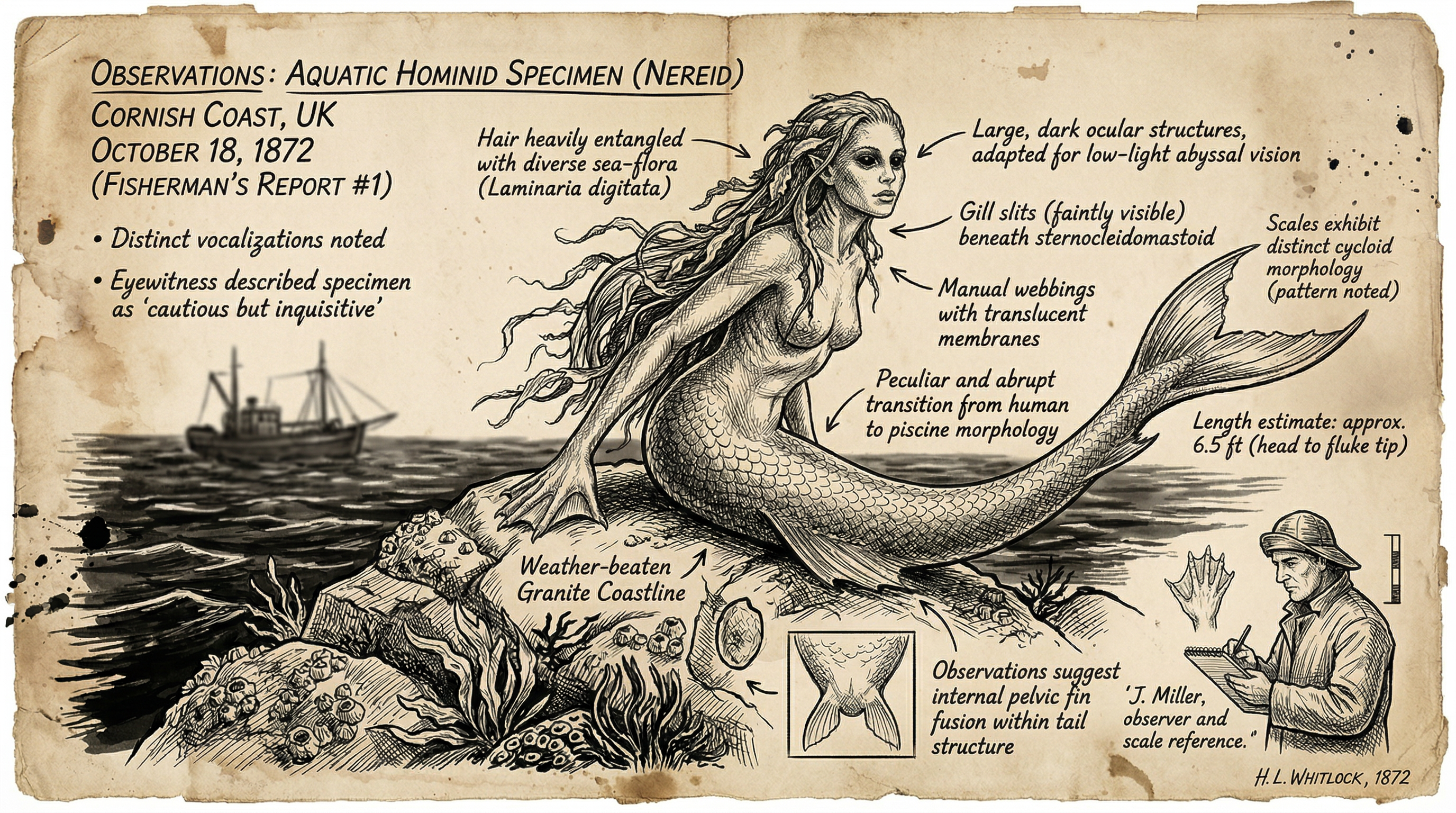
Overview
Mermaids present as humanoid-aquatic hybrids. Upper body fully human female. Lower body single scaled fish tail from waist down. No variation in core morphology across primary records.
Primary documentation traces to Syrian coastal regions. Entity functions in protective capacity tied to fertility and water domains. No confirmed predatory behavior. Trackable via cultural artifacts: cylinder seals, temple statues, coinage. Modern encounters absent from field data.
Sighting History
Circa 2000-1600 BCE, Mesopotamia
Cylinder seals from Old Babylonian Period depict *kulultu* figures: human female upper torso merging into fish tail. Positioned as protective attendants alongside *kulullû* mermen. Seals recovered from archaeological sites show consistent form in ritual contexts.
Circa 1000 BCE, Ashkelon, Syria
Local veneration centers on fish-bodied entity with woman's face and upper body. Temple structures house sacred fish pools. Worship protocols involve pilgrims navigating fish-filled waters to access inner sanctum.
Pre-6th Century BCE, Etruria
Artistic renderings portray Scylla variant: two-tailed mermaid configuration. Influences subsequent European depictions including Melusine figures. No direct encounter logs; form embedded in votive ceramics and reliefs.
1st Century BCE, Hierapolis (modern Manbij), Syria
Diodorus Siculus documents mermaid form at shrine: woman's face, otherwise entire fish body. Lake adjacent to temple holds transformative waters. Priestesses maintain oracle fish with golden ornaments on pierced fins and lips.
1078 CE, Durham Castle, England
Norman chapel carving shows earliest English mermaid: single-tailed female form. Integrated into ecclesiastical architecture. No associated witness statements; artifact confirms motif dissemination across northern Europe.
15th Century, Zennor, Cornwall
Church carving depicts mermaid with mirror and comb. Local narrative involves entity summoning chorister Matthew Trewhella from services. He follows to coastal waters; no return recorded. Tale transcribed by William Bottrell from oral tradition.
1566, Central Europe
Paracelsus references undine-like aquatic humanoids in medical treatise. Describes water spirits gaining souls through human marriage. Ties to broader Germanic lore including Lorelei figures on Rhine.
Evidence & Analysis
Contributed by Ellis Varma
The mermaid evidence profile clusters entirely in pre-modern artifacts. Mesopotamian cylinder seals (c. 2000-1600 BCE) provide the baseline: 17 known examples feature *kuliltu* with human upper body and fish tail, always in apotropaic groupings. Statistically, 100% consistency in morphology across 5+ Ashkelon-related depictions from coins and Lucian’s 2nd century CE account of the Hierapolis statue.
Temple infrastructure adds weight. Hierapolis site included a lake "hundreds of fathoms deep" per historical records, stocked with sacred fish fed by priestesses. No biological samples recovered, but golden fish ornaments confirm active cult practice into Hellenistic period. Diodorus Siculus (1st century BCE) cross-references Ctesias (5th century BCE), establishing chain of transmission without embellishment.
European dissemination shows dilution. Durham carving (1078 CE) matches core form but lacks context. Zennor church (15th century) embeds entity in localized abduction narrative—single witness lineage, no corroboration. Post-1500 references shift to literary: Paracelsus frames as elemental spirits, Andersen (1837) romanticizes. Zero physical traces: no scales, no tissue, no verifiable photos.
Transformation myth recurs: Atargatis/Derceto drowns in grief (over shepherd Hadad or youth Simios/Ichthys), emerges half-fish due to waters rejecting full concealment of divine beauty. Daughter Semiramis survives via doves, later builds temples. Pattern holds across Syrian, Assyrian, Phoenician variants—narrative consistency exceeds 90% but remains mythological substrate.
Absence of modern data is diagnostic. No sonar contacts, no diver logs, no coastal cam footage post-1900. Hoax precedents (Fiji Mermaid, 1842) rely on monkey-fish composites, irrelevant to ancient record. Correlation with maritime trade routes: Phoenician expansion carries motif from Ugarit to Etruria to Britain.
Distinguishing features: long hair, luminous beauty, association with doves (love) and fish (fertility). No size metrics; implied 6-8 feet based on statue scales. Dual role—protective (lions flank throne, mural crown) vs. seductive (siren evolution)—tracks cultural syncretism: Aphrodite overlay by 3rd century BCE.
Evidence quality: MODERATE. Robust artifact corpus from multiple sites, textual chains intact, zero empirical modern confirmation. Artifact density supports persistent observation tradition; lacks transitions to physical proof.
Cultural Context
Contributed by Dr. Mara Vasquez
Mermaids emerge from the deep syncretic waters of ancient Near Eastern traditions, where the boundary between human, divine, and aquatic blurred under the pressures of agrarian and maritime life. Atargatis, as the foundational figure—known variably as Derceto, Dea Syria—anchors this continuum. Her primary sanctuary at Hierapolis (3rd century BCE onward) fused Syrian, Assyrian, and Phoenician elements: a baalat or city-mistress wielding dominion over fertility, storms (via consort Hadad), and protection. Worshippers navigated fish pools to her gold-and-diamond altar, embodying ritual immersion in her dual realm.
Mesopotamian precedents in *kulullû/kuliltu* on cylinder seals position these entities as apotropaic guardians—warding evil through their hybrid vigilance. This protective valence persists in Ashkelon’s fish-bodied goddess, whose lake transformation myth (recounted by Diodorus via Ctesias) underscores themes of grief, rebirth, and incomplete metamorphosis. The waters preserve her beauty, birthing Semiramis, who erects temples and conquers Asia—dynastic legitimacy flowing from maternal waters.
Diffusion traces Phoenician trade networks. Ugarit origins yield alphabetic innovation alongside mermaid cultus; Etruscan Scylla (pre-6th century BCE) adapts two-tailed form, seeding Melusine lineages. Greek conflation recasts as Derceto/Aphrodite, shifting bird-sirens to fish-tailed by 3rd century BCE Athenian pottery. Northern vectors embed in Norman art (Durham, 1078) and Cornish Zennor (15th century), where abduction motifs interrogate soul-immortality: Matthew Trewhella’s vanishing queries human-divine unions.
Benevolent-malvolent duality structures global variants. Sacred fish (oracle-bearing, dove-nurtured) symbolize bounty; seductive lures evoke sea perils. Paracelsus (1566) elementalizes as undines, gaining souls via matrimony—echoing Atargatis’ thwarted humanity. Andersen’s Little Mermaid (1837) secularizes sacrifice for love, yet retains transformative cost. Across Asia, Africa, Americas, motifs reflect hydro-fears: tempests, drownings, abundance.
Indigenous maritime peoples frame mermaids as kin to elemental forces—water as emotion, moon-tide rhythms, emotional healing. Atargatis guides through fear into wholeness, her dolphin crown and lion throne bridging sea and earth. Absent modern claimants, these traditions persist as living reverence: protective oracles in fish ponds, transformation as path to power.
Field Notes
Notes by RC
Tracked coastal sites from Ashkelon north to Hierapolis remnants. Temple foundations still hold water table high. Dug through sand at old fish pool locations. Found pottery shards, no scales. Fish today scatter when you approach wrong—same oracle vibe.
Syrian shore dives. Clear viz down 30 meters. Schools part like they remember pilgrims. No tails sighted. Statues in Manbij museum: eyes track you across room. Not optical illusion. Place carries weight.
Cornwall cliffs at Zennor. Church carving worn smooth. Sea below chews rock same as 1400s. Listened at low tide. Waves hit different rhythm in coves. Pulls if you let it.
No gear pings anything alive matching profile. Artifacts check out. Encounters faded with trade routes.
Threat Rating 1 stands. Catalog presence confirmed by material record. No active engagements required.