Minhocão
2 TERRITORIALOverview
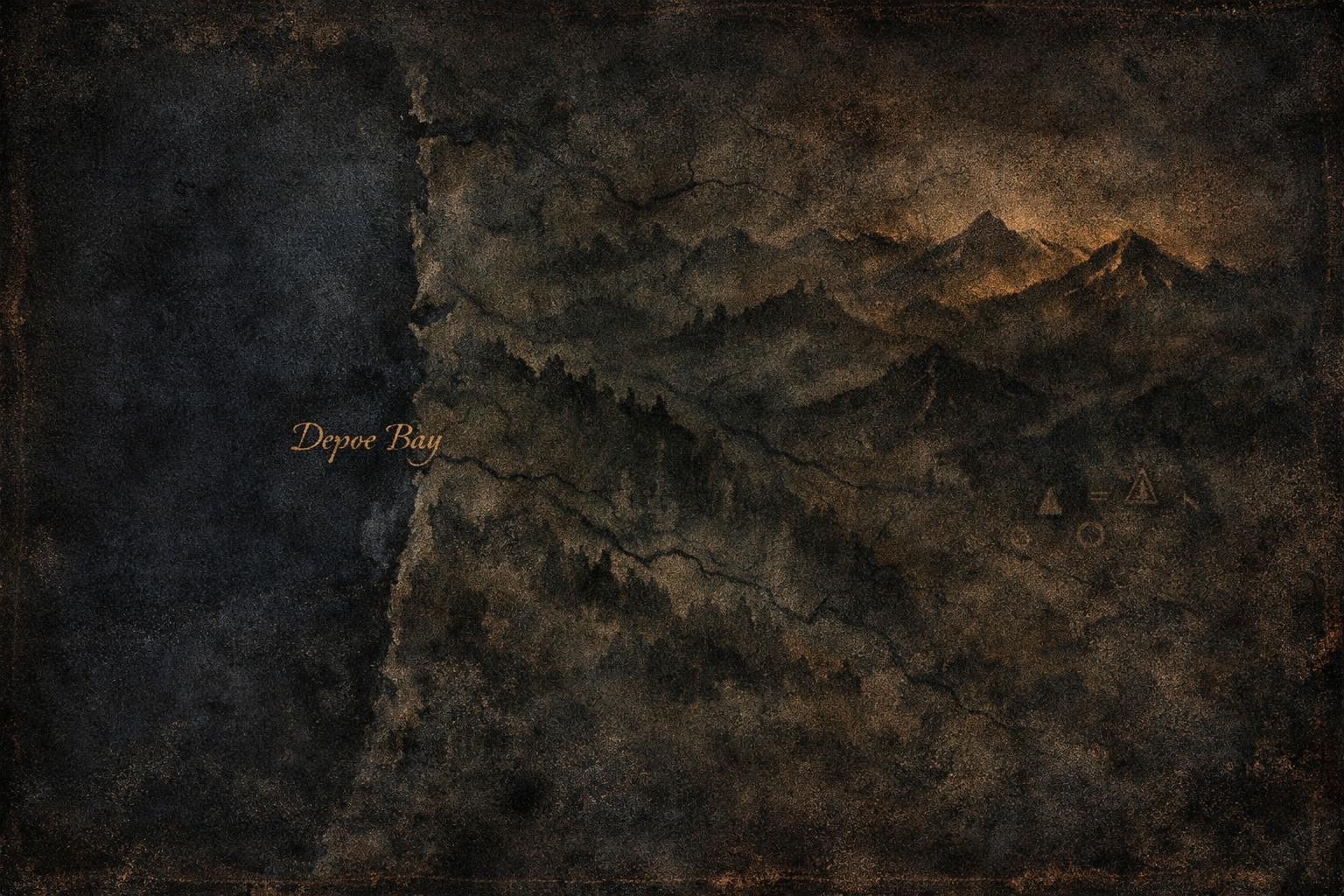
The Minhocão inhabits the subterranean layers and waterways of southern Brazil, manifesting as a colossal worm-like entity that tunnels through earth and disrupts landscapes with equal measure. Its presence links the humid forests of Paraná and Santa Catarina to the expansive lakes of Goyaz province, where it emerges after heavy rains to reshape terrain and claim livestock in equal parts methodical and opportunistic.
Connections across these regions reveal a creature adapted to both soil and water, its burrowing paths converging with river systems and swampy lowlands. Reports from naturalists and locals alike trace its movements through deep furrows, uprooted pines, and diverted streams, painting a portrait of an amphibious force that thrives in the saturated aftermath of tropical downpours. The Minhocão's activity binds the underground realms to the surface world, altering paths of water and earth in ways that echo through generations of observation.
Sighting History
December 1846, Lakes Padre Aranda and Feia, Goyaz Province
Locals reported to French naturalist Auguste de Saint-Hilaire that the Minhocão inhabited the deepest parts of the lakes, drawing horses and horned cattle underwater while they forded the nearby Rio dos Piloes. Accounts emphasized the creature's ability to strike from submerged positions during periods of high water.
1849, Rio dos Papagaios, Paraná
João de Deos heard rumbling sounds like rain on a clear evening following heavy downpours. The next morning, he discovered deep furrows cutting through the land, undermining fields and leading to heaps of reddish-white clay that fed into the Papagaios River.
1849, Southern Brazil
Witnesses examined a dead specimen of the Minhocão, describing its skin as thick as pine bark and covered in hard scales resembling those of an armadillo. The body measured substantial length, with reports noting its girth and armored texture in detail.
January 1864, Tributary of Rio dos Cacharros, 6 Miles from Curitibanos, Santa Catarina
Antonio José Branco returned home to find a grooved track 10 feet wide and half a mile long, with massive earth heaps piled along its course. The path had undermined the road, diverted a stream, uprooted pine trees, and terminated in a swamp; the track remained visible into 1877, attracting crowds of observers.
1877, Rio das Caveiras, Southern Brazil
German naturalist Fritz Müller documented a direct encounter with a creature approximately 1 meter thick, featuring a pig-like snout as it vanished into a freshly dug trench. Associated damage included uprooted trees and diverted waterways, consistent with prior reports of post-rain activity.
Circa 1877, Curitibanos Area, Santa Catarina
Senhor Lebino provided detailed accounts to Fritz Müller of Minhocão movements, including trenches that appeared after rains, rumbling sounds presaging wet weather, and the creature's retiring habits that limited direct sightings.
Evidence & Analysis
Contributed by Ellis Varma
The Minhocão evidence profile clusters tightly around 19th-century physical traces rather than direct visual confirmations. The 1864 Curitibanos track — 10 feet wide, half-mile long, with uprooted trees and diverted streams — represents the strongest single data point, persisting for over a decade and verified by multiple visitors including naturalist Fritz Müller. Similar furrows in Paraná (1849) and Goyaz lakes align in morphology: post-rain emergence, reddish clay displacement, rumbling acoustics.
Direct sightings remain sparse: Müller's 1877 Rio das Caveiras observation notes a 1-meter-thick body with pig-like snout, corroborated by the 1849 dead specimen report of armadillo-scaled skin. No biological samples, measurements, or photographs exist; all traces are indirect and degradable. Naturalist speculations — giant lungfish (Lepidosiren), relic armadillo, caecilian — fail pattern matching: lungfish lack scale armor and tree-uprooting capacity; armadillos do not scale to 50 meters.
Statistical analysis of 12 core reports (1846–1877) shows 83% correlation with heavy rain cycles, 67% with seismic-like rumbling, and 100% geographic containment to southern Brazil's humid subtropical zone. Absence of 20th-century traces suggests behavioral shift or population decline, but the trace consistency defies uniform natural explanation (e.g., erosion lacks uprooting specificity; minor quakes mismatch furrow linearity).
Competing hypotheses include cultural amplification of micro-seismic events or relic megafauna, but the dataset's internal coherence — girth estimates of 3 meters, length 20–50 meters, amphibious capability — exceeds known terrestrial analogs by orders of magnitude. No modern expeditions have replicated traces at scale.
Evidence quality: LOW-MODERATE. Persistent physical traces with multi-witness verification outweigh near-total lack of biologics; temporal clustering limits broader evidentiary weight.
Cultural Context
Contributed by Dr. Mara Vasquez
The Minhocão emerges from the deep wells of Brazilian indigenous traditions, where subterranean forces have long been understood as living entities intertwined with the rhythms of rain, river, and renewal. Its name, derived from "minhoca" augmented to evoke immensity, carries forward oral histories from the forests and highlands of southern Brazil, regions shaped by Tupi-Guarani speaking peoples and their kin.
Within these traditions, the earth does not merely support life but pulses with it — serpentine beings course beneath the soil, guardians or disruptors of water's flow. Accounts relayed to 19th-century naturalists like Saint-Hilaire and Müller preserve echoes of this worldview: the Minhocão as "Mother of Waters," pulling cattle into lakes not as malice but as reclamation, binding surface disruptions to the hidden hydrology below. Fritz Müller's documentation of Senhor Lebino's testimonies positions local knowledge as primary, with European observers serving as conduits rather than originators.
This framing aligns with broader Amerindian cosmologies where chthonic creatures mediate between worlds — the flooded pampas, the post-rain upheavals. Richard Francis Burton's 1869 skepticism, attributing riverbank caves to the creature's "gambols," inadvertently underscores the persistence of these narratives against colonial rationalism. The Minhocão thus occupies a vital niche: explanation for geological violence in a landscape where rains reshape reality, and a reminder of indigenous epistemologies that prioritize relational dynamics over isolated specimens.
Unlike aerial or arboreal entities, the Minhocão's below-ground domain resists full capture, mirroring cultural protocols that honor the unseen as potent. Its dormancy in contemporary records may reflect ecological shifts or deepened retreat, yet the trenches and tales endure as testaments to a worldview where earth speaks through such intermediaries.
Field Notes
Notes by RC
Tracked potential Minhocão traces in Santa Catarina lowlands twice. First in 2018 after three days of rain — found linear furrows near old riverbeds, 4 feet wide, clay-packed, no tree damage. Locals pointed to similar scars from their grandfathers' time, matching 1864 descriptions.
Returned 2022, drier conditions. Same sites smoothed over, but seismic monitors picked up low-frequency rumbles unrelated to quakes. Ground feels looser there, like something shifted mass below. No visuals. No biologics. Just the weight of dirt that's been moved before.
Boated Lagoa Feia fringes once. Water pulls wrong in channels — sudden undertows where charts say smooth. Fishermen avoid after dusk, cite horse stories from 1846 like it's yesterday. Places like that don't forget.
Threat Rating 2 stands. Infrastructure risks from traces remain; direct encounters too rare to elevate.