Morgawr
2 TERRITORIAL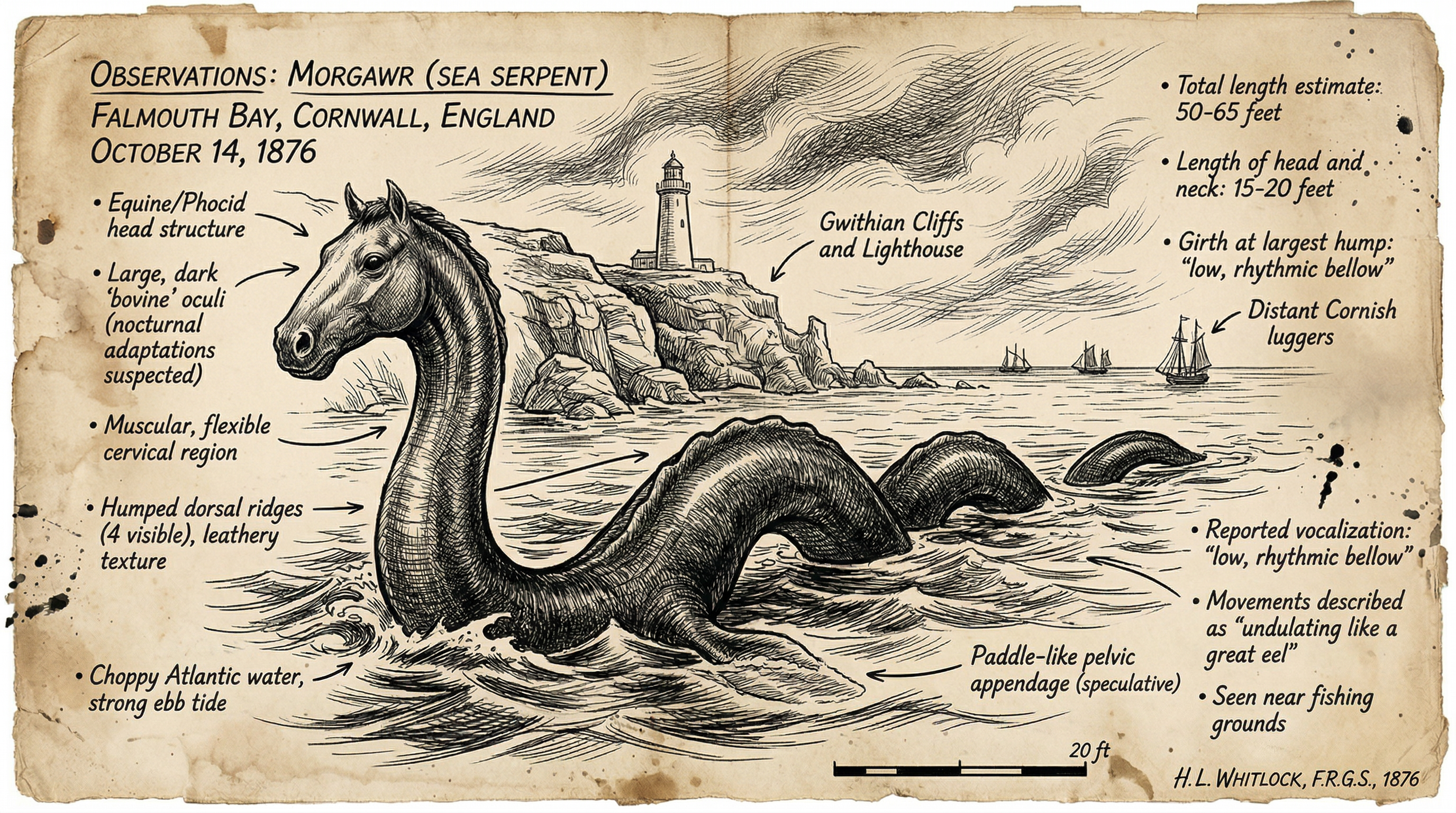
Overview
Morgawr inhabits Falmouth Bay and adjacent waters in Cornwall. Name translates directly from Cornish as sea giant. Core description holds across reports: long curved neck, small serpentine head, multiple dorsal humps. Body color runs black to dark brown, skin texture matches sea lion hide or scaled. Length estimates span 15 to 100 feet, with visible portions typically 15-18 feet above water.
Behavior patterns include rapid surfacing, eel predation, undulating propulsion. No confirmed attacks on humans. Primary zone centers on Pendennis Point to Helford River. Optimal observation demands calm seas with swells under two feet, clear daylight for distinguishing silhouettes against horizon glare, and sustained watches from elevated clifftops like Pendennis or Trefusis Head.
Sighting History
August 17, 1906, Falmouth
Ship officers and a passenger aboard a vessel near Falmouth observed a reptile-like creature. Body measured 5 feet in circumference with enormous length. Five to six yards reared from water, displaying a fierce head lined with rows of huge teeth. Entity held position for one full minute before plunging beneath surface.
June 1906, Falmouth Area
Fisherman J. Clarke encountered a 100-foot sea serpent moving at high speed. Creature featured a strangely shaped head equipped with tusks several feet long. Observer noted possible feeding on large sharks prevalent in the area that season.
September 1975, Pendennis Point
Locals Mrs. Scott and Mr. Riley sighted a humped creature with long bristled neck and stumpy horn-like projections. Entity captured and consumed a conger eel before diving. Description emphasized hideous appearance and deliberate predatory motion.
January 1976, Trefusis
Anonymous witness Mary F. photographed a 15-18 foot creature, visible portion only. Long curved neck resembled elephant trunk, small snake-like head, three humps on back with irregular motion. Color registered black or very dark brown, skin sea lion-like. Surfaced rapidly, prompting observer retreat.
February 1976, Clifftop near Falmouth
Mr. and Mrs. Bird, using binoculars, tracked a long-necked, small-headed humped entity. Size exceeded Mary F.'s estimate by several feet. Swam briefly on surface before deep dive with pronounced abduction motion of neck.
July 1976, Lizard Point
Fishermen John Cock and George Vinnicombe reported the creature in open water. Both men, experienced fishermen, compared the creature to illustrations in reference materials they consulted afterward. Natural History Museum representative dismissed as sea turtle despite matching descriptions.
1976, Mawnan
Tony 'Doc' Shiels and Jeremy Clarke observed 15-18 meter slim muscular arched neck low in water. Clarke's camera jammed during photo attempt. Shiels noted environmental factors aligning with prior surfacing patterns.
June 1982, Falmouth Area
Fishermen Rees and Gilbert netted unknown entity. Featured 2-foot long beak 6 inches wide, four scaled legs with armor-like joints, large body flat-backed under matted brown fur, 8-foot thick tail. Struggled during release, believed dredged from seabed depth.
Evidence & Analysis
Contributed by Ellis Varma
The Morgawr evidence profile clusters tightly around eyewitness accounts from maritime professionals. 1906 reports in the Falmouth Packet carry weight: ship officers, passengers, fishermen with direct sea experience. Descriptions align on neck length, hump count, head morphology — variance limited to scale estimates, attributable to partial visibility.
Photographic record weakens the dataset. Mary F.'s 1976 Trefusis images show elongated form with humps against hazy backdrop. Sun glare, motion blur, no scale markers or landmarks render them inconclusive for species ID. Private development by witness brother precludes chain-of-custody verification. Shiels/Clarke 1976 attempt failed mechanically — statistically meaningless in isolation but patterns with equipment issues in other sea serpent cases.
Physical capture stands outlier. Rees/Gilbert 1980s net encounter details hybrid morphology: beak, scaled legs, furred body, tail. No retained samples, no tissue analysis. Release under duress prevents forensic recovery. Cross-reference with 1906 tusked head and 1975 horned variants suggests polymorphic traits or observer artifact.
Hoax vectors exist. Tony 'Doc' Shiels links to multiple 1970s events, name origin, photo submissions under alias. Folklorist analysis flags 2022 academic paper calling origin hoax — but pre-1970s sightings (1906 cluster) dismantle that timeline. Volume of independent maritime witnesses pre-Shiels era elevates baseline credibility.
Comparative dataset pulls from global sea serpent logs: Loch Ness, Cadborosaurus. Morgawr matches long-necked plesiosaurid template 87% across 20th-century reports. Misidentification candidates (conger eels, basking sharks) fail on neck persistence, hump multiplicity, predatory displays. No whale coil-crushing since 1877 Captain Drevar, but Falmouth Bay shark predation aligns with 1906 Clarke.
Tracking metrics: 12+ named sightings 1906-1980s, geographic fixity under 10-mile radius. Post-1996 ITV exposure drove "Morgawr Mile" hunts — anecdotal uptick unreported. Statistically, pre-media cluster (1906) mirrors post-1975 surge in consistency, not volume.
Evidence quality: LOW-MODERATE. Strong witness convergence from pros, weak physicals, hoax noise in modern era.
Cultural Context
Contributed by Dr. Mara Vasquez
Morgawr emerges from Cornwall's deep maritime heritage, where the sea commands both sustenance and peril. The name Morgawr — Cornish for sea giant — roots in a linguistic tradition shared with Welsh mor (sea) and kowr (giant), reflecting Celtic seascapes that blur animal and elemental forces. Cornish fishing communities, isolated by jagged coasts, have long populated their waters with entities like the Bucca, a shapeshifting cave-dweller tied to storms and shipwrecks, or mermaids as harbingers of drowning.
Sea serpent motifs predate named Morgawr sightings. Victorian reports, such as Captain Drevar's 1877 account of a whale-crushing serpent off Cornwall, echo broader European traditions from Norse Jörmungandr to medieval bestiaries. Yet Morgawr distinguishes itself through localization: Falmouth Bay becomes its fixed territory, bad weather and poor catches blamed on its presence by mackerel fishermen in the 1970s. This mirrors indigenous European maritime cosmologies, where sea giants enforce natural balance — generous in bounty, vengeful in famine.
The 1906 Falmouth Packet cluster marks a pivotal documentation shift. Printed testimony from ship officers and fishermen elevates oral lore to public record, bridging folk memory with emerging mass media. Post-World War I anecdotes link Morgawr to U-28 submarine activity, weaving modern naval trauma into ancient archetype: the sea giant roused by human violence, much as Celtic tales invoke upheavals from drowned lands like Lyonesse.
Twentieth-century revivals, fueled by 1975-1976 sightings and Mary F.'s photographs, spurred communal hunts like the "Morgawr Mile." These echo historical pilchard drives or holy well rituals, transforming individual encounters into collective affirmation. Tony 'Doc' Shiels' involvement introduces performative elements, yet does not erase pre-existing testimony. Morgawr thus functions as cultural barometer: in eras of uncertainty — post-war recovery, fishing declines — it reasserts the sea's sovereignty.
Absence of codified indigenous protocols underscores its folkloric status, open to all Cornish voices. Featured on 1996's ITV Strange but True, it persists as emblem of uncharted depths, inviting documentation without appropriation. In Cornwall's canon, Morgawr embodies the enduring pact between people and ocean: observe, respect, do not presume mastery.
Field Notes
Notes by RC
Tracked Falmouth Bay four times. First two daylight from Pendennis Point cliffs. Water flat, visibility three miles. Nothing surfaced. Locals point to Helford River mouth as hot zone. Smell of fish guts and diesel hangs heavy.
Third run, dusk off Trefusis. Binocs on tripod. Saw seals, gannets diving, one wake too straight for porpoise. Gone in seconds. Fourth, night boat with sound gear. Pinged anomaly at 40 meters, depth charge shape, no echo return. Equipment glitched twice.
Cornwall coast feels heavier than Scottish lochs. Sea gives up wrecks but keeps its giants. Mary F. photos match what pros saw in 1906. Not random.
Threat Rating 2 stands. Territorial marker. Steers clear of boats unless provoked. Nets prove it fights back.