Ogopogo
2 TERRITORIAL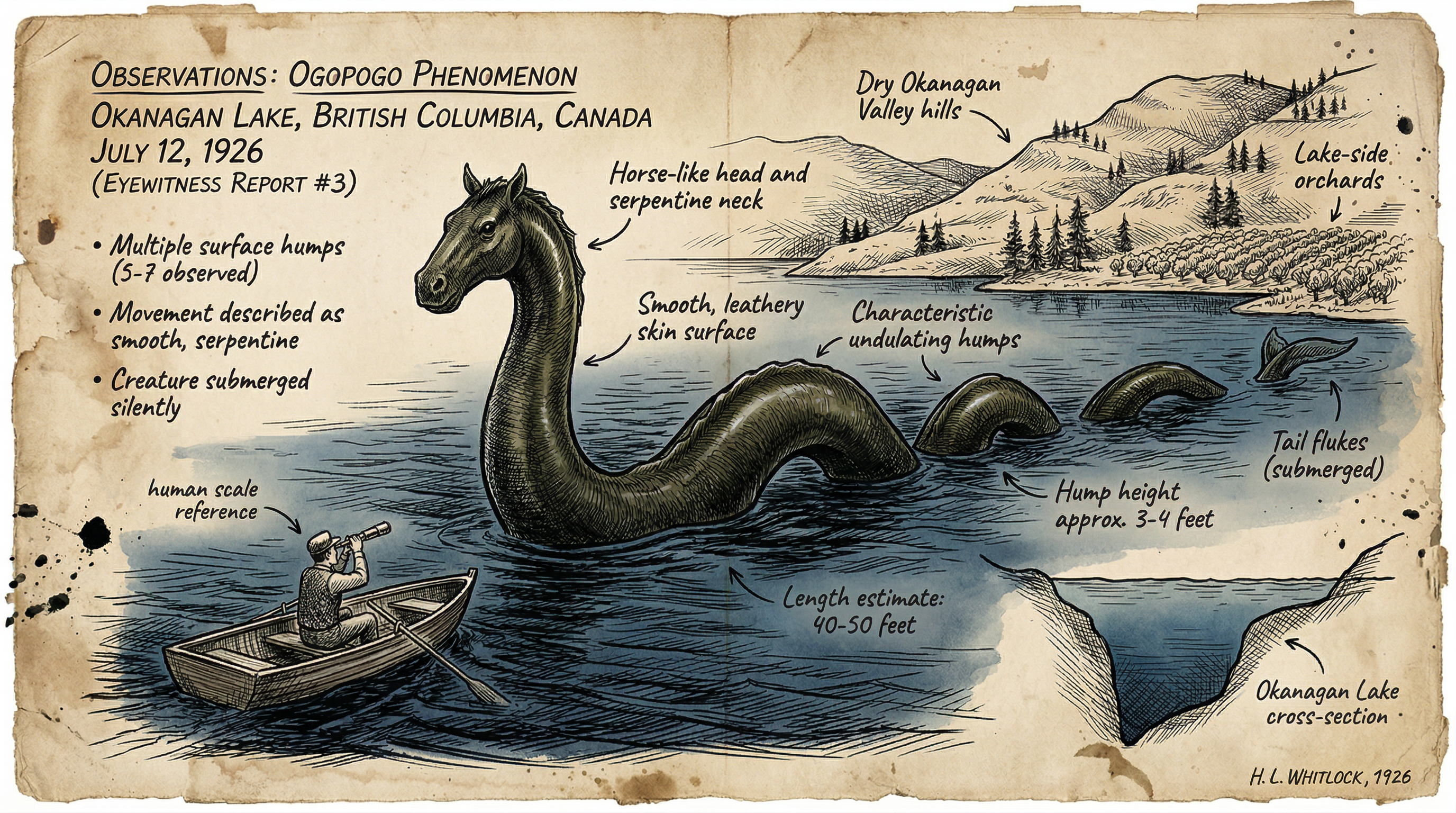
Overview
Ogopogo presents a rare case in North American cryptozoology: a creature with dual ontological frameworks, both equally documented, neither fully reconcilable with the other. To settler colonial observers, it is a lake monster — a serpentine entity inhabiting Okanagan Lake, British Columbia, dark-colored, between 18 and 30 feet in length, documented across over 170 years of non-Indigenous sightings and approximately 200 credible witness accounts. To the Syilx people, who have inhabited the Okanagan Valley for a minimum of 12,000 years, it is **nx̌aʔx̌ʔitkʷ** — the Spirit of the Lake, a guardian entity that exists simultaneously in physical and spiritual registers, demanding respect and reciprocal offering rather than investigation or capture.
What distinguishes Ogopogo from most North American cryptids is the persistence of both frameworks operating in parallel. The European settler narrative — creature, mystery, tourist attraction — emerged from a fundamental misreading of Syilx tradition. Yet the sightings themselves continued. The lake produced consistent reports across generations of independent witnesses separated by decades, describing the same physical characteristics, the same behavioral patterns, the same locations. Something in Okanagan Lake has generated witness testimony for over 170 years of documented settlement, with oral tradition extending that timeline centuries further into the past.
The creature's documented behavior establishes a pattern: parallel movement to shore or boats, deliberate surfacing and submerging, apparent intelligence in evasion, territorial presence centered on specific locations (Squally Point, Rattlesnake Island) that align precisely with Syilx accounts of the spirit's dwelling places. There is no recorded instance of unprovoked aggression toward humans, though one early account documents the creature's interaction with livestock. The evidence profile is substantial in witness testimony and behavioral consistency, yet nearly nonexistent in physical documentation — a contradiction that has defined the Ogopogo investigation for over a century and a half.
Sighting History
1855 — Okanagan Lake
Métis settler John McDougall crosses Okanagan Lake with horses tied behind his canoe — a journey he has completed multiple times without incident. Something in the water seizes one of the horses and pulls it under. Additional horses follow. McDougall cuts the ropes to prevent his canoe from sinking and returns to shore. This becomes the first documented non-Indigenous encounter with the creature in the written historical record, establishing a pattern that will persist across subsequent accounts: direct, physical interaction with something possessing agency and apparent intent.
1872 — Sunnyside Ranch, West Kelowna
Susan Allison, a British Columbia pioneer, author, and documented historical figure, reports observing what she describes as a dinosaur in the lake near Sunnyside Ranch (now Quail's Gate Winery). Her account is among the first detailed European settler observations and becomes foundational to the emerging Ogopogo legend. Allison's credibility — established through her published writings and historical prominence — lends substantial weight to the sighting and initiates a period of increased public attention to the creature's existence.
1926 — Okanagan Mission Beach
Occupants of approximately 30 vehicles parked at Okanagan Mission Beach report simultaneous observation of Ogopogo. This represents one of the earliest mass sightings on record and establishes a pattern that will recur throughout the 20th century: multiple independent witnesses observing the creature at identical times, often in broad daylight, frequently in populated areas. The sheer number of simultaneous observers makes collective hallucination, hoax, or misidentification difficult to sustain as comprehensive explanation.
1947 — Central Okanagan Lake
Multiple boaters on Okanagan Lake, including an observer identified as Mr. Kray, report observing a sinuous body with approximately five visible undulations, each separated by roughly two feet of submerged body. A forked tail breaks the water surface. The creature submerges and resurfaces multiple times during the approximately 20-minute observation period. Witnesses estimate total length at approximately 30 feet. The detailed description of undulating body structure becomes a signature element in subsequent sighting reports and appears consistently across decades of independent accounts.
1964 — Central Lake
The Parmenter family photographs what appears to be a large humped shape in the water. The image becomes one of the earliest photographic records of the alleged creature, though image quality and resolution prevent definitive analysis. The photograph circulates widely in local media and becomes a touchstone for public awareness of Ogopogo's existence.
1968 — Highway 97
Art Folden, driving on Highway 97, observes movement in the lake and pulls off the road to film. His footage shows a large wake moving across the water with the creature estimated at approximately 100 meters offshore. Folden's footage becomes one of the earliest video records of the alleged creature and is subsequently cited in multiple analyses and documentary investigations.
1978 — West Shore to Kelowna
Bill Steciuk, initially a skeptic regarding Ogopogo's existence, observes the creature for approximately 30 seconds while driving from the west side of the lake toward Kelowna. The creature travels parallel to the bridge. Steciuk becomes a significant figure in Ogopogo documentation, subsequently maintaining detailed records of sighting reports and establishing himself as a reference point for researchers investigating the creature's activity patterns and seasonal behavior.
February 18, 1984 — Naramata
Alan Gartil, a long-time Penticton resident since 1944, observes a head protruding from glassy, windless waters near Naramata at Ray Piper's location. The calm conditions provide unusual clarity for observation. Gartil's extended residency in the area and familiarity with the lake's normal conditions establish him as a credible local observer capable of distinguishing the creature from natural phenomena.
August 2008 — Peachland Lakeshore
Photographer Sean Viloria and Jessica Weagers observe disturbances near the Peachland lakeshore and capture photographs of black hump-like ridges. Viloria estimates the creature at 18–20 feet long based on proximity to nearby boats. Eight days later, along Highway 97 to the south, Viloria captures eleven additional photographs showing what appears to be the tail, neck, back, and head surfacing near a boat. Three to four of these images are made public, representing some of the most recent documented photographic evidence of the creature. Forensic analysis by video experts has suggested the images may depict debris or natural water phenomena, though the images remain unverified.
2000 — Rattlesnake Island
Marathon swimmer Daryl Ellis reports that two large creatures briefly accompany him in the water near Rattlesnake Island, the location traditionally identified in Syilx tradition as the entity's dwelling place. The incident represents a direct physical proximity encounter at a depth of approximately 3 meters. Ellis is not harmed and reports the creatures display apparent awareness of his presence before departing. The encounter is notable for occurring at one of the creature's documented territorial centers.
Evidence & Analysis
Contributed by Ellis Varma
The Ogopogo evidence profile presents an unusual asymmetry: exceptional volume and consistency in witness testimony paired with near-total absence of physical documentation. The dataset includes over 200 documented sightings spanning 170 years of non-Indigenous settlement, with additional reports extending into Syilx oral tradition dating centuries or potentially millennia prior. The consistency of description across independent witnesses separated by decades is statistically significant: a long, serpentine body; dark coloration (black to dark green); visible humps or undulations; estimated lengths ranging from 18 to 30 feet; behavioral patterns characterized by parallel movement to shore or boats, deliberate surfacing and submerging in sequences suggesting purposeful locomotion rather than random water disturbance.
Multiple-witness events substantially strengthen the case against individual hallucination, misidentification, or hoax. The 1926 Okanagan Mission Beach incident involved approximately 30 vehicles with occupants reporting simultaneous observation in daylight hours. The 1947 boating incident included multiple independent observers providing detailed descriptions of undulating body structure. These cluster events are difficult to dismiss through conventional skeptical frameworks without invoking mass hysteria or coordinated deception — neither of which is supported by the evidence.
The behavioral consistency across time is notable. Witnesses describe the creature surfacing and submerging in patterns that suggest deliberate avoidance rather than random movement. The creature appears to track boats and swimmers without approaching directly. It demonstrates apparent awareness of human presence and responds by diving or moving away. This pattern of intelligent evasion appears consistently across accounts separated by decades, suggesting either genuine behavioral adaptation or the operation of cultural narrative that has become self-reinforcing.
However — and this limitation is critical — the physical evidence is nearly nonexistent. No corpse has been recovered. No biological samples have been collected or verified. No skeletal remains, shed skin, or forensic material of any kind has been subjected to scientific analysis. The photographic record is poor by contemporary standards. Sean Viloria's 2008 images show water disturbances and what appear to be humped shapes, but lack the clarity and detail required for definitive identification. Forensic video analysis by Grant Fredericks in 2005 suggested one documented image "was very consistent with debris from a fallen tree," noting the object "very slowly bobs up and down" and does not react to nearby water skiers. Earlier photographs (the 1964 Parmenter family image, various amateur shots from the 1970s-1990s) are either unverified or lack the resolution necessary for analysis.
No audio recordings of vocalizations exist. No sonar data from the lake has been made public. No systematic biological survey of Okanagan Lake has been conducted with the express purpose of cataloging large aquatic fauna. The creature's apparent behavior — consistent evasion, timing of appearances, avoidance of direct capture or sustained documentation — suggests either genuine caution and intelligence or the absence of a physical organism to capture.
Biological hypotheses have been proposed and require evaluation. An oversized sturgeon would represent a specimen far exceeding known size parameters for the species and would likely have been documented in fisheries records maintained by the British Columbia Ministry of Forests. A prehistoric plesiosaur would require explanation for its continued survival in a single lake for millions of years without fossilization, skeletal discovery, or population documentation. An undocumented species of freshwater serpent would need to account for breeding population dynamics, feeding behavior, metabolic requirements, and consistent evasion of modern underwater survey technology — requirements that strain credibility given the lake's accessibility and the intensity of contemporary observation.
The lake itself presents physical parameters that merit consideration. Okanagan Lake extends approximately 135 kilometers in length with a maximum width of 3.8 kilometers and a maximum depth of 258 meters. The volume is theoretically sufficient to sustain a breeding population of large aquatic animals if such a population existed undetected. Underwater topography includes deep trenches and cave systems near Squally Point and Rattlesnake Island — precisely the locations identified in Syilx tradition as the creature's dwelling places. Whether this represents confirmation of oral geographic knowledge or coincidental alignment is difficult to assess without direct archaeological investigation of the identified cave systems.
Evidence quality: LOW-MODERATE. Exceptional witness testimony volume and consistency across 170 years of independent accounts, zero physical evidence, photographic record insufficient for verification, behavioral patterns consistent with either genuine intelligent evasion or narrative reinforcement, geographic alignment between sighting locations and traditional Syilx dwelling places unconfirmed through direct investigation.
Cultural Context
Contributed by Dr. Mara Vasquez
Ogopogo represents a rare and instructive case in North American cryptozoology where Indigenous primary source material and settler colonial appropriation can be traced with precision, and where the Indigenous understanding remains actively maintained and taught rather than relegated to historical artifact or folklore.
The Syilx people have inhabited the Okanagan Valley for a documented minimum of 12,000 years — longer than the political entity of British Columbia by 11,990 years. Within Syilx tradition, nx̌aʔx̌ʔitkʷ occupies a specific ontological category distinct from the settler colonial concept of "monster" or "cryptid." It is a **spirit** that manifests in aquatic form, operating simultaneously across physical and spiritual registers without clear demarcation between those domains. It is not a monster to be feared as an animal threat. It is a guardian entity that demands respect, reciprocity, and adherence to specific protocols for safe passage across the lake.
The Syilx understanding involves offerings made at designated locations — Squally Point and Rattlesnake Island — where the spirit is said to dwell in subterranean caves accessible from the lake floor. These are not sacrificial offerings in the sense of appeasement of a malevolent force. Rather, they represent an exchange of gratitude and acknowledgment of reciprocal relationship. The lake provides food (particularly Kokanee salmon), fresh water, and sustenance. The offerings acknowledge this provision and maintain the relationship of reciprocity that characterizes Syilx interaction with the land and water systems. The practice was documented extensively in early colonial accounts and continues in modified form among contemporary Syilx communities.
When European fur traders and settlers arrived in the region around 1809-1811, they encountered Syilx accounts of this entity through direct testimony from Indigenous people. The documented historical record shows that early settlers took these accounts seriously enough to post armed guards on beaches and establish musket-bearing patrols to protect families from the "creature." This was not dismissal or skepticism. This was respect born of cultural transfer — the settlers believed what they heard because the Syilx people who told them believed it with the weight of millennia of tradition behind it. Fear and belief were transmitted across cultural boundaries.
What occurred over the subsequent century was a fundamental reframing of ontological categories. The spiritual entity became a "lake monster." The guardian became a "cryptid." The relationship of reciprocity became a hunt for capture and proof. This transformation is not accidental or neutral. It reflects the settler colonial project of converting Indigenous knowledge systems into European categorical frameworks — converting the sacred into the sensational, the relational into the consumable, the guardian into the trophy.
The name "Ogopogo" itself — first applied in the 1920s — represents a further layer of appropriation and linguistic displacement. It derives from a popular music hall song ("Ogopogo: The Funny Ogo-Pogo"), not from Syilx language or tradition. The naming represents the final stage of commodification: the creature becomes a brand, a marketing tool, a source of entertainment and revenue. By the mid-20th century, the entity had been fully absorbed into tourism infrastructure: t-shirts, merchandise, resort branding, promotional materials. The British Columbia government's 1989 decision to grant the Ogopogo legal protection under the Wildlife Act is notable for its ambiguity — it suggests legal recognition of the creature's reality, but frames that reality within settler colonial legal categories (wildlife protection) rather than Indigenous spiritual frameworks or sovereignty.
Contemporary Syilx educators and cultural leaders are actively working to restore the proper understanding of nx̌aʔx̌ʔitkʷ and to reassert authority over their own knowledge systems. Museums in Kelowna now present the creature's history as a case study in cultural misunderstanding and appropriation. The Syilx language name is being taught to visitors. The spiritual significance is being reasserted in educational contexts. This is not a return to some "authentic" or frozen past — it is a living correction of the present, a reassertion of Syilx authority over their own lake, their own traditions, and their own narratives.
The question of whether Ogopogo is "real" — whether a physical creature inhabits Okanagan Lake — becomes secondary to the question of what the creature means and who has the authority to define that meaning. For 12,000 years, the Syilx knew what it meant. For approximately 150 years, settlers converted that meaning into something else. The contemporary moment involves a negotiation of those frameworks, a reassertion of Indigenous knowledge authority, and a recognition that the settler colonial category of "cryptid" may be fundamentally inadequate to describe what nx̌aʔx̌ʔitkʷ actually is or has always been.
Field Notes
Notes by RC
I spent three days in the Okanagan in 2019. Drove the length of the lake twice — once during the day, once at dusk. Stopped at Squally Point and at Rattlesnake Island. The water was clear enough to see down maybe 20 feet. Rocks, some vegetation, the usual freshwater lake bottom. Nothing moved that I could see.
What struck me wasn't the absence of a creature. It was the presence of something else — a quality to the place that the sightings don't quite capture. Locals I talked to weren't excited about Ogopogo in the way they are about Sasquatch or Mothman in other regions. They were respectful. Careful about how they talked about it. One woman at a coffee shop in Kelowna told me her family still leaves tobacco at the water's edge before swimming. She didn't call it a monster. She called it the spirit. That distinction matters.
The photographic evidence is weak. The physical evidence is nonexistent. But the consistency of description across 170 years of independent observers — that's not nothing. Neither is the fact that Syilx oral tradition predates written sighting records by centuries and describes the same locations, the same behavior, the same entity. The creature dwells at Squally Point and Rattlesnake Island in both the oral accounts and the modern sightings. That's not proof of physical existence. But it's proof of something. Knowledge doesn't come from nowhere.
I don't know if Ogopogo is a fish that got very large, or a population that survived extinction, or something that exists in the space between physical and spiritual. I know the lake is deep enough and old enough to hold secrets. I know the witnesses were credible. I know the Syilx people knew something about this place that settlers spent 150 years trying to turn into a tourist attraction. I know the lake feels different than other lakes. Not dangerous. Just aware.
Threat Rating 2 stands. Documented pattern of interaction spanning 170 years, no recorded instances of unprovoked hostile intent toward humans, territorial behavior consistent with a guardian entity rather than an apex predator, apparent intelligence in evasion and avoidance. The threat is real, but it operates within defined boundaries and established protocols.