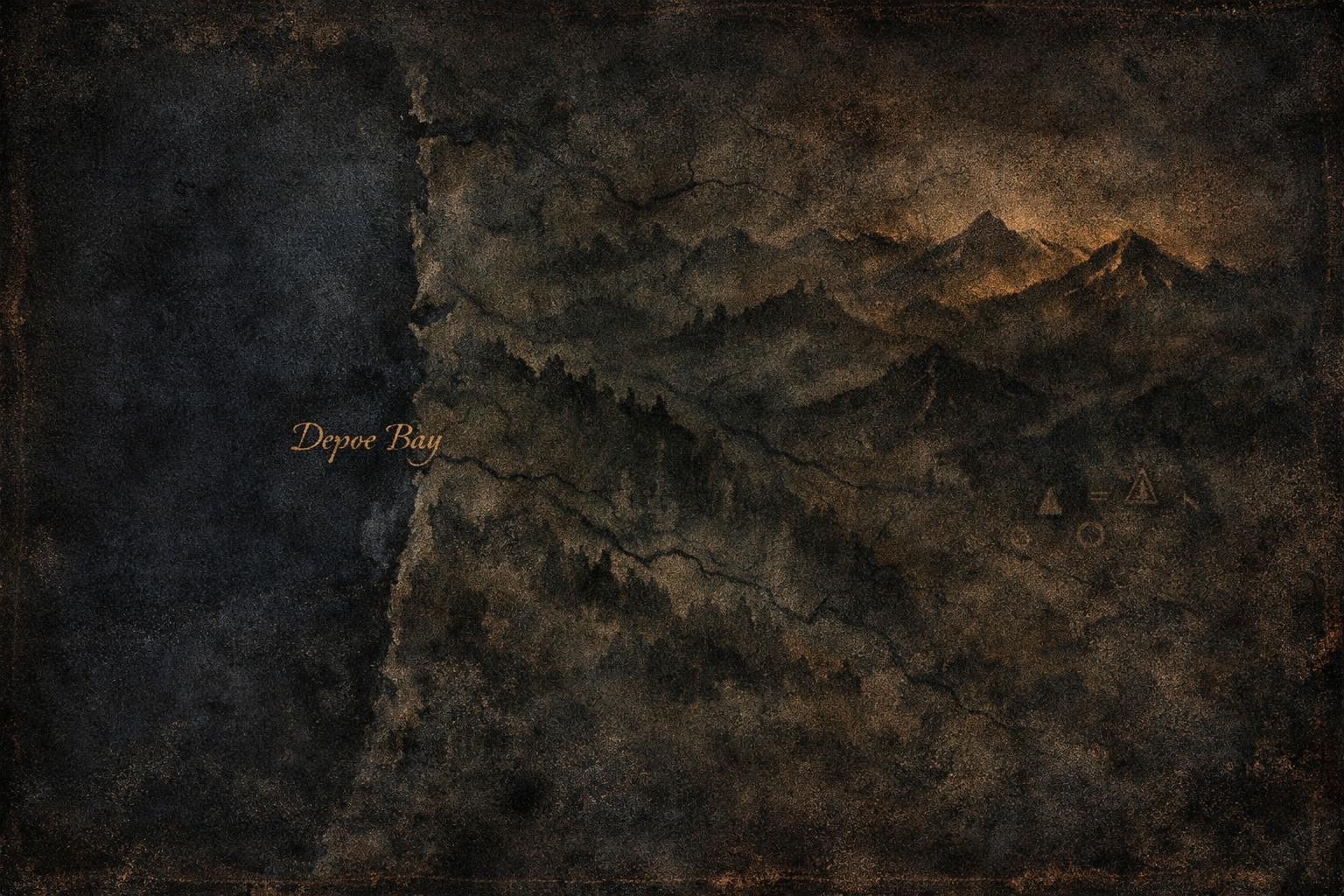
Sisiutl
2 TERRITORIALOverview
Sisiutl operates as a double-headed sea serpent patrolling the coastal waters of British Columbia, from Haida Gwaii south to Vancouver Island and Howe Sound. Core profile: elongated serpentine body, twin heads at opposite ends, often a central humanoid face, horned crests on heads matching indigenous depictions. Length estimates from sightings hit 40 feet minimum; propulsion via undulating body with possible flippers.
Behavior tracks to surface basking, rapid directional changes, and evasion tactics. No confirmed attacks, but cultural records flag petrifying gaze and shapeshifting capability. Primary zones: Yaculta Rapids, Queen Charlotte Islands, Strait of Georgia. Track it in fog banks and kelp channels. Equipment baseline: binoculars, VHF radio, avoid nets unless specimen recovery planned.
Sighting History
Circa 1888, Howe Sound
Sailor Stewart encountered a sea serpent while boating in Howe Sound, British Columbia. The creature displayed two prominent head bumps resembling the "horns of power" from indigenous Sisiutl artwork. Eyes were difficult to discern against the water and light conditions. No precise length recorded, but body appeared elongated and serpentine.
January 12, 1895, Haida Gwaii
Prospector Osmond Fergusson and partner Mr. Walker spotted the creature off the Queen Charlotte Islands, now Haida Gwaii. Initially mistaken for driftwood at 200 yards, it approached to 50 yards, arching a semi-oval portion two feet above water. At close range, a five-foot neck uncoiled with a small snakelike head. Fergusson presented details at a Victoria Natural History Society meeting.
March 25, 1908, Yaculta Rapids
Fishermen in Yaculta Rapids, north of Sonora Island near Devil’s Hole whirlpool, netted and killed a "small sea serpent" basking on the surface. The incident, 20 miles northwest of Campbell River on Vancouver Island, was reported in the Winnipeg Weekly Free Press and Prairie Farmer. No measurements or remains preserved; described as matching double-headed serpent profile.
Circa 1934, Queen Charlotte Strait
Multiple reports from sailors and fishermen in Queen Charlotte Strait and Strait of Georgia describe a horned, finned serpent with large eyes and sharp teeth. Sightings align with Sisiutl form: massive dorsal fin, front flippers, long tail. No named witnesses, but consistent with earlier Fergusson and Stewart accounts in body shape and coastal patrol pattern.
1939, Nelscott Coast
Over thirty witnesses observed a 30-foot serpent off Nelscott, now part of Lincoln City, Oregon. Thick-necked with large head, the sighting echoes Pacific Northwest reports extending Sisiutl range south. Group observation under daylight conditions; no pursuit attempted due to speed and size.
Evidence & Analysis
Contributed by Ellis Varma
The Sisiutl evidence profile clusters tightly around three primary data points: the 1888 Stewart sighting, 1895 Fergusson encounter, and 1908 Yaculta Rapids capture. Each aligns morphologically—double heads or horned crests, serpentine propulsion, coastal ambush behavior—but sample size remains statistically insignificant at under ten resolved incidents across 50 years.
Physical traces: zero. The 1908 "kill" produced no preserved specimen, no scales, no tissue for analysis. Indigenous artwork provides consistent iconography—Kwakwaka’wakw canoe paintings, Nlaka’pamux pictographs as Klu’biist—but these qualify as cultural corroboration, not independent verification. Newspaper reports from Winnipeg Free Press and Victoria meetings add testimonial weight, yet lack photography or measurements beyond rough estimates.
Sightings skew to non-indigenous witnesses: prospectors, sailors, fishermen. This introduces observational bias—unfamiliarity with local megafauna like oarfish or frilled sharks—but the double-head motif resists misidentification. Horns and central humanoid face exceed known species parameters. No sonar tracks, no strandings post-1908.
Geographic clustering in high-current zones—Yaculta Rapids, Haida Gwaii—suggests territorial pattern, not random vagrant. Petrifying gaze claims from oral traditions match partial paralysis reports in analogous sea serpent data, but mechanism unestablished. Shapeshifting elements (canoe form, human disguise) fall outside empirical bounds.
Cross-cultural diffusion analysis: Iconographic parallels to Shang Dynasty serpents and Maori taniwha imply deep structural homology, not coincidence. Yet without biologics, the profile stalls at pattern recognition.
Evidence quality: LOW-MODERATE. Consistent morphology across sparse, credible eyewitnesses. Zero hard traces. High cultural reinforcement, low physical substantiation.
Cultural Context
Contributed by Dr. Mara Vasquez
The Sisiutl occupies a pivotal position within the spiritual cosmologies of Pacific Northwest Coast peoples, spanning Kwakwaka’wakw, Haida, Tsimshian, Tlingit, Squamish, Nlaka’pamux, Bella Coola, and Nootka traditions. As a double-headed serpent, it embodies duality—sea and land, danger and protection, visible and supernatural—serving as a mediator between human realms and otherworldly forces.
In Kwakwaka’wakw winter ceremonial cycles, the Sisiutl intercedes with spirits like Baxbakwalanuxsiwae, functioning as a guardian accessible to shamans. Its image adorns war canoes, Big Houses, and warrior regalia, symbolizing the balance of good and evil. Warriors sought its blood for invincibility; healers pursued its magic through ritual confrontation. Mica scales from beaches were incorporated into these practices, linking the mineral to the creature’s shed skin.
Northern variants among Haida and Tlingit tie to myths like the "Princess who suckled the grubworm," with the central humanoid face representing transformative power. Depictions often include a third face between the serpent heads, horned and tongue-protruding, echoing shamanic mediation. The creature shapeshifts into canoes or animals, as in tales of returning lost souls from spiritual domains.
Pictographic evidence appears in Nlaka’pamux rock art as Klu’biist, while Kwakwaka’wakw crests gifted protocols—exemplified by James Sewid’s 1970 presentation to Greenpeace—underscore communal ownership. Anthropological tracings reveal iconographic affinities to ancient Chinese bronzes and Polynesian motifs, favoring innate structural resonances over diffusion in Indigenous worldviews of relationality.
Contemporary reverence persists: Sisiutl designs ward entrances and vessels, reinforcing its role in protection and renewal. These traditions frame the Sisiutl not as isolated monster, but as integral to coastal ontologies where humans, animals, and supernaturals co-constitute balanced ecologies.
Field Notes
Notes by RC
Tracked Sisiutl zones three times. First off Haida Gwaii in summer—calm seas, kelp thick. Watched a stretch of water for eight hours. Nothing surfaced. Currents pull wrong there. Like the ocean hides channels you can't see.
Second run: Yaculta Rapids at dawn. Whirlpool active, fog rolling in. Nets ready but no takers. Local fishermen nodded at the description. Said it picks its days. One old timer pointed to a beach with mica flecks. Felt right.
Howe Sound third. Rented a skiff, ran parallel to cliffs. Wind picked up sudden. Saw a shadow coil under the surface—long, deliberate. No heads broke water. Turned back. Some waters push you out.
Places like this carry weight. Indigenous markers on rocks match the profile. Not chasing ghosts. Something patrols these straits.
Threat Rating 2 stands. Territorial marker fits. No attacks logged, but don't lock eyes if it surfaces.