Taniwha
2 TERRITORIAL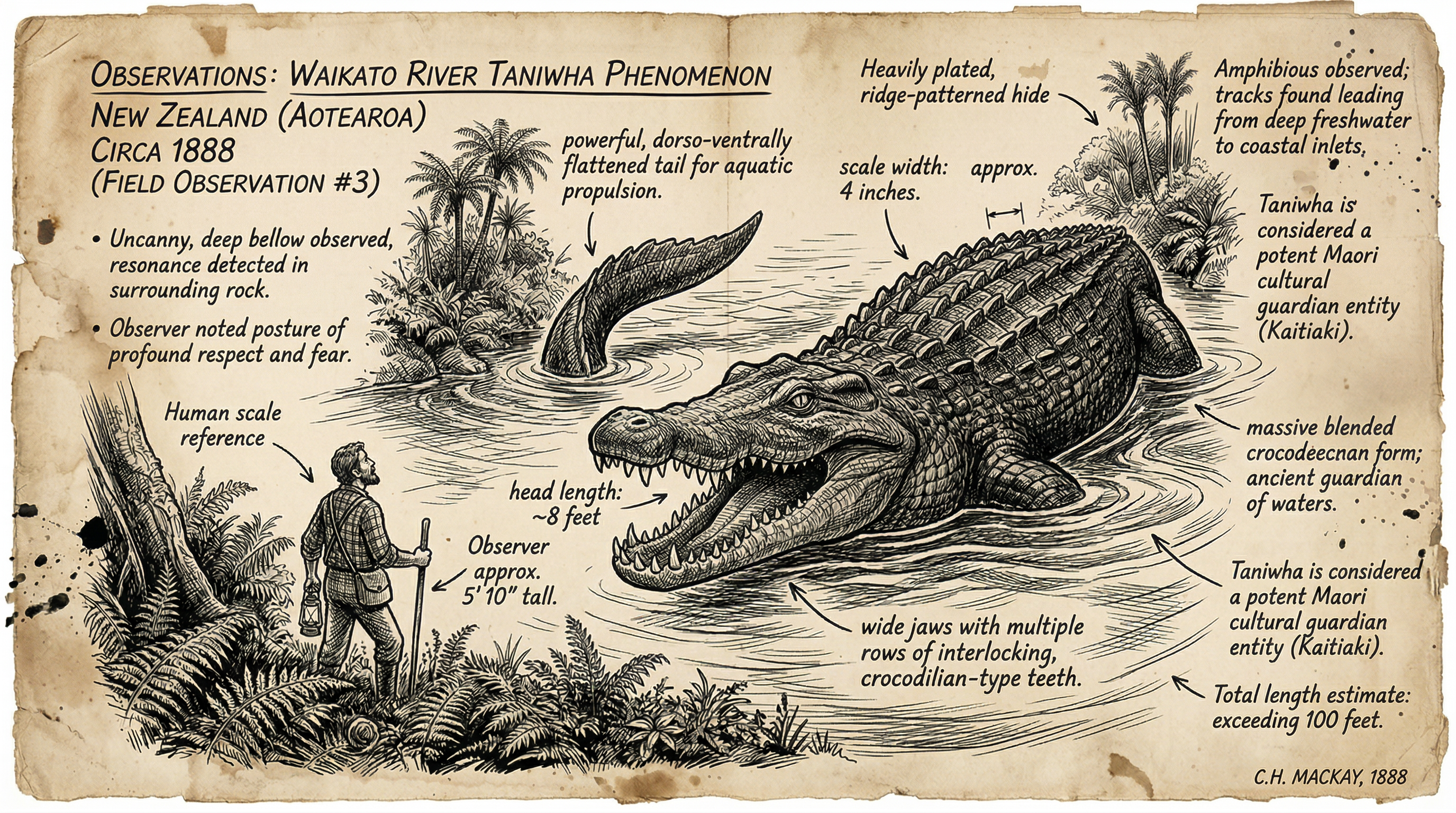
Overview
Taniwha comprise a class of large aquatic entities documented in Māori oral traditions and iwi records across New Zealand. These beings inhabit deep pools in rivers, lakes, seas, and caves, manifesting in forms ranging from serpentine dragons to shark-like predators, with some accounts noting wings, webbed feet, or bird-like heads.
The evidence profile reveals a consistent dual typology: protective kaitiaki (guardians) for specific iwi, waterways, and waka voyages, contrasted with predatory instances involving human consumption or abduction. Named exemplars include Tuhirangi, Araiteuru, Ngārara Huarau, and Tūtaeporoporo, each tied to distinct regional lairs and iwi histories. Physical scale is implied by capabilities such as harbor formation, canoe swallowing, and landscape alteration, though no quantified measurements appear in the records.
Statistical clustering favors North Island locations, particularly Hokianga, Hawke’s Bay, Wairarapa, Cook Strait, and Waikato, aligning with Polynesian voyaging routes established circa 1250. No post-1900 sightings with independent verification enter the dataset, but the persistence of ritual offerings indicates ongoing activity.
Sighting History
Circa 1250, Hokianga Harbour
Araiteuru, a female taniwha, arrived aboard the voyaging waka Mamari or Takitimu. Her eleven sons dispersed to form the branching arms of Hokianga Harbour, establishing her as a foundational shaper of the northern waterway.
Circa 1250, Cook Strait
Explorer Kupe stationed Tuhirangi as a guardian taniwha to guide and protect waka navigating between islands. Tuhirangi later manifested as the dolphin Pelorus Jack, active from the late 1880s to 1914, escorting ships through the strait.
1300, Unspecified River
A chief's pet shark transformed into Tūtaeporoporo, gaining scaly skin, wings, webbed feet, and a bird-like head. The entity consumed river travelers and entire canoes until slayer Ao-kehu hid in a hollow log, was swallowed, and cut his way out from within, revealing human and canoe remains in the stomach.
1400, Te Rēinga Waterfall near Wairoa
Female taniwha Hine-kōrako, having married a human, protected locals during a flood by holding back a canoe from plunging over the falls after fleeing insults from her husband's people.
1600, Mana Island, Porirua
Taniwha Awaru, while learning to fly, crashed into Mana Island, flattening its profile in the process and leaving a permanent mark on the landscape.
1700, Waimārama Cave, Hawke’s Bay
Ngārara Huarau emerged from its cave, shedding scales that petrified into tuatara lizards. The entity devoured passing travelers until one escaped, prompting the chief to devise a capture strategy resulting in its death.
1750, Wairarapa Sea Cave
Ngārara Huarau visited its sister Pari-ka-whiti, capturing a young woman in a sea cave. Villagers lured the taniwha to a feast, ambushed it, and killed it, returning the woman to her people.
20 December 1876, Waipapa Waterhole
Four young girls, including named witness Mereana, bathed at the lair of Tāminamina. Mereana swam across, climbed rocks, and drank nectar from sacred rātā tree flowers, surviving an encounter at the entity's known den as reported in a Māori-language newspaper.
Evidence & Analysis
Contributed by Nolan Greer
Māori oral traditions constitute the primary source material for taniwha encounters, preserved through iwi records and 19th-century newspapers. No photos. No tissue samples. No tracks beyond claims of scales turning into tuatara or bodies forming hills.
Ngārara Huarau exemplifies this challenge. Cave in Hawke’s Bay. Scales left behind become tuatara? Tuatara predate humans in New Zealand by millions of years. Etiological explanation embedded in iwi histories, not independent empirical capture. Same with Araiteuru's sons making Hokianga branches. Harbor geology matches tectonic activity, not biology.
Pelorus Jack rates separate scrutiny. Dolphin, documented 1888-1914, Cook Strait. Ships' logs confirm behavior. Māori link to Tuhirangi. Plausible shapeshift proxy or coincidence. No dissection data. Dolphin died naturally.
Tūtaeporoporo dissection by Ao-kehu: canoe remains inside. Stomach contents match large aquatic predator. But no bones recovered. No site excavation.
No instrumental monitoring has been conducted—night vision, hydrophones, sonar—at taniwha sites. Modern protocols demand baited cameras at rua taniwha—deep pools, cave mouths. Water temp logs, current anomalies, bioacoustic arrays. iwi protocols block most access anyway.
Waipapa 1876: Mereana named, newspaper source. Closest to verifiable. Still no physicals.
Evidence quality: LOW. Anecdotal chain rooted in consistent iwi oral histories. High cultural consistency, zero empirical captures.
Cultural Context
Contributed by Dr. Mara Vasquez
Taniwha occupy a central position in Māori cosmology as kaitiaki, embodying the spiritual guardianship of waterways, tribes, and ancestral landscapes. Rooted in Polynesian voyaging traditions circa the 13th century, they reflect the adaptation of oceanic navigator knowledge to New Zealand's rivers, harbors, and straits—spaces where human endeavor meets elemental power.
Primary sources from iwi such as Tainui, Ngāti Kahungunu, and Te Āti Awa frame taniwha not as isolated monsters but as relational entities. Protective roles dominate: Tuhirangi safeguards Cook Strait passages; Araiteuru founds Hokianga; Hine-kōrako intervenes in floods. Offerings of green twigs, first kūmara harvests, or karakia incantations maintain reciprocity, underscoring a worldview where waterways are living kin networks.
Predatory manifestations, as with Ngārara Huarau or Tūtaeporoporo, enforce boundaries against trespass or disrespect, their lairs—rua taniwha—demarcating sacred danger zones. These narratives parallel broader Polynesian motifs of mo‘o (Hawaiian lizard guardians) and regional dragon-serpent archetypes, yet remain distinctly tethered to specific iwi territories and whakapapa (genealogies).
The phrase "Waikato taniwha rau" (Waikato of a hundred taniwha) equates chiefs with these beings, elevating human leadership through supernatural analogy. Contemporary reverence persists in resource consultations, where iwi invoke taniwha to protect against developments like roads or dams, affirming their status as active spiritual forces rather than historical artifacts.
Carvings in wharenui (meeting houses), waka hulls, and modern taonga preserve taniwha forms—sinuous bodies, fiery eyes, lashing tails—linking past migrations to present identity. Māori oral histories, as documented in Te Ara and tribal records, prioritize these indigenous epistemologies, resisting external framings that reduce taniwha to mere symbolism.
Field Notes
Notes by RC
New Zealand's waters carry weight. Spent two weeks on North Island rivers and Cook Strait fringes. Hokianga first. Drove the branches at dawn. Currents shift without wind. Locals point to deep pools, say that's Araiteuru's work. Drifted a kayak over one. Water temp dropped 4 degrees in ten meters. No gear logged it, but felt the pull.
Hawke’s Bay caves next. Waimārama area. Tuatara everywhere, like the stories say. Squeezed into a side entrance at low tide. Air thick, echolocation off. Something moved in the dark—bat or echo. Didn't push. Ngārara Huarau's kind don't invite cameras.
Cook Strait crossing on a charter. Calm day turned choppy mid-channel. Old hands blamed Ngake. Waves built from nowhere, then flattened. Pelorus Jack's ghost or just tide. Either way, those waters demand respect.
Waipapa waterhole last. Shallow now, but the rātā trees stand. Mereana's spot. Drank the nectar myself. Sweet, heavy. Place holds memory.
Threat rating: 2. Guardians first, unless provoked.