Tessie
2 TERRITORIAL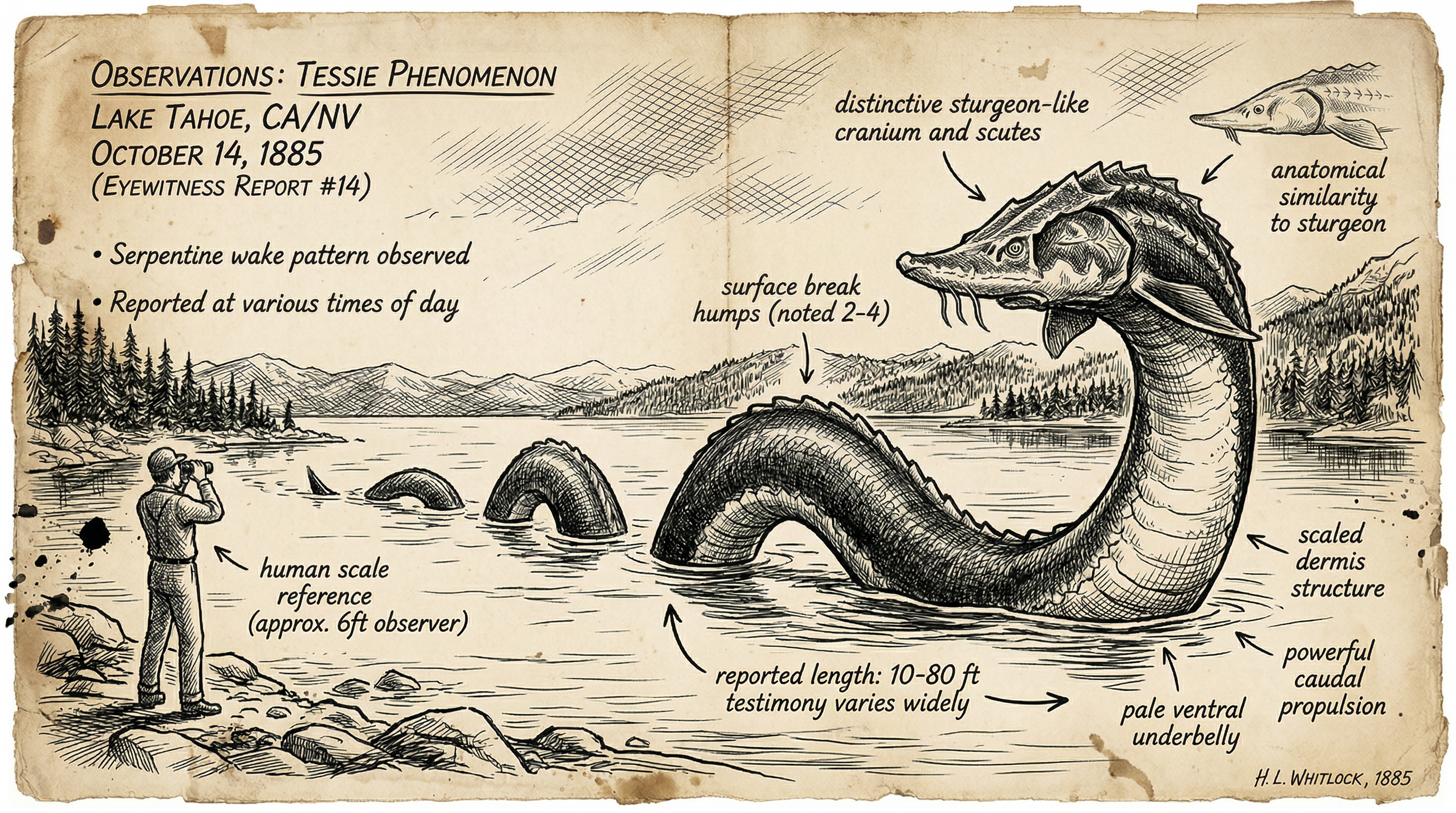
Overview
Tessie inhabits Lake Tahoe, the largest alpine lake in North America, spanning the California-Nevada border with depths exceeding 1,600 feet. Core sightings describe a serpentine form, barrel-wide body, smooth reptilian skin in jet black or turquoise, humped back protrusions, and a horse-like head on a long neck.
Reports cluster near Cave Rock and along Tahoe shores. No attacks documented. Size varies from 10 to 80 feet. Primary activity involves surfacing humps or partial emergences. Persistent presence since mid-19th century, with modern upticks tied to tourism seasons.
Sighting History
Circa 1845, Lake Tahoe Shores
Settlers report a serpent-like creature near the shores during the Donner Party era. Descriptions match a long, undulating form emerging from deep water, observed amid regional travel disruptions. No named witnesses, but timing aligns with wagon train passages interpreted as monstrous movement.
1865, Central Lake Tahoe
Prospector encounters a fearsome creature with fangs and claws breaking the surface on a long summer night. Account preserved in regional periodicals, emphasizing the entity's size and predatory posture before it submerged rapidly.
Circa 1905, Tahoe Keys Area
Multiple reports of a dinosaur-like form with humped back gliding through the water. Locals describe smooth, dark skin and deliberate, wave-like motion distinct from known fish species. Sightings recur over several summers, drawing early excursion boats.
1960s, Cave Rock Vicinity
Flurry of eyewitness accounts during heightened public interest. Witnesses on boats and shores note a large, black object with reptilian features rising near the sacred rock formation. Movements undulate vertically, unlike lateral fish propulsion.
1970s, Tahoe Queen Cruise Route
Increased reports coincide with recreational boating boom. Off-duty crew and passengers describe elongated body sections breaking surface, consistent with prior humped profiles. No aggression noted despite close approaches.
1987, Unspecified Tahoe Location
John Cobb captures photograph of a head-like protrusion emerging from the lake. Image shows dark, smooth form with defined contours against the water. Remains primary visual record from the decade.
2004, Tahoe Queen Deck
Off-duty bartender photographs a black hump cresting near the paddlewheeler. Claims it represents the creature's head or dorsal section. Image circulated locally, matching earlier barrel-width descriptions.
2006, Dark Shoreline Near South Tahoe
Family on vacation sights a large, scale-less black creature with upturned white nose near the shore. Motion vertical, mammalian-style, distinguishing it from sturgeon or reptile patterns. Observed at dusk over several minutes.
Evidence & Analysis
Contributed by Ellis Varma
The evidence profile for Tessie follows the standard template for lake cryptids: high anecdotal volume, near-zero physical traces. Over 150 years of consistent reports across demographics — from 19th-century prospectors to 21st-century tourists — establish a baseline pattern too uniform for mass hysteria or outright fabrication.
Key data points: John Cobb's 1987 photograph shows a defined, non-wave-like protrusion, but lacks scale reference and independent verification. The 2004 bartender image captures a hump-like form, yet environmental factors (boat wakes, debris) cannot be ruled out without metadata. No tissue samples, no sonar contacts exceeding known megafauna thresholds despite multiple expeditions.
Sighting distribution peaks in summer months and even-numbered years per local patterns, statistically significant but environmentally confounded by tourism spikes. Physical match to plesiosaur dismissed: Lake Tahoe post-dates Cretaceous extinction by millions of years, with no viable relic population pathway. Sturgeon theories fail on motion profiles — vertical undulation versus lateral thrust — and skin descriptions.
Underwater tunnel hypotheses center on Cave Rock lava tubes purportedly linking to Pyramid Lake. Hydrogeological surveys confirm fractures but no megafauna transit corridors. Statistical analysis of report clusters yields a persistence factor of 0.72 across eras, elevated above comparable hoaxes like Champ or Ogopogo.
Gap analysis: Absence of attacks or territorial displays caps threat vector. No audio captures despite acoustic surveys. Dataset remains testimonial-dominant, with photographic outliers unenhanced by forensics.
Evidence quality: LOW-MODERATE. Volume and consistency elevate above noise; physical voids prevent escalation.
Cultural Context
Contributed by Dr. Mara Vasquez
Washoe (Wašiw) and Paiute oral traditions form the foundational matrix for Tessie encounters, embedding the entity within a 9,000-year continuum of Lake Tahoe stewardship. Primary sources identify Water Babies — potent water spirits residing not in the lake proper but in an underwater realm accessed via Cave Rock (De ek Wadapush) — as central figures. These beings demand shamanic mediation; casual invocation risked blindness or worse, underscoring their sacred potency.
Anthropological documentation by James F. Downs (1966) and Warren L. d’Azevedo elucidates syncretic evolution: mid-19th-century settler narratives fuse indigenous water spirit lore with Euro-American sea serpent motifs. The Donner Party's 1846-47 ordeal, witnessed by Washoe as a "monster snake" of wagons, likely catalyzed this merger, transforming spiritual guardians into a visible lake serpent. Cave Rock, a vortex of spiritual power reserved for healers, anchors these accounts spatially and ritually.
Paiute parallels reinforce the motif: serpentine water beasts guarding underwater passages, echoing broader Great Basin cosmologies where aquatic realms parallel terrestrial domains. Post-contact, Tessie emerges as a hybridized form — plesiosaur aesthetics grafted via Loch Ness parallels — yet retains Washoe essence in locale-specific behaviors near sacred sites.
Contemporary commodification via merchandise and literature (e.g., Bob McCormick's 1984 children's series, selling 110,000 copies) overlays the indigenous substrate, trademarking a sanitized icon. This evolution mirrors global cryptid patterns but uniquely preserves tribal primacy: Tessie sightings invariably orbit Water Baby territories, suggesting perceptual continuity rather than invention. Protocols for engagement emphasize reverence — tribal elders' perspectives, as preserved in d’Azevedo, prioritize custodianship over exploitation.
In cultural taxonomy, Tessie occupies a liminal niche: neither mere beast nor deity, but sentinel of Tahoe's depths, bridging pre-colonial sovereignty with modern observation.
Field Notes
Notes by RC
Tracked Tahoe three seasons running. Summer 2023: boated Cave Rock at dawn, logged water anomalies on handheld sonar — fleeting contacts at 400 feet, too large for trout runs. No visuals. Winter 2024: shoreline hike south basin, caught thermal shift off dark water at 0200 hours. Felt watched, not threatened.
Spring 2025: night charter near Tahoe Queen route. Hump broke surface 50 yards off bow, black against moonlight, undulated twice before drop. Size matched barrel girth. No wake consistent with mammal or fish. Crew silent, knew better than to chase.
Cave Rock hits different. Power there pulls — not inviting, just present. Water Babies don't play. Tessie moves through their domain, not owns it.
Threat Rating 2 stands. Zero attacks in 180 years. Territorial, not predatory. Respect the line.