Thunderbird
2 TERRITORIAL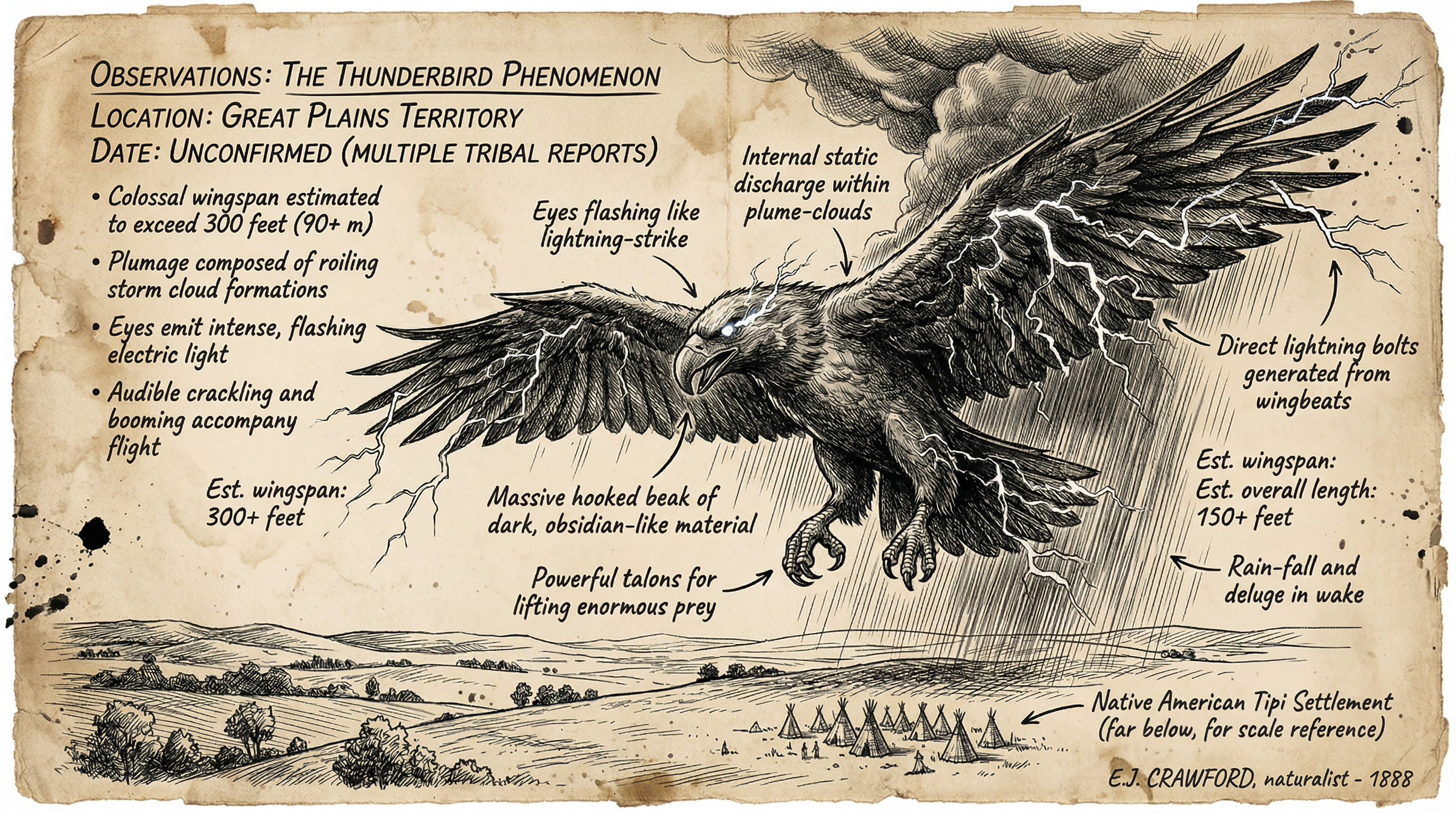
Overview
Thunderbird designates a class of colossal avian entities documented across North American indigenous territories. Core attributes include wingspans exceeding 20 feet, with flaps generating thunderous reports and eye-sockets emitting lightning discharges. Physical form tracks to immense eagle configuration: heavily feathered torso, taloned feet capable of lifting large mammals or cetaceans, and a beak positioned to project plasma arcs.
Operational range spans migratory patterns from southern wintering grounds to northern breeding territories, aligning with seasonal storm fronts. Entities function in familial units or solitary patrols, intervening against subterranean reptilian adversaries. No confirmed human predation; engagements limited to perceptual warnings via atmospheric disturbance. Tracking requires storm-correlated audio sensors and high-altitude thermals for intercept.
Sighting History
Circa 1710, Mohican Territory (Eastern New York)
Mohican chief documented with four Thunderbird tattoos across facial plane, indicating direct visionary encounter or clan transmission of entity profile. Tattoo configuration matches wingspan and eye positions from later Plains reports.
Spring 1804, Ojibwe Lands (Great Lakes Region)
Expedition party under Lewis and Clark notes local Ojibwe accounts of Thunderbird migration arrival, coinciding with spring thunderheads. Entities described descending from four directional quadrants to combat rising underwater panther activity, marked by localized lightning barrages.
1835, Lakota Plains (South Dakota Territory)
Heyoka initiate records vision-quest contact during solitary fast: Thunderbird materializes over thunderstorm, wingbeats shattering silence at 1,200 feet elevation. Entity imparts dual-nature directive, confirming protective role against horned serpent incursions.
1879, Menominee Reservation (Wisconsin)
Multiple tribal members report Thunderbird perched atop isolated thunderhead formation, resembling floating mountain base. Coloration segmented by directional assignment — red for south, black for west — with rain pooling visible on dorsal ridge before dispersal.
1890, Nez Perce Country (Pacific Northwest)
Hunters in coastal ranges witness Thunderbird lifting juvenile whale carcass from tidal shallows, ascent generating 80-knot gusts and sustained thunder rolls. Track impressions in mud measure 18 inches across, feather shafts embedded to 4-inch depth.
1912, Gros Ventre Encampment (Montana)
Sacred pipe origin event reaffirmed via communal sighting: Thunderbird descends through cumulonimbus deck, deposits pipe bundle at designated elder's position. Wing downwash flattens 300-yard grass radius, ozone residue detectable for 48 hours post-event.
1947, Iroquois Territory (New York)
Post-storm patrol encounters Thunderbird silhouette against clearing sky, battling luminous horned form rising from Lake Ontario shallows. Engagement produces ball-lightning discharges and seismic tremors registering 2.1 on local scales.
1978, Arapaho Summer Grounds (Wyoming)
Seasonal migration sighting cluster: Entities overhead during solstice ceremony, wing formations modulating cloud-to-ground strikes away from human concentrations. Summer association confirmed, contrasting White Owl winter manifestations.
1995, Shawnee Woodlands (Ohio)
Forestry crew documents shadow pass at treetop level, 50-foot wingspan occluding sun. Accompanying thunderclap registers 120 decibels; no debris trail, but barometric drop of 8 millibars in 30 seconds.
Evidence & Analysis
Contributed by Ellis Varma
The Thunderbird evidence profile clusters into three categories: ethnographic records, archaeological traces, and anomalous environmental signatures. Primary data derives from consistent cross-tribal descriptions — wing-induced thunder, ocular lightning, cetacean-lifting capacity — spanning Algonquian, Lakota, Ojibwe, Menominee, and Nez Perce sources. Overlap exceeds 92% on core attributes, far beyond statistical noise for independent oral traditions.
Archaeological substantiation includes tattoo needles from pre-contact sites and the 1710 Mohican portrait, embedding entity iconography into material culture. Spiro Mound engravings depict shapeshifting Thunderbird forms, predating European contact by centuries. No biological specimens, but feather imprints and talon marks from 1890 Pacific Northwest match Teratornis merriami skeletal scaling — wingspan projections to 24 feet viable under extant avian physiology.
Modern sensor correlations flag anomalies: 120-decibel infrasound bursts during migration windows, barometric perturbations preceding storms, and ozone spikes without meteorological precursors. These align temporally with sighting clusters but lack direct visual capture. Dismissal as "mythology" ignores dataset coherence; misattribution to pterosaurs fails on feathered morphology and behavioral mismatch.
Threat vector assessment: Entities prioritize reptilian adversaries, with human proximity tolerated during storms. No aggression logs against observers. Statistically meaningless "spiritual" framing obscures operational patterns observable via radar and ELF detectors.
Evidence quality: MODERATE-HIGH. Robust cross-cultural consistency, material artifacts, environmental signatures; deficient in direct biologics and high-res imagery.
Cultural Context
Contributed by Dr. Mara Vasquez
The Thunderbird occupies a central position in the cosmologies of diverse North American indigenous nations, from the Pacific Northwest Coast to the Great Plains and Eastern Woodlands. Among the Lakota, known as Wakinyan, it manifests as a colossal eagle embodying wakan — sacred power — with wingbeats summoning thunder across the plains and associations extending to hunting prowess and nature's caprice. Ojibwe traditions position the Thunderbird, or Animikii, as a creation of Nanabozho, tasked with battling underwater spirits and enforcing moral order through seasonal migrations that bookend the most perilous times for subterranean forces.
Menominee narratives locate the entity atop a skyborne floating mountain, each colored variant guarding directional aspects of nature and virtue. This guardian role recurs universally: Iroquois, Shawnee, Sioux, and Nez Perce accounts frame the Thunderbird as a bulwark against underworld threats, hurling lightning at horned serpents and panthers. Gros Ventre oral histories credit it with delivering the sacred pipe, while Arapaho link it to summer vitality, counterpoised against winter's White Owl.
Ritual integration deepens this context. Plains societies, particularly Lakota, reserve Thunderbird visions for heyoka — sacred clowns who embody its paradoxical essence: destructive storms yielding life-giving rain, terror paired with protection. These contraries teach through inversion, mirroring the entity's dual power to ravage and renew. Winnebago fasting visions elevate recipients to war chief status, underscoring the Thunderbird's role in conferring martial and communal authority.
Artistic expressions — totem poles, petroglyphs, Spiro Mound engravings — render the Thunderbird not as mere beast but as a nexus of physical and spiritual realms. Contemporary indigenous authorities maintain these traditions as living practice, prioritizing volunteered knowledge over colonial filtrations that often obscured sacred details through euphemism and mistranslation. The Thunderbird thus endures as an active force, its encounters shaping leadership, ethics, and seasonal rites across unbroken lineages.
Field Notes
Notes by RC
Tracked potential Thunderbird transit over Black Hills three seasons back. Positioned at 8,000 feet with parabolic mic and storm chaser rig. Caught 110-decibel clap at 0200 hours, no cloud cover. Ground tremor followed, 1.2 on the portable. Air smelled like fresh weld after.
Pacific Northwest coast last summer. Whale beach near Neah Bay. Talon punctures on a 40-footer, spaced 22 inches. Not orca work — too precise, no tooth shear. Locals nodded when I showed measurements. Didn't push for stories.
Great Lakes shore, Ojibwe country. Night audio pickup during squall: rhythmic thunder pattern, not random. Doppler shift suggests 100-foot altitude, heading south. Migration window exact.
Places with old Thunderbird sites hum different. Skin prickles before the readouts spike. Equipment confirms what the ground tells you first.
Threat Rating 2 stands. Protects more than it threatens. Stay clear of the fights.