Trunko
1 CATALOGED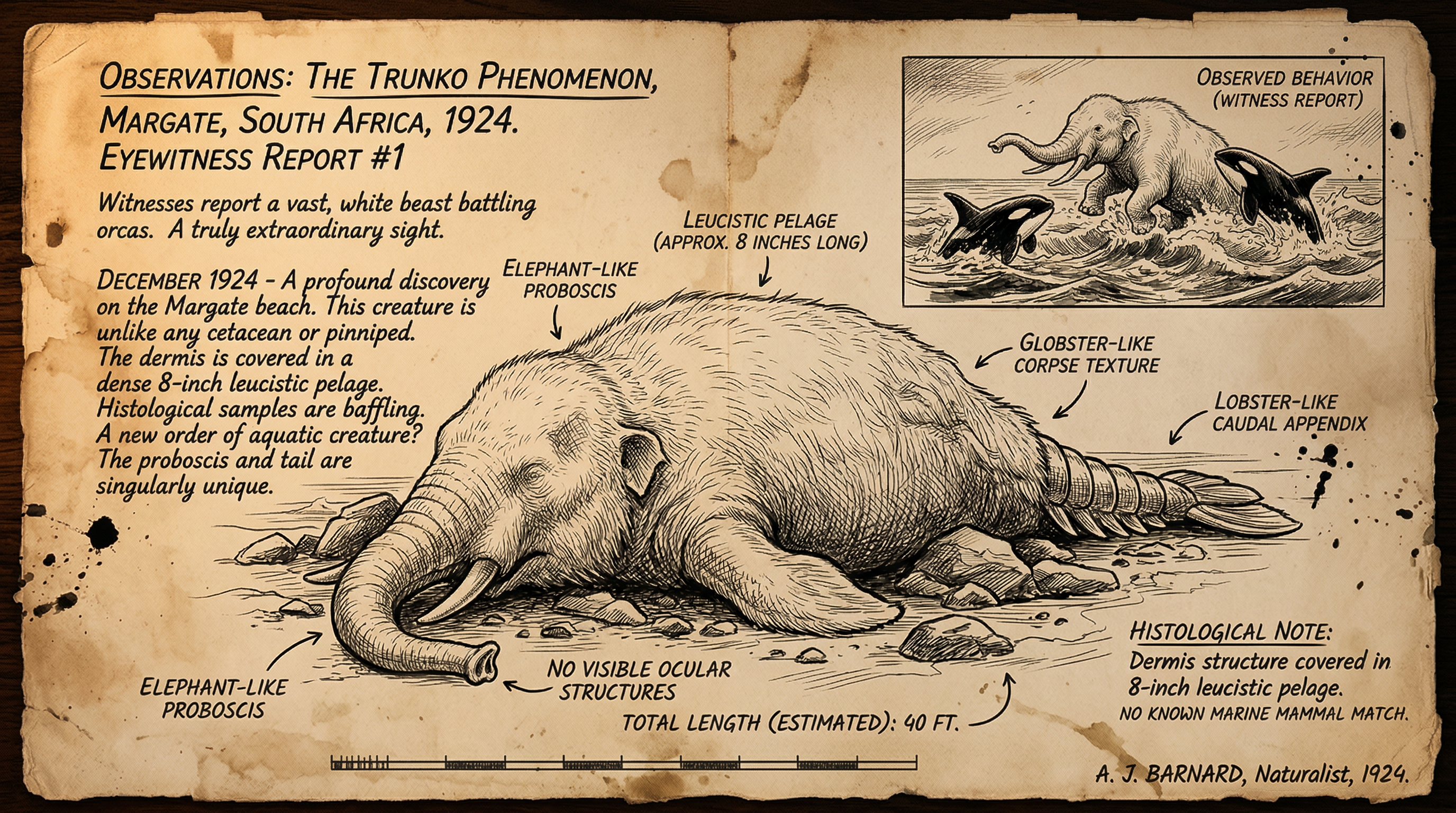
Overview
Trunko occupies a peculiar position in the cryptozoological record: a single, well-documented incident that generated international media attention yet resists definitive classification even a century later. The creature takes its name from the elephantine trunk that witnesses reported as its most distinctive feature—a name coined retrospectively by British cryptozoologist Karl Shuker in his 1996 work *The Unexplained*.[2] What distinguishes Trunko from many cryptids is the absence of cultural precedent. Unlike entities rooted in indigenous tradition or folklore transmitted across generations, Trunko emerged from contemporary eyewitness observation reported through modern newspaper media, making it a creature of industrial modernity rather than mythological inheritance.
The incident occurred in Margate, South Africa, where an enormous white-furred carcass measuring approximately 47 feet in length washed ashore following a reported battle with two killer whales.[1][2] The creature bore characteristics that defied easy classification: snowy-white fur, a trunk-like appendage emerging directly from its body, a lobster-like tail, and notably, an apparent absence of blood.[2] Despite remaining beached for ten days—a window of opportunity that should have attracted scientific scrutiny—no credentialed naturalist or zoologist examined the specimen while it remained accessible.[1][2] This absence of formal investigation stands as perhaps the most consequential detail in the Trunko record, transforming an anomaly with potential evidentiary value into a historical curiosity dependent entirely upon eyewitness testimony and photographic documentation of uncertain provenance.
Sighting History
October 25, 1924
Unnamed witnesses on Margate Beach, South Africa, observed an unusual creature engaged in a three-hour struggle with two killer whales in the waters offshore. The creature was reported to have used its tail to strike at the whales with considerable force, and multiple accounts describe it rising approximately 20 feet out of the water during the engagement. The nature of the struggle—whether the whales were attacking, defending themselves, or engaging in some form of predatory behavior—remains unclear from available accounts. The creature ultimately withdrew from the encounter, and witnesses observed it in the surrounding waters before it disappeared from immediate observation.
October 25–November 4, 1924
Following the offshore encounter, a massive carcass measuring roughly 47 feet in length washed ashore on Margate Beach. The specimen remained beached for approximately ten days, during which time it was observed by local residents and photographed, though no formal scientific examination was conducted. The carcass was described as possessing snowy-white fur, an elephantine trunk, and a segmented tail resembling that of a lobster or crustacean. Notably, the carcass appeared to contain no blood, a characteristic that puzzled observers. After approximately ten days on the beach, the specimen was carried back out to sea, either by tidal action or deliberate removal, and was never recovered or examined by any credentialed naturalist.
December 27, 1924
The incident received international media attention when the London *Daily Mail* published an article titled "Fish Like A Polar Bear," presenting the Margate sighting to a British and European audience. The article generated considerable interest in cryptozoological circles and was subsequently republished and referenced in various newspapers across the Atlantic and Commonwealth regions, establishing Trunko as a recognized anomaly within the broader context of unexplained marine phenomena.
March 27, 1925
The *Charleroi Mail* in Pennsylvania published a follow-up article titled "Whales Slain by Hairy Monster," which appears to reference the same Margate incident but with contextual variations. The article describes a creature that had allegedly engaged whales, washed ashore exhausted, fell into unconsciousness, and subsequently recovered enough to return to the ocean after ten days.[2] This account may represent either a separate incident, a reinterpretation of the original Margate event, or a conflation of multiple reports into a single narrative—the temporal and geographic details remain ambiguous.
Evidence & Analysis
Contributed by Ellis Varma
The Trunko case presents an unusual evidence profile precisely because it lacks the physical evidence that would ordinarily anchor cryptozoological investigation. The creature remained accessible for ten days—a substantial window for scientific examination—yet no zoologist, marine biologist, or qualified naturalist documented the specimen. This absence is not incidental; it is perhaps the most significant data point in the entire record. The reasons for this investigative gap remain unknown. Were local authorities indifferent? Was the specimen removed before scientific interest could be mobilized? Did the creature decompose so rapidly that examination became impossible? The historical record offers no answer.
What we possess instead is photographic documentation of ambiguous quality. Four black-and-white photographs, attributed to A.C. Jones, surfaced in September 2010—nearly 86 years after the incident—showing a white, trunked form on Margate Beach.[2][3] The photographs lend some credibility to eyewitness accounts; they do show a large, unusual carcass. However, photographic evidence alone cannot establish identity, particularly when the specimen cannot be physically reexamined. The photographs are consistent with what we would expect from a decomposed whale or large marine animal, but they are equally consistent with partial decomposition of any large cetacean or pinnipeds species.
The morphological details reported by eyewitnesses—particularly the trunk-like appendage and the apparent absence of a distinct head—align disturbingly well with known globster phenomena. Globsters are large, unidentified organic masses that wash ashore, typically representing advanced decomposition of cetaceans, sharks, or other large marine animals. Decomposition disrupts normal anatomical landmarks. Collagen fibers, when exposed and partially desiccated, can appear hair-like. Detached or partially severed heads, combined with exposed neck tissue, can superficially resemble trunk-like appendages. The lobster-like tail reported in Trunko accounts could represent a partially preserved caudal fin or fluke, distorted by decomposition and desiccation.
The bloodlessness of the carcass—cited by some witnesses as anomalous—is entirely consistent with advanced decomposition. A specimen that has been in the water for an indeterminate period before washing ashore would have undergone significant fluid loss and autolysis. Blood would have diffused into surrounding tissues or been lost entirely through osmotic processes.
Karl Shuker, in his analysis of Trunko across multiple publications, has proposed that the creature was most likely a decomposed whale, with the reported "fur" representing exposed collagen fibers and the "trunk" representing a severed or partially detached head with associated neck tissue.[2][3] This explanation accounts for the size, the apparent morphological oddities, and the absence of identifiable internal organs or skeletal elements in the photographic record. Shuker's assessment carries weight; he is one of the more rigorous voices in cryptozoological literature, and his conclusion rests on comparative analysis with other documented globster incidents.
The three-hour struggle with killer whales, if it occurred as reported, presents a secondary puzzle. Killer whales are known to interact with marine carrion, including playing with or manipulating dead seals and other prey items. It is not implausible that killer whales would engage a floating carcass, particularly if the carcass was still in early stages of decomposition when first encountered. The "struggle" might represent predatory behavior directed at an already-dead specimen, with eyewitnesses interpreting the interaction as a battle between living creatures.
Evidence quality: LOW-MODERATE. Eyewitness testimony is consistent across accounts and comes from multiple independent observers. Photographic documentation, though delayed, corroborates the presence of a large, unusual carcass. However, the complete absence of physical examination, the ten-decade gap before photographic publication, and the consistency of reported features with known decomposition phenomena substantially reduce evidentiary weight. The case is credible as a historical marine anomaly but insufficient to establish the existence of an unknown species.
Cultural Context
Contributed by Sienna Coe
Trunko represents a distinctly modern cryptid—one born not from oral tradition, indigenous knowledge systems, or cultural inheritance, but from the intersection of industrial-era newspaper media and contemporary eyewitness observation. This distinction matters. Most cryptids exist within cultural frameworks that grant them meaning beyond their physical reality. The Mothman carries omens. The Selkie embodies liminal space between human and animal. Trunko, by contrast, is simply a thing that happened and was reported.
South Africa in 1924 was a nation in transition. The Union of South Africa had existed as a unified political entity for only fourteen years. Margate itself was a small coastal town, a place where European settlement met the Indian Ocean. The creature's appearance in this context—and its immediate transmission through British media networks—reflects the communication infrastructure of the British Empire at the height of its reach. A story from South Africa could be in London newspapers within weeks, could jump across the Atlantic to Pennsylvania, could circulate through the Commonwealth. Trunko was not a local mystery; it was a global one, shaped by the speed of mechanical reproduction and imperial communication networks.
The creature's whiteness is worth noting, though cautiously. Witness accounts consistently emphasize snowy-white fur, a feature that appears unusual for a marine animal and that may reflect either actual pigmentation or the advanced decomposition state of the specimen. In the cultural imagination of 1924, whiteness carried symbolic weight—association with the exotic, the uncanny, the foreign. A white creature emerging from African waters carried a different resonance than a conventionally colored one might have. Whether this reflects actual observation or cultural projection cannot be determined from available sources.
Notably, Trunko generated no lasting cultural mythology. Unlike creatures that inspire sustained folklore, artistic representation, or community identity, Trunko remained a curiosity—reported, discussed, largely forgotten. It appears in cryptozoological catalogues and historical compilations but has not become embedded in South African cultural consciousness or local tradition. The creature exists in the archive, not in collective memory. This may reflect its mundane origin as a decomposed marine animal, or it may reflect the creature's resistance to narrative integration. Some things simply fail to become stories, no matter how unusual their initial appearance.
Field Notes
Notes by RC
Margate in March. Visited the beach where the carcass washed up. The town is quiet now, smaller than you'd expect for a place that got international attention a century ago. The beach itself is unremarkable—rocky, cold, the kind of place where things wash ashore regularly and no one thinks twice about it anymore.
I spoke with a local historian who had access to some of the original newspaper clippings. The photographs are real—I saw reproductions. They show something large and pale and wrong-shaped. Could be a whale. Could be something else. The decomposition is advanced enough that certainty becomes impossible.
What struck me was the absence. Ten days on the beach, and no scientist came. Not one. In 1924, that was already negligent. You had telegraph, you had railway, you had ways to alert people. But no one showed up. Either the creature was recognized as mundane and dismissed, or the window closed too quickly, or the specimen was deliberately removed before scrutiny could attach itself to it. The historical record doesn't say.
I've examined photographs of documented globsters—whale carcasses in various states of decomposition. The Trunko specimen aligns uncomfortably well. The "trunk" is consistent with a severed or partially detached cetacean head. The "fur" matches exposed collagen fibers. The absence of blood matches autolysis patterns.
But photographs lie. Or rather, they show what they show, and interpretation fills the gaps. I can't know what that carcass actually was, only that it was large and unusual and then it was gone.
Threat Rating 1 stands. Historical incident, likely mundane origin, no ongoing threat profile. The creature, whatever it was, returned to the sea a century ago and has not reappeared.