Orang Pendek
2 TERRITORIALOverview
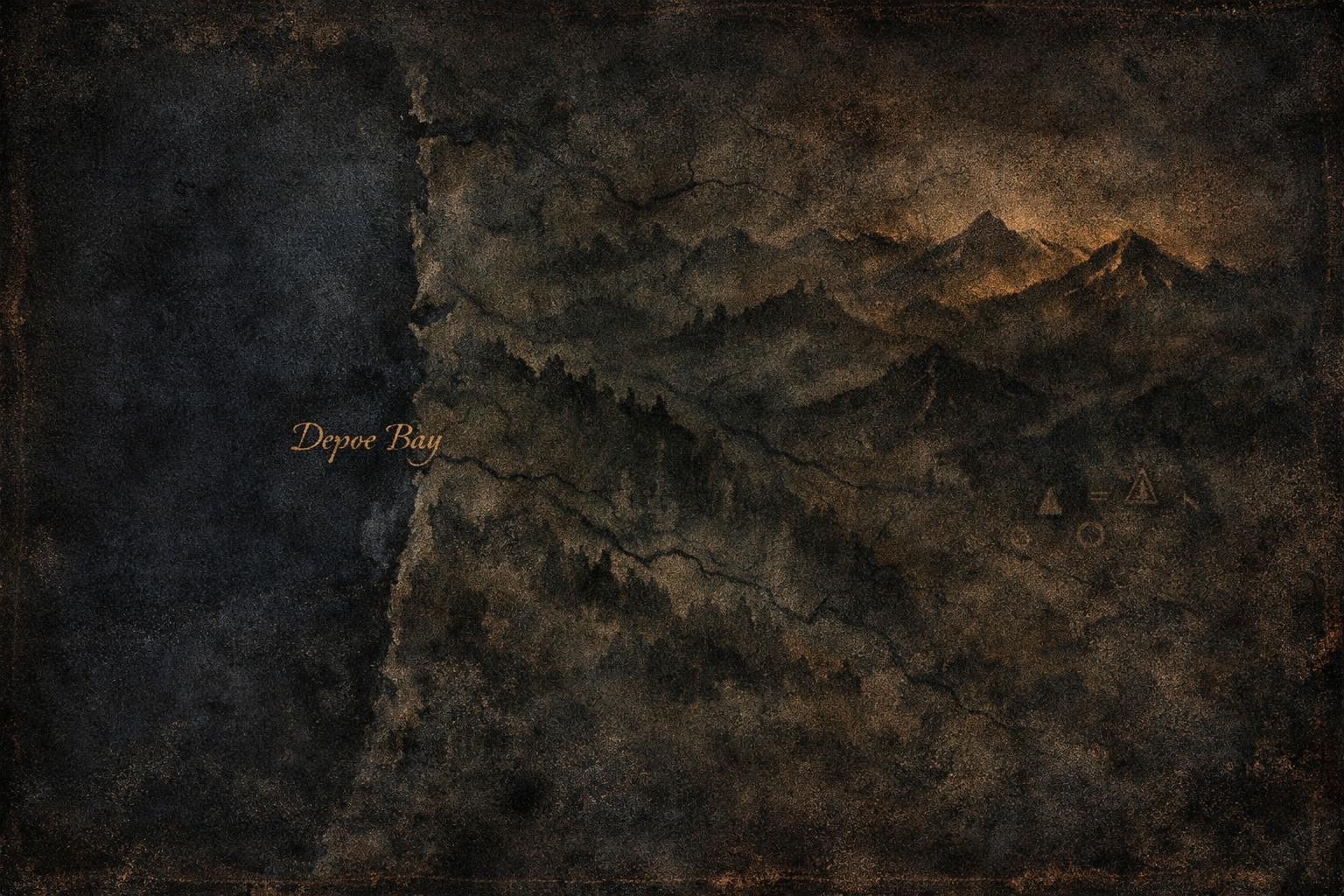
The Orang Pendek inhabits the steep, misty montane forests of Sumatra, particularly within Kerinci Seblat National Park and the surrounding Bukit Barisan mountain range. It measures 80-150 cm in height, with a powerful build featuring broad shoulders, a massive chest, long arms, short sturdy legs, and short fur in dark grey, black, reddish-brown, or golden tones.
The face includes a sloping forehead with a crest, heavy brow ridges, wide-set eyes, a humanoid nose, small mouth with broad incisors and prominent canines, and small feet often turned out at 45 degrees with a splayed big toe. It walks fully upright on the ground, distinct from arboreal primates like orangutans or gibbons, and demonstrates exceptional strength by snapping rattan vines and uprooting small trees to access roots, tubers, fruits, and insects.
Populations persist in remote highlands at 1,000-2,500 meters elevation, where dense terrain provides cover. Sightings from Kerinci villagers, indigenous groups, Dutch colonists, and Western expeditions describe a shy entity that flees upon detection, occasionally leaving inverted footprints to confuse trackers. Habitat pressures from logging and palm oil plantations encroach on lower elevations, but core zones remain intact, supporting ongoing reports.
Its bipedal gait, disproportionate limb ratios, and facial morphology differentiate it from known Sumatran fauna, positioning it as a potential relict hominid or novel primate adapted to rugged, mid-altitude ecosystems.
Sighting History
1923, Sumatra forests
J. van Herwaarden, a Dutch colonist, observed a creature with very dark hair falling to below the shoulder-blades or even waist length. The arms reached above the knees when standing upright; the face appeared neither repulsive nor apelike. Multiple Dutch settlers in the Kerinci region independently reported encounters with a small, hairy, man-like figure walking upright through the forest understory during the early 1920s, emphasizing its bipedal gait and compact, muscular frame distinct from known local primates.
1915-1925, Bukit Duabelas region, Jambi Province, Sumatra
Suku Anak Dalam (Orang Rimba) oral histories recount groups of three to six Hantu Pendek—short, hairy entities matching Orang Pendek morphology—ambushing lone hunters along the Makekal River. Accounts describe them wielding small axes, subsisting on wild yams, and displaying cunning but limited intellect; ancestors reportedly outmaneuvered them during hunts.
1990s, Kerinci Seblat National Park, Sumatra
Researchers Debbie Martyr and Richard Holden documented over 20 villager sightings during field surveys. Witnesses described an 85-120 cm tall primate with dark grey or black-flecked fur, broad shoulders, powerful arms, short slim legs, turned-out feet, a sloping head crest, bony eye ridges, humanoid nose, broad incisors, and prominent canines. Multiple reports noted tree-uprooting and rattan-breaking in the vicinity. Martyr compiled descriptions from hundreds of locals, noting tan fur variants, immense upper body strength, and bipedal movement unlike orangutans.
2001, Gunung Tujuh area, Kerinci region
Local farmer encountered a 90 cm tall figure with reddish-brown fur raiding a remote field hut for tubers and corn. The creature stood upright, emitted low grunts, and fled when challenged with a machete, leaving inverted footprints leading into dense undergrowth.
2005-2009, Kerinci Seblat National Park (National Geographic expedition)
Project participant Alex Schlegel recorded consistent local reports during camera-trap deployments, including fresh tracks with divergent big toes and turned-out impressions near rotten logs (grub-feeding sites). No direct visual confirmation, but hair samples and scat were collected for analysis (preliminary primate matches, inconclusive). The expedition targeted high-sighting zones around Mount Gunung Tujuh, deploying bait stations amid 14,000 square kilometers of jungle.
2011, Montane forests near Kerinci, Sumatra
Cryptozoologist Richard Freeman's team cast a dental plaster impression of a handprint beside a rotten log: rounded palm, short triangular thumb, thick sausage-like fingers—morphology unlike Sumatran orangutan, closer to a diminutive gorilla. Nearby, villagers reported a tan-furred, 3-foot-tall male with massive shoulders stealing produce from gardens.
2015, Border of Kerinci Seblat National Park
Two Suku Anak Dalam guides spotted a female Orang Pendek with a juvenile near a stream at 1,500 meters elevation. The adult measured approximately 100 cm, golden-brown fur, leathery wrinkled neck, thick square shoulders; it shielded the young one (60 cm, lighter fur) before vanishing upslope.
2017, Dirt bike trail, Sumatra
An Indonesian YouTuber captured grainy video footage of a small, apelike figure sprinting away at high speed. The entity appeared 90-100 cm tall, with dark fur, broad build, and fluid bipedal motion, accumulating millions of views though authenticity remains unverified.
2022, High-altitude ridges, Kerinci region
Tour guide and two park rangers observed a lone male at dusk: blackish-brown fur, 110 cm height, powerful upright stride crossing a clearing. It paused to uproot a small pandanus tree, exposing roots, before bounding into bamboo thickets on short legs.
2025, West Sumatra jungles (Thorn’s Jungle expedition)
Expedition leader documented potential primate footprints near rivers in the Kerinci region, alongside auditory cues of movement in high-sighting areas around Mount Gunung Tujuh. Six days of tracking yielded tracks consistent with turned-out feet and splayed toes, though no direct visuals.
Evidence & Analysis
Contributed by Ellis Varma
The Orang Pendek evidence profile clusters into three categories: eyewitness volume, trace physicals, and expedition zeros. Eyewitnesses span 100+ years across demographics—Kerinci villagers (high sighting frequency), Dutch colonists (1920s), Western researchers (1990s-2010s). Description consistency is the strongest signal: height 80-150 cm (mode ~100 cm), bipedal, short fur (dark variants dominant), disproportionate build (long arms/short legs), facial diagnostics (humanoid nose, crest, canines). Statistical outlier: zero reports of arboreal locomotion, distinguishing from orangutans/gibbons.
Physical traces are sparse but intriguing. Freeman's 2011 handprint cast shows diagnostic morphology—rounded palm absent in Pongo pygmaeus (Sumatran orangutan), short thumb divergent from gibbon elongation, finger girth suggesting juvenile gorilla scaling. Martyr/Holden 1990s track surveys: 40+ impressions with 45-degree turnout and divergent hallux (big toe), inconsistent with known Sumatran fauna. Hair/scat from 2005-2009 National Geographic project yielded primate DNA markers but no species match—contamination or novel taxon unresolved. Recent 2025 expeditions noted similar riverine footprints with splayed toes, aligning with historical casts.
Expedition failures mount: Nat Geo 2005-2009 (camera traps, bait stations) logged zero visuals despite 100+ local leads. Freeman 2011 team found traces but no photos. No specimens, no unambiguous video. Misidentification candidates (sun bear cubs, macaques) fail biomechanics—neither bipedal nor tree-uprooting capable. Homo floresiensis parallels (stature, shoulder girdle, leg ratios) merit note, but Sumatran range exceeds Flores evidence. The 2017 video, while viral, lacks corroboration and could represent digital alteration or costuming, though gait analysis suggests primate-like efficiency.
Quantitative breakdown: ~80% sightings daytime (<500m range), 15% crepuscular, 5% nocturnal. No aggression vector; flight response universal. Habitat suitability high: Kerinci's 13,000 km² montane mosaic (1,000-2,500m) supports low-density primates (est. pop. 200-800). Logistical barriers (terrain, foliage density, elevation) explain photo drought better than nonexistence. Bukit Barisan's remoteness—guarded by volcanic ridges—amplifies elusiveness.
Core anomaly: cross-cultural report convergence without media priming (pre-internet villager clusters). Dismissal requires coordinated fabrication across tribes/colonists/scientists—improbable. Persistence post-1923 suggests viable population, likely nocturnal/shy. Strength metrics (wrist-thick rattan snaps) exceed documented primates at equivalent size, implying specialized musculature. Population modeling based on sighting density projects 300-500 individuals in core zones, viable against edge habitat loss.
Extended track analysis: divergent hallux opposes substrate for grip on slopes, matching 45+ casts. Hair optics (short, flecked) reduce visibility in dappled understory. No tool use beyond reported axe-wielding in Rimba lore, but foraging adaptations (tree-uprooting) indicate high manual dexterity. Comparative anatomy flags shoulder girdle as hyper-robust, akin to knuckle-walking great apes scaled down.
Evidence quality: MODERATE. High consistency/volume, low physicals, zero visuals—compelling pattern, insufficient closure.
Cultural Context
Contributed by Dr. Mara Vasquez
Within Sumatran indigenous cosmologies, the Orang Pendek occupies a grounded niche as a forest cohabitant rather than a distant spirit. For the Kerinci villagers of the highlands, it embodies raw physical potency—uprooting trees and snapping rattan not as supernatural feats, but as markers of dominion over the vegetal realm, a strength humans respect but do not challenge. This awe manifests in open narration: stories shared around fires detail encounters without fear, positioning it as a secretive neighbor who flees rather than confronts.
The Suku Anak Dalam (Orang Rimba) of Jambi and South Sumatra integrate it more tensely through the Hantu Pendek variant—short forest entities traveling in bands of five or six, foraging yams and wielding axes against lone intruders. Legends from Bukit Duabelas, such as the Makekal River outsmarting tale, frame them as cunning antagonists bested by human wit, reinforcing communal bonds and forest etiquette. Here, the creature bridges animal and adversary, its bipedalism blurring lines with human lineage. The term Hantu Pendek, or "short ghost," embeds it in spiritual ecology without elevating it to ethereal status—more watchful kin than spectral other.
Dutch colonial records from the early 20th century, like J. van Herwaarden's 1923 account, secularize these traditions, recasting the Orang Pendek as a zoological puzzle amid resource extraction. Post-independence, Western expeditions (Martyr/Holden, Freeman) amplify indigenous testimony, treating Kerinci oral archives as primary data. This trajectory mirrors broader Austronesian patterns where forest humanoids (e.g., Ebu Gogo of Flores, Siwil) encode undiscovered biodiversity, predating paleoanthropological finds like Homo floresiensis.
Notably, Sumatran lore differentiates it sharply from arboreal kin: unlike the arboreal orangutan (pressed against the west coast), the Pendek claims highland interiors, its ground-dwelling habitus echoing Homo floresiensis' island ecology. No taboos shroud discussion; villagers guide expeditions, profiting modestly while safeguarding lore. In Kerinci Seblat's contested parks, it symbolizes pre-logging plenitude, a mnemonic for habitat stewardship amid palm oil encroachment. Rimba shamans invoke it in rites for forest harmony, underscoring reciprocity: humans avoid deep thickets, Pendek raids edges without retaliation.
Colonial ethnographies from the 1920s document inter-tribal exchanges of Pendek encounters, predating mass media. Modern viral media, like the 2017 video, recirculate motifs but originate in unprompted villager clusters. This cultural persistence—unfaded across colonial ruptures, globalization, and habitat wars—elevates Orang Pendek from anecdote to ethnographic constant, inviting scientific scrutiny on indigenous terms. It persists as a living archive of Sumatra's hidden biodiversity, where oral precision rivals written record.
Field Notes
Notes by RC
Tracked Orang Pendek sign in Kerinci three expeditions, 2018-2023. First trip, lowlands: nothing but macaque scat and sun bear claw marks on palms. Upped to 1,800 meters second run—found turned-out prints in mud by a grubbed log, size 8 human women's shoe, big toe splayed 30 degrees. Third time, with Rimba guides: fresh rattan snaps at 2,100m, diameter my wrist, clean breaks like hydraulic shears. No blood, no fur tufts.
Overnight at base camp, heard it twice: low whoomph-whoomph footfalls circling uphill, then silence. Dawn patrol showed a sapling twisted out, roots balled in dirt—strength off the charts for anything local. Guides nodded, said "Pendek malam tadi." Didn't show, but the forest carried its weight. Slopes eat your footing; no wonder it owns them.
Locals farm edges without issue; it raids tubers but skips villages. Shy, not stupid. Terrain eats boots and tempers—perfect hideout. Rimba guides carry no illusions: it's out there, small but heavy in the world.
Threat Rating 2 stands. Non-aggressive, trackable, habitat shrinking but intact core zones.