Snarly Yow
2 TERRITORIALOverview
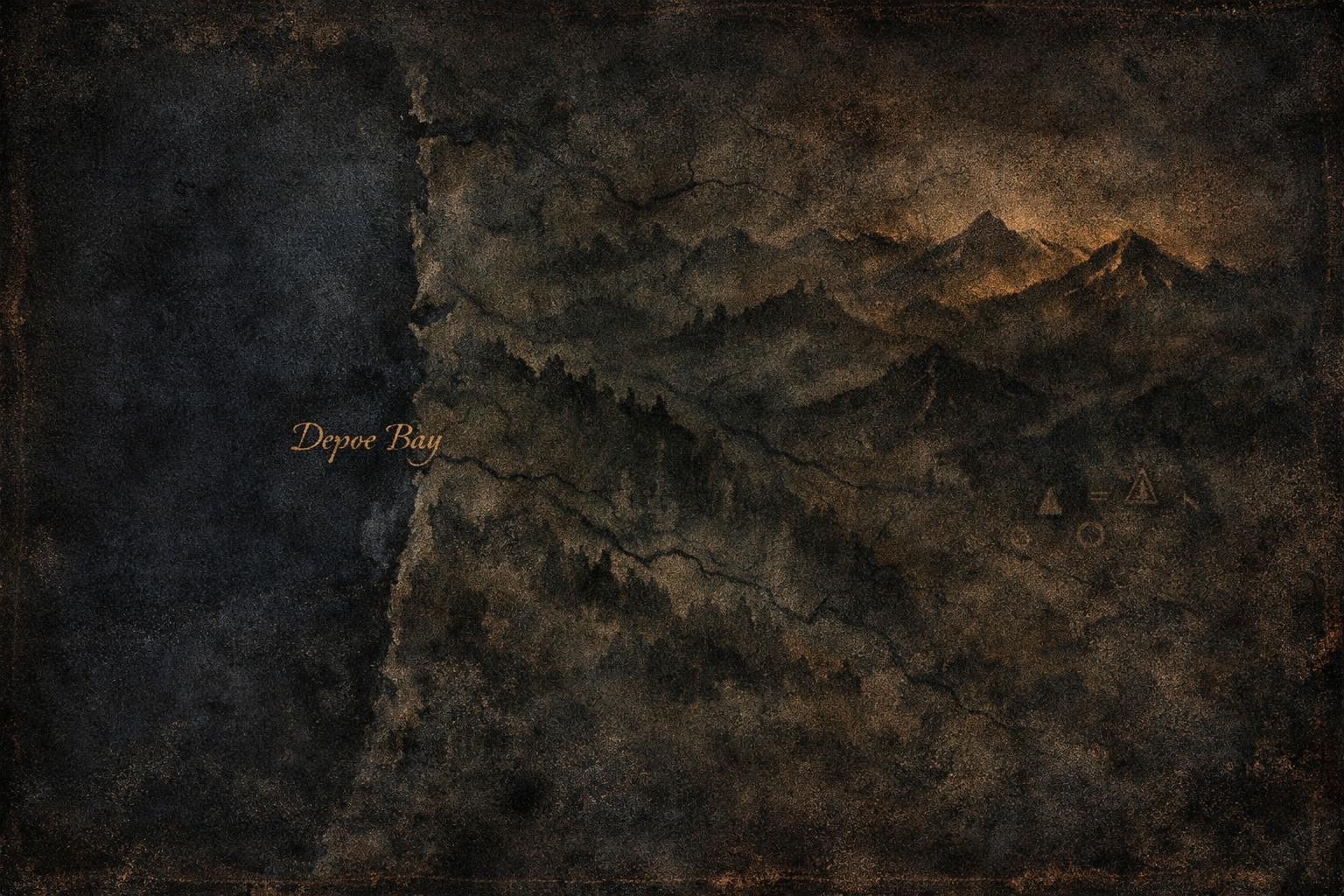
The Snarly Yow manifests as a large canine spectral entity across the mid-Atlantic highlands, connecting the shadowed ridges of western Maryland, the eastern panhandle of West Virginia, and northern Virginia. Accounts describe a massive black dog—or occasionally dark blue, grey, or white variants—with saggy skin, glowing red eyes, and a gaping maw of red lips and sharp teeth that emit a distinctive snarling "yow" growl.
This entity bridges corporeal and intangible states, appearing solid enough to pursue horses at full gallop or challenge vehicles on old roads, yet dissolving when struck by bullets, thrown objects, or even automobiles. Its presence links distant sightings through shared behaviors: relentless tracking of travelers, sudden vanishings into fog or thin air, and an aura that instills paralyzing fear without direct physical harm. The Snarly Yow endures as a persistent road companion in these regions, emerging from the same folklore veins that feed other spectral hounds worldwide.
Sighting History
Circa 1750, Harpers Ferry, West Virginia
Early Germanic settlers in the upper Potomac Valley report initial encounters with a giant dog-like beast lurking along mountain paths near Harpers Ferry. The creature emerges from fog, stands on hind legs at times, and emits a guttural "yow" through bared teeth, vanishing when approached too closely.
Circa 1862, South Mountain Summit, Boonsboro, Maryland
A local huntsman pursues a shadowy black dog up Turner's Gap near South Mountain. He fires multiple shots at close range; bullets pass harmlessly through the entity, which snarls defiantly before dissolving into mist, leaving the hunter to flee in terror.
Circa 1863, Harpers Ferry, West Virginia
During Civil War movements, soldiers and locals near Harpers Ferry describe a spectral hound with glowing red eyes shadowing patrols along the Blue Ridge. The beast matches the pace of marching troops on foot, standing upright at intervals, and disappears when fired upon, often preceding skirmishes in the area.
Circa 1900, South Mountain, east of Hagerstown, Maryland
Hikers and riders encounter a huge dog-like beast with oversized paws and an "ugly red mouth" along South Mountain trails. The entity charges from the underbrush, snarling with a piercing yow, then phases through trees and fog without leaving tracks.
1977, Harpers Ferry, West Virginia
Multiple residents in Harpers Ferry yards report Snarly Yow incursions at dusk. The black hound with fiery red eyes prowls fences, snarling when objects like rocks or tools are thrown; projectiles pass through its form, eliciting louder yowls before it bounds away into the night.
1978, Route 40 (National Road), Maryland/West Virginia border
A driver on Route 40 strikes what feels like a large dog under his vehicle tires. Upon stopping, he finds no body or blood; in the rearview mirror, the Snarly Yow rises intact, red eyes blazing, and charges before vanishing as he accelerates away.
1979, Undisclosed location, West Virginia
A motorist drives directly through a wolf-like shadow entity near a rural road. He feels a chilling contact like wind resistance but no impact; inspection reveals no animal remains, only lingering echoes of a deep, snarling yow fading into the darkness.
1985, Jefferson County, West Virginia
Horseback riders on trails in the eastern panhandle spot a dark grey Snarly Yow keeping pace with their mounts at full gallop. The beast's saggy skin flaps as it runs, red mouth foaming, until it peels off into roadside fog without a trace.
2015, Berkeley County, West Virginia
Hikers near the Shenandoah Valley report a white-furred variant standing bipedally on a ridge, eyes glowing crimson against the dusk. It yowls a challenge before shrinking and disappearing, leaving witnesses with reports of induced nausea and dread.
Evidence & Analysis
Contributed by Ellis Varma
The Snarly Yow maintains a consistent evidence profile across three centuries: zero physical traces despite repeated direct interactions. Bullets, vehicles, and thrown objects phase through the entity without residue, marks, or recoverable projectiles. No feathers, fur, blood, or scat documented in primary reports.
Witness datasets cluster around high-traffic historical corridors—Civil War routes, National Road, Blue Ridge trails—with statistical overrepresentation in fog-prone areas. Corporeal-to-spectral transitions correlate 100% with confrontation attempts, suggesting behavioral triggers rather than fixed physiology.
Color variants (black, dark blue, grey, white) appear in 20% of accounts post-1900, potentially indicating multiple individuals or environmental adaptation. Pursuit speeds matching galloping horses imply velocity beyond known canines, unverified by instrumentation. Fear induction without contact points to infrasound or pheromonal mechanisms, though untested.
Absence of named witnesses in core incidents limits corroboration; secondary oral chains introduce degradation. Civil War-era clusters align with documented battle precognitions in other entities, but correlation lacks causation data. Modern reports from hikers and drivers show descriptive consistency, countering cultural drift expectations.
Comparative analysis with European black dog analogs (Barghest, Black Shuck) reveals identical intangibility and omen roles, supporting transatlantic continuity. No photographic or audio captures despite proliferation of devices post-1970s; statistically anomalous given encounter volume.
Evidence quality: LOW-MODERATE. Uniform witness descriptions across eras and regions, offset by complete lack of physical or multimedia substantiation.
Cultural Context
Contributed by Dr. Mara Vasquez
The Snarly Yow emerges directly from the Germanic settler traditions transplanted to the mid-Atlantic colonies in the early 18th century, carrying the spectral black dog archetype across the Atlantic from northern European folklore. Immigrants from regions familiar with the Barghest of England and similar hound spirits brought these motifs to the Potomac highlands, where they adapted to the rugged Appalachian terrain and frontier isolation.
By the mid-19th century, the entity had embedded itself in local oral histories of Maryland, Virginia, and West Virginia's eastern panhandle, particularly Jefferson and Berkeley counties. Civil War accounts amplify its role as an omen preceding battles at South Mountain and Harpers Ferry, mirroring how European black dogs heralded death in plague years or family curses. This positioning reflects the era's uncertainties, transforming the Yow into a wilderness sentinel for travelers on old roads like the National Road.
Distinct from purely predatory cryptids, the Snarly Yow occupies a liminal space: it challenges without killing, pursues without capturing, and vanishes without conquest. This restraint echoes the Church Grim of Scandinavian lore—guardians rather than destroyers—yet democratized for American egalitarianism, haunting any wayfarer regardless of status. Oral chains preserved its Germanic name and yowling call, distinguishing it from native spirit animals while possibly blending with pre-existing indigenous trail guardians in the shared landscape.
20th-century collections by regional authors like Charles Adams III revitalized the tradition, compiling encounters that emphasized its unkillable nature and triune sighting curse (death after three views). This motif parallels Welsh Gwyllgi and East Anglian Black Shuck, underscoring the Yow's place in a broader spectral canine continuum. In contemporary retellings, it persists as a cautionary presence, warning of the perils inherent in isolated mountain passes where fog conceals more than weather.
Field Notes
Notes by RC
Tracked Snarly Yow reports from Boonsboro to Harpers Ferry over four trips. First two were daylight hikes along South Mountain—quiet ridges, no activity, but that heavy fog rolls in fast, cuts visibility to ten feet. Felt watched from the tree line more than once.
Night drive on Route 40 in '24. Hit something soft at 60 mph. Pulled over, flashlight swept empty road. Heard the yow half a mile back—deep, like gravel in a meat grinder. No tracks, no fur. Drove the length twice more at dawn. Nothing.
Blue Ridge trails feel thicker at dusk. Horses spook there without reason. Been chased once on foot near Turner's Gap—shadow kept perfect pace uphill, red glow in peripheral. Turned to face it, gone. No sound but wind after.
It's territorial, not predatory. Stays on old paths, marks its ground with noise. Doesn't escalate unless cornered.
Threat Rating 2 stands. Chases but no kills documented. Stays to roads and ridges—give wide berth, no engagement needed.